EMPIRE OF INK: The Printers, Rogues, and Radicals Who Invented the American Newspaper, by Alex Wright
One day Tony Soprano was padding down his driveway in bedroom slippers to retrieve his daily newspaper; the next a Silicon Valley hotshot was describing newspapers (and magazines) to me as “these things outside that get wet … like roadkill.” Ouch.
In his scholarly, unruffled third book, “Empire of Ink,” Alex Wright reports that America is down from 9,000 papers in 2005 to 6,000 in 2025 (more than I would have guessed), with an average of two more closing each week. Starbucks stopped selling them months before the pandemic.
Still, many of my fellow journalists — younger ones, too — continue to monitor anxiously whether their articles will appear in print and celebrate when they land on the front page. This though the internet version will be the one that endures, with clicks and screen “stickiness” the new metrics of popularity, if not always quality.
“Empire of Ink” helps explain the lingering attachment to the increasingly obsolete and overlooked technology of type on paper. It’s an unsentimental history of the American newspaper from the Revolutionary War to the beginning of the 20th century, finding in the actual cut-and-paste culture from then much in common with today’s jostling, jousting online media.
Wright is a digital designer and researcher who has done work for Google News and The New York Times (we haven’t met), and the author of two previous books about how human knowledge is indexed and distributed. He’s also a descendant of newspaper people, including a great-great-aunt who was friends with Margaret Mitchell, a reporter for The Atlanta Journal before an ankle injury sidelined her into writing “Gone With the Wind.”
Many novelists besides Mitchell have contributed to newspapers, of course, but Wright is more interested in those who tussled with them. Charles Dickens, a former reporter himself whose books were hugely successful in serial, found the American penny papers “so filthy and so bestial that no honest man would admit one into his house, for a water-closet door-mat.” The hero of his “Life and Adventures of Martin Chuzzlewit” is confronted with self-important scandal sheets like The New York Sewer and The New York Rowdy Journal.
James Fenimore Cooper filed 14 libel suits against various newspapers, all of which he won, and declared that “the American press is the pest of society, the bane of decency, the perverter of truth and the pander of crime.” (He would fit right in on Threads.) Edgar Allan Poe once challenged the editor of The Richmond Examiner, a defender of slavery who’d written about Poe’s rumored affair with a local widow, to a duel. The poet showed up too drunk to fight; they repaired to a tavern and became lifelong friends.
The literary figure most conjoined to this era of newspapers, however, was Samuel Clemens, a.k.a. Mark Twain, who started as an impoverished printer’s apprentice at Missouri’s Hannibal Courier and ended one of the few ink-stained rich.
In between, he was an itinerant “tramp printer,” roaming the country with his brother Orion, playing pranks and gathering material for his semi-fictional memoir “Roughing It.” He wrote a popular piece defending redheads that was picked up without attribution — as was then typical — which Wright calls “his first taste of viral fame.” In his white suit, he suggests, Twain was to become “the original influencer.”
The book labors hard, and mostly well, to build a bridge from yesteryear’s multitasking print mavens to the TikTokerati of today, stopping by legends (like Horace Greeley) and little-knowns along the way.
“The old small-town country editor — trading subscriptions for whiskey or eggs; soliciting gifts of poems, essays and bits of gossip from the neighbors; and exchanging newspapers with fellow editors all over the country, free of charge,” Wright argues, “may be a better avatar for the news creator of the future than the comfortably middle-class newsroom typewriter jockeys of the mid-20th century.”
But there will be no bringing back the days when “typesetting tournaments” were more suspenseful than the N.B.A. finals; one Jalen Brunson of a “compositor” at The Times was so fast he became known as the Velocipede.
Twain was a tech enthusiast who foresaw versions of microfilm and Siri, but one of his major failures was investing in a mechanical venture called the Paige Compositor after its inventor.
Its 218-page patent application was nicknamed the Whale, but the 18,000-part machine proved a white whale: lapped by the nimbler Linotype, the invention of Ottmar Mergenthaler, and decreed “the eighth wonder of the world” by Thomas Edison. The Linotype’s own long retirement party began in the 1970s, with the arrival of phototypesetting and then computers.
Essentially, “Empire of Ink” argues that technology transforms, but the fundamental human drive to share and compare notes remains the same.
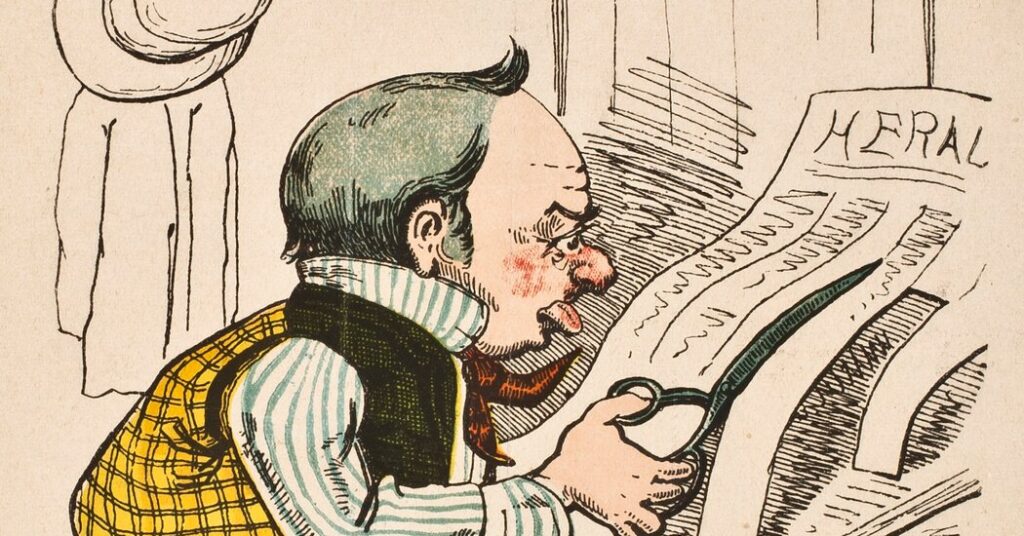
There’s been ample nostalgia out in the world for the post-Watergate seriousness of mission. Wright rewinds to a much earlier time, when newspapers were like zines or crazy quilts, passed around, hotly politicized and — thanks to exclusion from the Copyright Act of 1790 — wildly plagiarized by bold editors, “knights of the scissors,” who presaged aggregation and perhaps even A.I.
He doesn’t have a road map for the future of journalism, but when the news about news has been so grim, what a relief to be invited onboard the optimism train.
EMPIRE OF INK: The Printers, Rogues, and Radicals Who Invented the American Newspaper | By Alex Wright | Basic Books | 384 pp. | $34
The post A Spunky History of Newspapers Adds Color to the Black and White appeared first on New York Times.