NASA needs many things need to happen before it can try to land humans on the moon in 2028. A timely flight of Artemis III, the third phase in the agency’s moon program, is one of them.
On Tuesday, NASA unveiled the crew of Artemis III and gave an optimistic update on the mission’s status. But it failed to address an elephant in the room: Will Artemis III actually be ready to fly next year?
Jared Isaacman, the NASA administrator, acknowledged that the agency has a history of being over budget and behind schedule. “I fully understand the skepticism,” he said in an interview with The New York Times. “We are doing things differently now.”
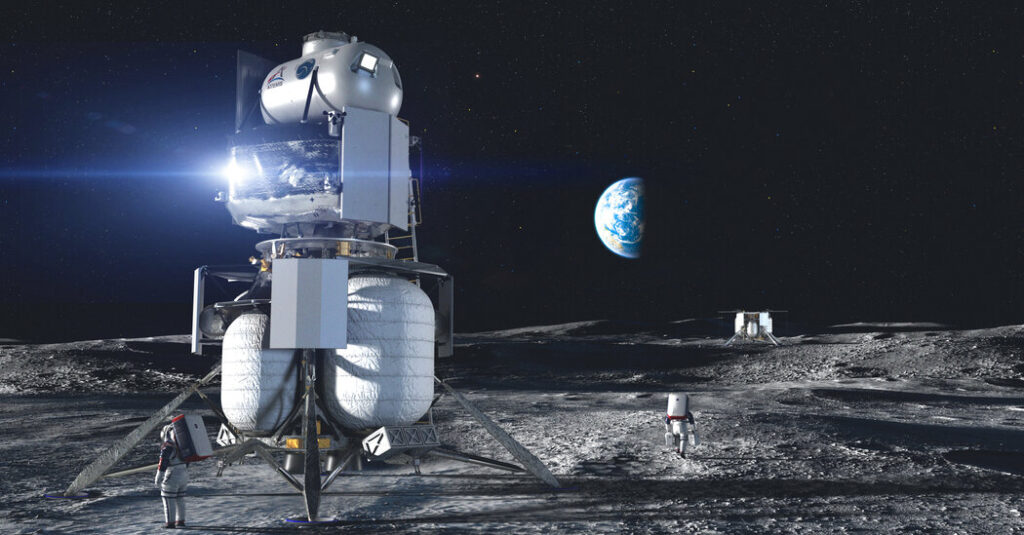
Much of the readiness for Artemis III depends on Elon Musk’s SpaceX and Jeff Bezos’ Blue Origin. Both rocket companies are developing landers to be used in future missions to carry astronauts from lunar orbit to the lunar surface. Artemis III will first test critical maneuvers with versions of these vehicles closer to Earth.
Here’s what to know about Artemis III and the milestones that need to be achieved to keep NASA’s moon program on track.
What does the Artemis III mission need to accomplish?
Artemis III is complex: It requires coordinated launches from teams of three mission controllers. NASA will fly the astronauts; SpaceX and Blue Origin will launch their vehicles. The three spacecraft will meet in low-Earth orbit.
At the event on Tuesday, Jeremy Parsons, the Artemis program manager, explained that Blue Origin’s lander, called Blue Moon, would launch first and remain in space for up to 90 days.
During that time, NASA will fly its Orion spacecraft, with the Artemis III crew on board, atop the Space Launch System rocket. Orion and Blue Moon will rendezvous and spend about two days docked to each other. The crew will transfer to Blue Moon to test electronics and life-support systems.
SpaceX’s Starship vehicle will lift off next. Orion will dock to Starship for about a day, but the crew will not enter. Instead, NASA will test other controls and collect data for future Artemis missions, when Starship’s engines may thrust Orion toward the moon.
According to Mr. Parsons, the mission will last about two weeks. The astronauts will return home via splashdown in the Pacific Ocean.
How ready are SpaceX and Blue Origin?
For Artemis III, SpaceX and Blue Origin need working versions of their lunar landers. They also need to be able to get those vehicles into space.
For Artemis III, SpaceX will not be launching a prototype of its Starship lander. At Tuesday’s event, Jessica Jensen, a SpaceX executive, explained that the company will instead use one of its Starship vehicles, currently being built for other missions, with a docking port attached.
SpaceX aims to fly the vehicle on a new iteration of the company’s Starship rocket, known as Version 3. It debuted the version during a mostly successful test flight in May.
Days later, the Federal Aviation Administration grounded SpaceX’s rocket because of engine failures during the flight. SpaceX is required to complete an investigation into the mishap before launching again. This could affect the company’s ability to perform enough test flights ahead of Artemis III.
John Couluris, an executive at Blue Origin, said on Tuesday that the company expected its Blue Moon lander to be ready for an Artemis III launch in 2027.
For some, Blue Moon — to be launched on Blue Origin’s New Glenn rocket — seemed a more surefire bet for Artemis III. But at the end of May, New Glenn exploded during a test of its engines, damaging the only launchpad Blue Origin has available to fly this rocket.
The F.A.A. subsequently grounded New Glenn, too. Experts say repairing the launchpad — or finishing construction of another pad — could take months, if not longer. Dave Limp, Blue Origin’s chief executive, said in a social media post that New Glenn would fly again by the end of the year.
Despite the setbacks, Mr. Isaacman remained confident that both companies would be ready by mid-2027. NASA is also exploring the option of flying Blue Moon on a different rocket, he said, “if that’s what’s necessary to maintain our timelines.”
How is NASA preparing for Artemis III?
NASA engineers need to refurbish the mobile launcher — a movable platform that the Space Launch System rocket sits on for launch — from damage that occurred during the Artemis II mission in April. Then they will meticulously assemble the rocket, piece by piece, from the ground up, a process known as stacking.
Mr. Isaacman said that stacking would begin in a couple of weeks. It took NASA engineers about 11 months to finish stacking the Space Launch System, with Orion on top, for Artemis II.
In an interview with Ars Technica, Mr. Parsons explained that NASA will perform a “wet dress rehearsal” of the partly stacked rocket this fall, when mission specialists will pump propellants into the rocket’s tanks to work out issues with the launch procedure.
NASA also has other milestones to accomplish, like installing Orion’s new heat shield, which protects the spacecraft from searing temperatures during its return to Earth.
It also needs to ready its astronauts. Randy Bresnik, the Artemis III commander, shared in an interview with the Times that the crew would start training on Monday.
What happens after Artemis III?
For NASA to attempt to land astronauts on the moon in 2028, both Blue Origin and SpaceX need to finalize their lunar landers. They also need to demonstrate safe, uncrewed landings on the moon’s surface using these landers.
For Blue Origin, that means recovering its launchpad as quickly as possible. SpaceX has an additional hurdle. Because the Starship rocket is so big and heavy, it can reach only low-Earth orbit before running out of fuel. It will need to be refueled in space before heading to the moon, a process that SpaceX has yet to demonstrate.
According to Mr. Isaacman, uncrewed moon landings by SpaceX and Blue Origin would ideally occur in 2027, sometime after Artemis III. That commits NASA to a relatively fast turnaround to analyze those demos and make any changes necessary for a safe, crewed landing in 2028.
Clayton Swope, the deputy director of the Aerospace Security Project, said that optimism regarding the Artemis program is “wonderful” to have, but also that “it is good to really have a reality check of what things are feasible and when.”
Mr. Swope is skeptical that NASA can perform a crewed landing by 2028, but believes the United States can beat China to the moon by the end of the decade. He also cautioned against committing to unrealistic schedules.
“Making a habit of setting timelines that are missed risks eroding public trust that NASA can deliver on its promises,” he said, adding that it may leave Americans wondering, “Why spend money on this?”
Kenneth Chang contributed reporting.
The post What NASA Needs to Stay on Track for the Moon appeared first on New York Times.