SOMETHING WE SAID: Richard Pryor, a Notorious Word, and Me, by Elizabeth Stordeur Pryor
Here it comes again. That nasty, naughty, no-good n-word. You’re not supposed to say it, if you are white. I am allowed to say it, but I don’t, even though I am Black.
Why don’t I say it? It is rarely used among my family and friends, and its history as a hateful slur followed me around like an unwanted stray dog when I was a child. Of course, I know many Black people — from artists to random kids on the New York subway — who have subverted that history and reclaimed the word, making it their own. I respect this. As far as white people using the n-word goes, my take is simple: I’m wise enough to know that you don’t have to use the n-word to be a racist, but it certainly doesn’t help.
On its surface, “Something We Said” is a family memoir written by Elizabeth Stordeur Pryor, the daughter of the comedian Richard Pryor. But it is probably better described as a book about who can and can’t say the n-word. (The word does not appear in the book.) I would like to tell you it is a book about language and the ways in which language evolves and how it is important not to think of a single word as though it were trapped in amber, its meaning unchanged despite all evidence to the contrary.
Instead, I’ll describe the book that I read.
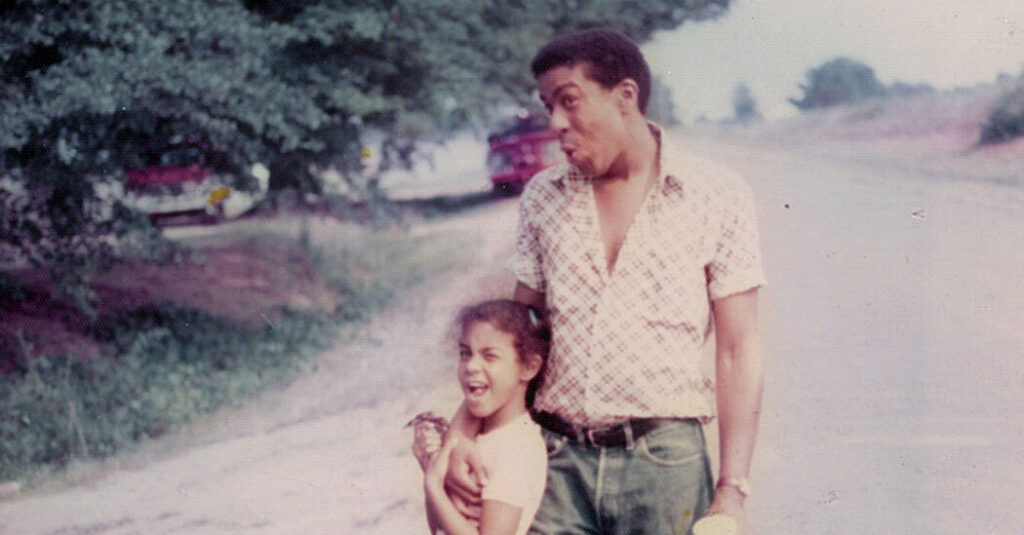
The author spent her early childhood with her Jewish mother in Massachusetts. Her famous dad was mostly absent for the first six years of her life, but she still manages to write about him with the sort of girlish affection that many daughters reserve for their fathers. Things weren’t always so pretty. Her father was raised in a brothel in Peoria, Ill., where he witnessed the constant terror of violence and rape. His father was a pimp. His grandmother, who raised him, ran the family sex business. But Pryor escaped, using comedy as an outlet for his trauma.
By the time Elizabeth came along, her father was well on his way to becoming one of America’s greatest standup comedians. She grew up traveling to Hawaii with him and her half siblings, and going to posh bar mitzvahs as a student at an expensive prep school in Los Angeles. She admits that she and her father had little in common, but then she landed on an epiphany.
Pryor went on to teach history at Smith College. During a lecture, one of her white students quoted a line in full from “Blazing Saddles,” the 1974 comedy written by her father, Mel Brooks and others: “We’ll take the ch*nks and the n***ers, but we don’t want the Irish.” The line is supposed to be a blunt critique of the absurdities of racism. But Pryor froze, or, as she describes it, “became unhinged.” She had never seen the movie and she didn’t know what to do when a white student said the n-word in her classroom.
Later she realized that the moment presented an opportunity. Her father made a living defanging the n-word, titling some of his most popular standup routines things like “That N***er’s Crazy” and “Bicentennial N***er.” She made a living teaching. Why not connect his legacy with her own by becoming a foremost scholar of the n-word? “To be a true scholar of the n-word, I had to listen to his work,” she writes. She now has a TED Talk about the n-word, she tells us proudly toward the end of the book.
But the citation of a TED Talk as a crowning achievement isn’t what saddens me most about this trim and at times courageous memoir. It is the yearning in Pryor’s voice as she writes of her attempts to better understand her father and thus herself through the prism of race and racism. Growing up mixed race in Nixon’s America, she was privileged and sheltered and confused. She frequently describes how she would suck her thumb to comfort herself in difficult situations, even as a preteen. She recalls telling white students in prep school that they should call her “n***er. Or n*g.”
What struck me as the most telling part of “Something We Said” was not an exchange that Pryor had with her father or her peers, but one she had with her mother. During an argument, her mother called her the n-word, a moment that Pryor writes would “stay with me forever.” And yet, she doesn’t dwell on it in the book, choosing to focus on the relationship she had with her father, who eventually vowed to stop using the n-word in his comedy after a 1979 trip to Kenya.
Failing to closely examine the word being wielded like a dagger by one’s own white mother is a shame and a disappointment. Perhaps Pryor was looking in all the wrong places on her quest to self-discovery and the ultimate understanding of all things n-word. As James Baldwin said, it’s not the job of Black people to explain why white people invented and are in such a hurry to use the n-word.
That’s for white people to figure out.
SOMETHING WE SAID: Richard Pryor, a Notorious Word, and Me | By Elizabeth Stordeur Pryor | 37 Ink | 287 pp. | $29
The post Richard Pryor’s Daughter Grapples With a Flawed Father and a Hateful Word appeared first on New York Times.