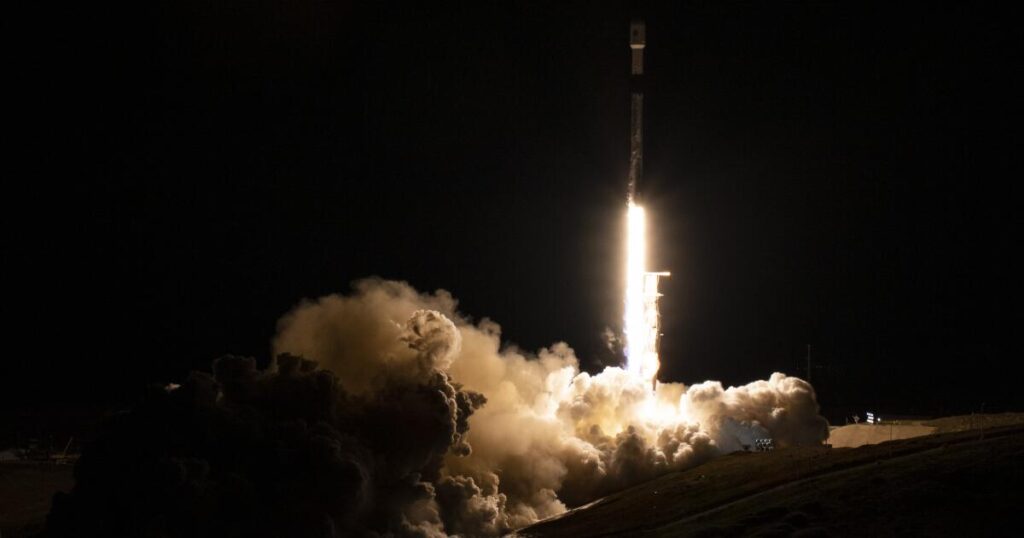
The sonic booms often arrive without warning. In the strawberry fields outside Lompoc, Calif., farmworkers flinch and look skyward. They feel the vibrations in their toes. Children jump in their seats in classrooms a few miles away. Inside the Lompoc federal prison complex, more than 3,000 inmates absorb the shock waves and rattling walls with no way to escape them. And across a coastline the Chumash people have considered sacred for thousands of years, the ground shudders.
This is what a SpaceX launch feels like from below.
For most Americans, Elon Musk’s rockets are something seen on a livestream — a puffy white plume against a blue sky, a triumphant feat of engineering. But for the agricultural communities, ranches, schools, retirees and people who are incarcerated surrounding Vandenberg Space Force Base, these launches are an increasingly frequent intrusion into daily life.
Late last year, the Air Force authorized a cadence of up to 100 missions per year from Vandenberg — roughly one every three days. SpaceX alone intends to put 42,000 Starlink satellites in orbit by 2030. And prior to its IPO this week, the company has detailed its plans to launch up to 1 million new satellites as AI data centers. Vandenberg officials proclaim the base is becoming a major spaceport — “the LAX of orbital access.” The Central California coast is being commercialized at a pace no community in the country has ever absorbed.
Through the Satellite Coast research project, supported by the National Science Foundation, my colleagues, Carlos Jimenez, Jr. and Althea Wasow, and I have spent time in Lompoc, attended Environmental Impact Statement and California Coastal Commission hearings, witnessed launches and boost-back landings, and listened to residents describe what this scale of activity means on the ground. The picture that emerges is not anti-space, anti-science or anti-progress. It is something subtler and more urgent: a community being asked to bear unprecedented costs without ever being meaningfully consulted and without seeing a proportionate share of the benefits.
Lompoc has been here before. In the 1980s, the town was promised that it would become the West Coast home of NASA’s space shuttle. Federal money poured in. Then Challenger exploded in early 1986 and the program was shelved. The Lompoc community was left with mothballed facilities and broken expectations. Today’s residents have learned to be skeptical of boom cycles. They watch high-paying aerospace jobs go to engineers trained out of state while the public schools — whose bonds voters have repeatedly struggled to pass — lack basic resources. SpaceX, valued north of $1.7 trillion prior to the world’s largest IPO, has not meaningfully invested in the community that hosts its West Coast operations.
The deepest failure, though, is democratic. The Air Force holds public hearings on its environmental impact statements, but the people most affected almost never speak at them. With no sustained public outreach in Spanish or Indigenous languages, area farmworkers have largely been left in the dark about launches and public hearings. People who are incarcerated have no access to environmental impact statements and no microphone at all. Chumash voices emerge powerfully at the hearings only to be ignored — this pattern dates back to the 1970s. A handful of residents show up to complain about damage to their properties, and base officials check the box marked “community engagement.”
Lompoc is not alone. Similar concerns surround SpaceX’s Starbase launch site in Boca Chica, Texas. Yet the privately owned Starbase has seen more launch failures and lawsuits. After a Starship rocket exploded on April 20, 2023, showering debris across vital wetlands and wildlife habitat, the Carrizo/Comecrudo Tribe of Texas and environmental groups filed suit alleging that the FAA’s environmental impact statements process had not been rigorous enough.
Though that case was dismissed in late 2025, a separate suit challenged a Texas state law used to restrict public beach access during launches. Most recently, a group of 80 South Texas residents sued SpaceX for gross negligence, trespassing and property damage they allege was caused by two years of sonic booms across 11 rocket tests.
These legal disputes reveal a common pattern: As launch infrastructure expands, the environmental and social costs disproportionately land on nearby communities and ecosystems, often outpacing the regulatory mechanisms meant to account for them. The more pressing question is how to distribute the gains of launch infrastructure more equitably from the outset.
There is a better path. It begins with treating Lompoc’s historically underrepresented communities as partners with expertise. Lompoc is 63% Hispanic. Hearings should be held in Spanish as well as English, in venues working people regularly use. The Air Force and elected officials should commission and publish independent studies of cumulative noise, ecological and public health and safety impacts. And the city, the base and commercial space operators should negotiate a binding community benefits agreement.
Through such a process, commercial space operators would commit to providing long-term community benefits. A serious CBA, such as the one for LAX, could help fund STEM and aerospace education in Lompoc’s public schools, subsidize satellite internet services, restore public beach access and bolster public safety and environmental protection programs.
A launch every three days is not a routine operational decision. It is the transformation of a place. Most of the residents I spoke with are not calling for the rockets to stop. They are asking to be consulted on the terms by which their home is being remade, to know what is being built above their heads, and to be recognized as experts on what increased launch cadences truly cost.
Lisa Parks leads the Satellite Coast research project and is a professor of media studies at UC Santa Barbara, a MacArthur fellow and a fellow of the OpEd Project.
The post Elon Musk’s rocket launches are a nuisance for this California town appeared first on Los Angeles Times.