The casting call seemed simple enough: An unnamed nonprofit was offering $75 in cash to people who could spend a couple of hours acting as zombies in a “mock demonstration.” The scenes would be part of an instructional video, and actors were asked to wear tattered clothing and to be ready to have their faces painted.
But when the group of 40 or so participants arrived at the filming site in Downtown Brooklyn on Thursday evening, things started to take a turn.
First, they discovered that the organization behind the event was a pro-landlord advocacy group known as the Gotham Housing Alliance. The actors were to become zombies to symbolize the “death” of the housing industry at the hands of Mayor Zohran Mamdani, a democratic socialist.
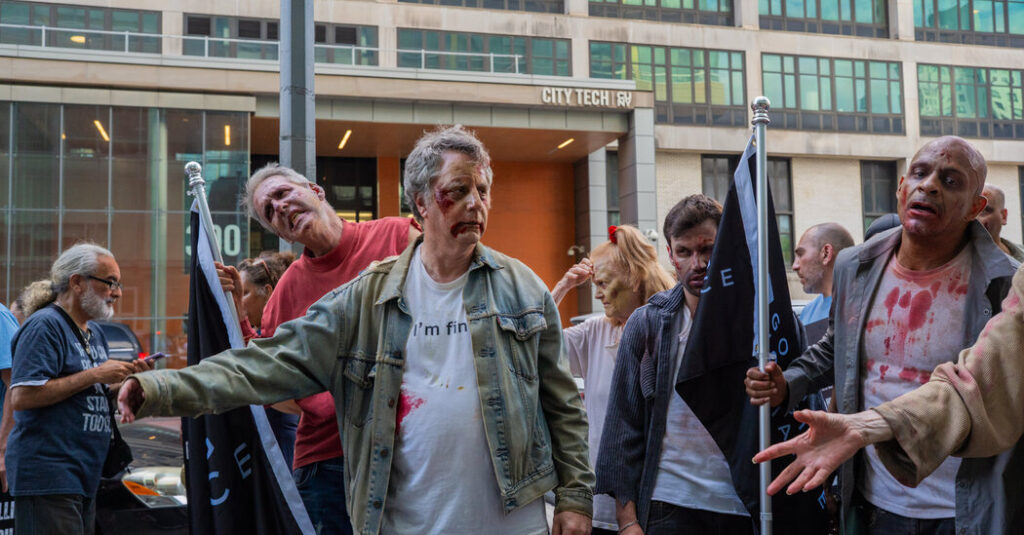
Then it became clear that the “mock” demonstration was, in fact, real. The actors were directed to march down Jay Street in the sweltering heat, moaning and shuffling alongside landlords, some carrying Gotham Housing Alliance flags.
Eventually, the group mustered outside a building where a city panel was set to hold a hearing on whether to freeze rents in nearly one million rent-stabilized buildings.
A crowd of at least 50 pro-tenant protesters had also gathered there, and the confluence of the two groups grew tense, with expletives hurled in both directions. (At least one zombie, staying in character, snarled and barked at the pro-tenant group.) As the evening progressed, many of the actors, several of whom identified themselves as renters, grew visibly uncomfortable, hiding their faces behind signs or flags. Several murmured that they felt they had been duped to show up on the “wrong side.”
“To discover, in the moment, that I’m doing something I love, and it’s being utilized against me — that’s especially disturbing,” said Ian Cobb, one of the zombie actors, who said he lives in a rent-stabilized apartment.
Like others, Mr. Cobb, 25, said he had been given no further details about the project beforehand. And while he had played unsavory roles before onstage, this felt different.
Many of the performers said they had felt pressured to take part in the protest even after realizing it was not what they had expected. The casting call, shared with The New York Times by Erik Rivera, an actor and skateboarder who was part of the group, said that people who were hired and did not show up would be put on a “Do Not Cast” list and would be reported to an online casting platform. The casting call made clear that the actors would be paid only at the end of the event.
Mr. Rivera, 29, said he pays about $2,800 a month to share a rent-stabilized three-bedroom apartment in Brooklyn with two roommates.
“I much rather would have been on the other side for free,” he said.
H.L. Lopes, the president of the Gotham Housing Alliance, said all of the actors should have known what the demonstration was about, especially after they arrived at the site.
“We were very, very clear: ‘Hey, this is what we’re doing, this is where we’re going,’” he said, adding that if he had been in their position and felt that something was unclear, he would have asked for more information. Any actors who did not want to participate could have left, Mr. Lopes said.
The dust-up is yet another manifestation of the theatrics surrounding New York City’s housing debates, particularly rent stabilization. The hearings held by the Rent Guidelines Board, the panel that votes on rent increases each year, have turned into loud and raucous affairs as tenant and landlord groups clash.
This year, the debate has been inflamed further. A majority of members of the board have been appointed by Mr. Mamdani, who was elected on a promise to freeze rents, an idea that landlords say would make it harder for them to maintain buildings and could threaten their livelihoods. The board is expected to vote on a rent freeze on June 25.
The meetings are typically dominated by pro-tenant groups. But Mr. Lopes and his organization sought to make the meeting on Thursday a rare show of force for the landlord side.
Mr. Lopes’s son Jovian Lopes, the operating officer of the Gotham Housing Alliance, said he came up with the idea for the zombie demonstration after the board’s April meeting, where he saw a marching band, among other “socialist theatrics,” that seemed to be influential.
“I decided we should match their theatrics with our own,” he said. “Zombies are dope because it’s symbolic: The industry is going to become the walking dead.”
Jovian Lopes said he had reached out to several casting services to help him find more than three dozen people to show up on short notice for the demonstration. He ultimately went with a company called Characters for Hire, paying between $3,000 and $4,000 for the gimmick, he said.
Asked to respond to the actors’ complaints, H.L. Lopes said all his group had done was hire the casting company.
“How they attract their people, I don’t know,” he said.
But in an interview, the owner of Characters for Hire, Nick Sarelli, said the casting call had only passed along what his company had been told — that the event would be a “mock demonstration.” He said about 500 people had responded, adding that people “love to be zombies.”
“We didn’t know it was a real demonstration; we were told it was a mock demonstration,” he said, adding that his company does not intend to mislead actors. In the future, he said, the company would “do a little more due diligence.”
Mr. Sarelli said the actors could have decided not to participate once they realized the nature of the job. And though he learned from an on-scene coordinator that the event was different from what the company had expected, he said the only reason he would call off a booking would be if the demonstration seemed dangerous.
Some of the actors who showed up did decide to bow out partway through.
“As soon as we started walking, I was like ‘I’m out of here,’” said Darby O’Donnell, 22, whose father is a renter. She said she had showed up at 3 p.m. and stayed for several hours in the extreme heat before leaving the crowd and waiting nearby for the protest to end. All of the actors were ultimately paid the full $75 fee.
Mr. Rivera said he thought it was unethical to fail to provide actors with more information ahead of time. He also worries about the effect that participating in such a demonstration could have on his career.
“All it takes is the wrong casting director to look at this and be like, ‘No,’” he said. “The last thing we want is to be blacklisted from something we love doing.”
The post The Casting Call Was for Zombies. The Job Was Actually a Landlord Rally. appeared first on New York Times.