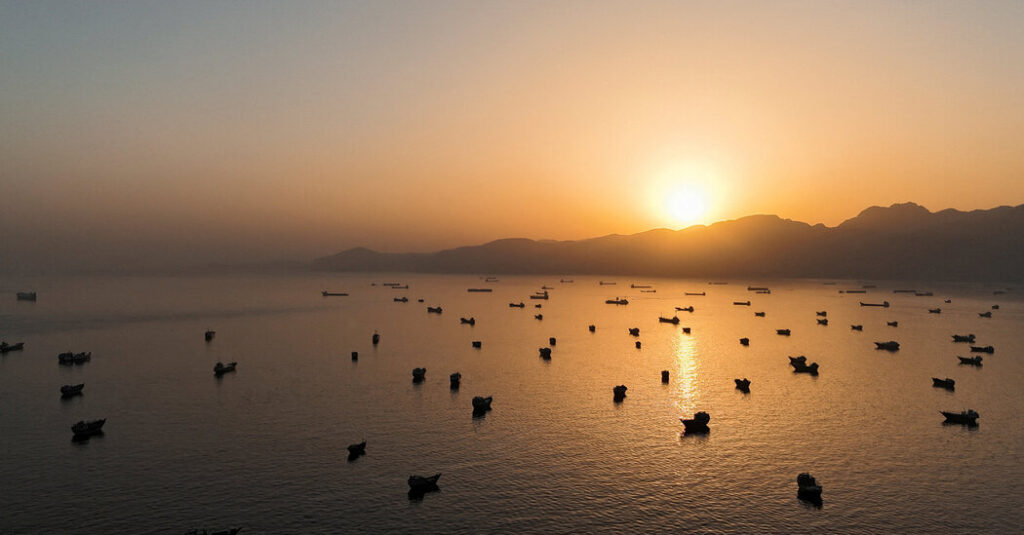
Pankaj Khanna, the chief executive of Heidmar Maritime Holdings, knows what it’s like to be stranded at sea in a war zone. Long before he became a shipping executive, he was a seafarer himself, a crew member on a ship during the Persian Gulf war of 1991 as a Scud missile flew overhead. He recalled the paralyzing fear of some seafarers on board.
Today, the stress on the roughly 11,000 stranded sailors in the Persian Gulf may be even greater. Seafarers now have internet access and are often watching livestreams of attacks happening around them, while also seeing explosions from their ship decks.
“The fact that they are sitting on board the ships with real-time information — it is psychologically very traumatic,” said Mr. Khanna, 55.
Three commercial vessels have been hit by U.S. forces this week. One of the strikes killed three people, bringing the number of seafarers killed since the start of the war to 14. All told, there have been 46 attacks on international ships in and around the Strait of Hormuz since Feb. 28, most by Iran and some by the United States.
The war in Iran is approaching its 15th week. For the shipping industry caught in the middle, pressure is mounting — on the sailors, the shipowners and operators losing hundreds of thousands of dollars a day, and the customers awaiting the delivery of oil and goods. At stake is not only the safety of those in the line of fire but the functioning of the global economy.
A tense calm prevailed in the Gulf on Friday on hopes that a deal to end the fighting could be near.
“We have heard this like 20 times,” Mr. Khanna said. “So what are the prospects? I don’t know.”
Even after a reopening of the strait, he added, ships will need a “framework” before they attempt to get out. “We need to know which parts of the strait are clear,” he said.
Heidmar Maritime, based in Athens, manages a fleet of 60 vessels that operate all over the world, including off the coasts of Europe, South America and northern Asia and in the Red Sea. Just two weeks ago, one of its ships was attacked by Somali pirates.
The company’s ship in the Persian Gulf, carrying Saudi crude oil, is one of about 500 large vessels operated by established companies that have been stranded there since the early days of the war in late February. Some vessels have taken advantage of windows of calm to slip out of the gulf. But departures have slowed recently, according to Lloyd’s List Intelligence, as tensions have increased.
And it seems less likely that conditions faced by shipping businesses will quickly return to their prewar state even if a deal was reached.
“Even if a solution for peace is put in place in the coming weeks, there’s no guarantee there won’t be another crisis later on, and we can’t be prisoners to Hormuz,” Rodolphe Saadé, the chief executive of CMA CGM, the French shipping giant, told a French parliamentary hearing on Tuesday.
The world’s third-largest container line, CMA CGM has 11 vessels stranded in the gulf after three others were able to leave. “I won’t be fixated on the idea that the Strait of Hormuz is going to reopen and everything will return to how it was,” Mr. Saadé said.
As the strait remains effectively blockaded, shipowners are subject to marine insurance fees as high as $6 million to $7 million to exit the gulf, said Mr. Khanna of Heidmar Maritime. Perishable cargoes are expiring and insurance premiums are adding up. Still, shipping companies have, in some ways, benefited from higher tanker rates and longer journeys needed to reroute around risky areas like the Red Sea.
For the companies with ships stuck in the gulf, Iran has offered a way out: Pay a fee to secure safe passage. But sanctions imposed on Iran by the United States and Europe make it illegal for companies with American or European connections to pay.
The shipping industry has more or less steadfastly maintained that the resumption of free passage through the strait is essential for global trade. Now the rising costs have led to some cracks in that argument.
Last week, Evangelos Marinakis, the owner of one of Greece’s biggest shipping businesses, said at a conference in Athens that paying $100,000 or $200,000 to Iran to secure safe passage through the strait would be better than having the strait closed, according to TradeWinds.
And the stress for seafarers keeps mounting.
Mohamed Arrachedi, the Middle East coordinator of the International Transport Workers’ Federation, a seafarers’ union, said he was receiving WhatsApp messages at all times of day from seafarers requesting repatriation or reporting unpaid wages.
“They were hopeful, but now, observing that it is starting again, people are not only anxious, worried and concerned, but people are desperate,” Mr. Arrachedi said.
In recent weeks, more seafarers reported shortages of fresh fruit and vegetables than in the first couple of weeks, he said. On some ships, people are surviving on dry food alone. Drinking water, too, has become an issue since vessels have to be moving in deep water to generate their own supply.
“It’s kind of like being on the front line of a war that you have absolutely no involvement in,” said Michelle Wiese Bockmann, an analyst at the maritime intelligence firm Windward. “You don’t have a dog in the fight, and you’re just there.”
Peter Eavis contributed reporting.
The post Ships Stranded by War Face Costly Dilemma: Wait It Out or Risk Attack appeared first on New York Times.