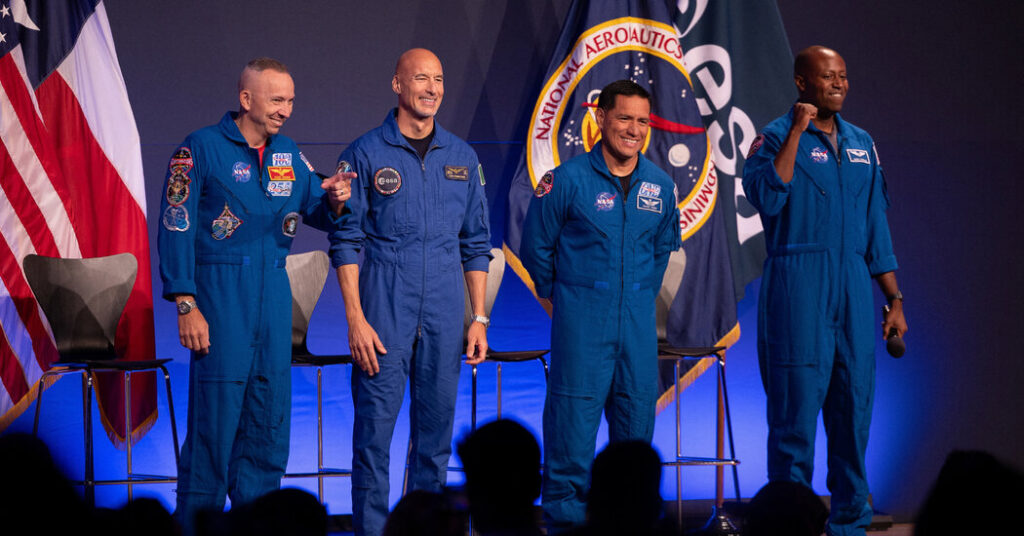
When NASA announced the astronauts who would fly on Artemis III, the next mission in its return-to-the-moon efforts, it was striking to many that the crew consisted of four men and zero women.
Was this part of the push by the Trump administration against diversity, equity and inclusion, or D.E.I.?
Jared Isaacman, the NASA administrator, strongly objects to such criticism.
“I don’t think anyone should be reading into this,” Mr. Isaacman said to reporters at NASA’s Johnson Space Center on Tuesday after the event announcing the crew. “Our last astronaut candidate class was greater than 50 percent female. We’ll assemble the best astronauts to undertake the objectives.”
Of the 10 people NASA selected last year to be its newest astronauts, six were women, the first time that women outnumbered men, but the group appeared less racially diverse.
The all-male Artemis III crew includes Andre Douglas, who is Black, and Frank Rubio, who is Latino.
In an interview with The New York Times on Friday, Mr. Isaacman said NASA followed its usual procedures, handled by Scott Tingle, the chief of the astronaut office, and Norman Knight, the director of the flight operations directorate.
“I didn’t pick the crew,” Mr. Isaacman said. “Our goal is always to put the best astronauts on the mission to give it the highest probability of success, and that’s based on expertise and background and availability.”
Asked if the selection of astronauts is gender- and race-blind, Mr. Isaacman said, “Of course.”
For several decades, NASA had prioritized diversity in its recruitment of astronauts. NASA invites applications once every few years and typically selects about a dozen people. Since 1978, every new class of astronauts has included women and usually reflected a multiplicity of races and ethnicities.
“You didn’t lose sight of wanting your astronaut corps to be reflective of society,” said Duane Ross, who worked as manager of NASA’s astronaut selection office from 1976 until he retired in 2014, during an interview in 2025.
Mr. Ross said then that with so many outstanding applicants, choosing a diversified, highly qualified group of candidates was an achievable goal.
Last year, the Trump administration dismantled D.E.I. programs throughout the federal government, including at NASA.
Expressing a mix of emotions was Sian Proctor, who flew to space in 2021 with Mr. Isaacman on a private astronaut mission. “Congratulations to the NASA Artemis III crew!” Dr. Proctor wrote on Instagram. “Your success will pave the way for the … all-women Artemis IV crew.”
Mr. Isaacman, a billionaire who was running Shift4, a payments processing company he started after dropping out of high school, bought a flight to orbit from SpaceX and decided to take along three strangers for the ride.
Dr. Proctor, a Black woman, won her seat on the mission, known as Inspiration4, in a contest sponsored by Shift4 that sought entrepreneurial space e-commerce ideas. Her entry included a poem about making space just, equitable, diverse and inclusive — JEDI, a nod to “Star Wars.”
In an email, Dr. Proctor told The New York Times she supported Mr. Isaacman as NASA administrator, “but I also believe NASA made a choice when not putting at least one of the many highly qualified women on the Artemis III mission.”
She said that questioning Mr. Isaacman about the all-male crew was “valid.”
“I am hopefully optimistic that NASA will be brave and bold and go with an all-women crew to the moon because they have done a good job selecting well-qualified women for the roles they need specifically for those lunar landing tasks,” Dr. Proctor wrote in her email. ”And that’s what I expressed in my post. But I also know history — so we will see what happens.”
Mr. Isaacman noted that recent trips to the International Space Station included many female astronauts, including the Crew-10 mission, where the two NASA astronauts aboard serving as commander and pilot were women. (The other crew members were men, chosen by Roscosmos, the state corporation that runs Russia’s space program, and JAXA, the Japanese space agency.)
Many of the top officials at NASA are also women, he said. “You’re trying to find controversy where it doesn’t need to be,” he said.
Mr. Isaacman also hinted that a woman could be in line to walk on the moon in the coming years.
He argued that it would be a disservice for NASA to reassign an astronaut who has been working on, say, the development of new spacesuits — and who might also be one of the best candidates for walking on the moon — and tell them, “‘You need to be on Artemis III just because this is what the public may want to do,’” Mr. Isaacman said. “That’s not how you run a space agency.”
Katrina Miller contributed reporting.
The post NASA Leader Pushes Back on Complaints That No Women Will Be on the Next Artemis Mission appeared first on New York Times.