A cheating crisis is growing at American universities as AI rapidly becomes embedded in learning: Extreme and uneven classroom practices are in force to prevent deception, false accusations against students are increasing and the definition of what it means to cheat is shifting, professors, students and specialists in academic integrity say.
At UCLA, students in a recent sociology class said they were told in an email to “procure a mirror large enough to fully reflect your entire desk-area work space,” and turn on their laptop camera so the professor could watch them during an online test. In another course, students said they had to take their oral video exam with their arms crossed in front of them or behind their heads so they couldn’t type into AI platforms.
A Los Angeles attorney who represents students under disciplinary proceedings at California colleges said AI accusations now make up roughly 35% of her firm’s education caseload and are increasing rapidly. She has seen multiple cases where professors report more than half a class for AI violations.
Complicating it all: defining cheating these days can be murky with rules about AI use varying widely as instructors strive to redesign the classroom experience. Some faculty allow students to cite AI sources in drafts. On the other end, the UC Berkeley law school last month instituted a ban on nearly all AI use.
Ambiguity and contradictions, higher education experts say, are at the heart of the conflict at many campuses where AI policy is left to individual instructors seeking to encourage its ethical use while preserving academic integrity — as the technology evolves faster than university rules.
“It’s a messy environment,” said Lee Rainie, who directs Elon University’s Imagining the Digital Future Center. The underlying issue is trust, he said.
“There’s a sense that students think faculty are using it and not disclosing it, and faculty think students are using it and not disclosing it,” he said. Over multiple surveys he has found no consensus on what counts as cheating with AI.
The AI cheating conundrum
Igor Chirikov, a researcher at UC Berkeley’s Center for Studies in Higher Education who co-led a report published this year that is the largest study of undergraduate AI use, said the prevalence of the technology in the classroom — and questions about what constitutes cheating — are rapidly growing.
Of more than 95,000 students at 20 public research universities he surveyed in spring 2024, about two-thirds had used AI for classwork and one-third used it regularly. An additional 9% of users said they had used it to cheat, such as writing a paper with the assistance of AI when it was not allowed or tasking AI with solving a math assignment.
But Chirikov noted that AI tools were less common two years ago, and said he had unpublished 2026 data that found AI use has mushroomed to 80%.
Chirikov did not survey about cheating, false accusations or discipline practices this year. But he said the nature of cheating has shifted. University conduct officers have told him that plagiarism cases are being replaced by AI-based cases “that are much more difficult to prove.”
Failed assignments suspected of being AI generated and integrity hearings over alleged cheating have spawned an industry of academic AI-defense lawyers — and an evolving student playbook for how to fight back or avoid discipline.
The fallout has hit hardest upon students who said they did not use AI and were accused because of a professor’s suspicion or detection software that researchers have found can produce false-positives, especially on writing by non-native English speakers.
Turnitin, one of the most common AI checkers, says its scanner is wrong less than 1% of the time but warns “there is still a small risk of false positives.” Other studies, including ones from University of Pennsylvaniaacademics and European researchers, have found higher failure rates among the plethora of commonly used AI-scanning apps.
A UCLA Humanities Technology article last year warned that detection tools are “deeply flawed” due to false positives, can rely on older AI technologies than the current chatbots and raise “the fundamental question of whether we should be using AI to catch AI.”
Mirrors and body movements
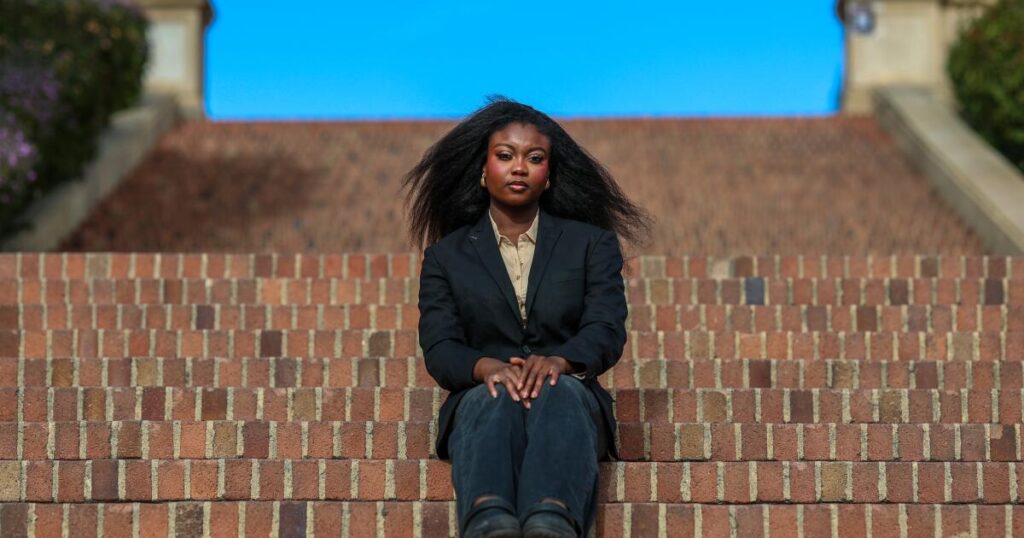
Titi Olotu, a UCLA junior with an accommodation through UCLA’s Center for Accessible Education, was weighing whether to drop the sociology professor’s course when the mirror email arrived. Her accommodation called for brief snack breaks during exams and the option to write down notes on paper. Olotu said she felt the online proctoring treated any movement as suspect.
“Any little thing, moving, breathing, talking, looking, is cheating,” Olotu said. She dropped the class.
The UCLA professor did not respond to requests for an interview. A spokesperson said the school “takes student concerns seriously” and has processes for reviewing student-faculty conflicts but does not discuss individual cases.
While lock-down browsers and sharing screen videos are common in online exams, mirrors and body movement restrictions are more extreme. But students and experts said it is all a reflection of the chaos, confusion and fear a new technology has wreaked upon the classroom.
“It just felt so degrading,” said Ashley, another UCLA sociology student who studied under the same professor, who required students to show their arms and hands. A UCLA junior, she said she faced accusations of plagiarism, incorrect citations and suspiciously short intervals for Google Docs time stamps after she said she drafted assignments in a separate notes app and pasted them in the day they were due.
Online message boards are full of student complaints about policies gone too far, such as proctoring software that uses keystroke patterns, eye-movement tracking or facial scans to detect if students are using AI prompts.
The student playbook
Some students have built their own defenses. Ivan Ornelas, who graduated from UC San Diego last month with a bachelor’s in neuroscience, said he never used AI but composed every paper in Google Docs so the version history would show his work.
“You could see every small thing, every copy and paste, every edit,” he said. He began to scrub what he described as “AI tells” — em dashes, cliches and vague statements — from his writing to avoid accusations.
Aldan Creo, a master’s student in data science at UC San Diego, took similar measures. He said he was accused of using AI on a math assignment last November because his explanations of his process were unusually detailed. His grade was docked by half before he made an appeal during the professor’s office hours.
Since then, he said, “I will change the way I explain things and just make it look a little bit more careless and unprofessional. … I don’t like doing that but I just felt it was the only thing that I could do to be on the safe side.”
Adrienne Hahn, the Los Angeles-based attorney who represents students at California campuses, said defending against AI accusations is the area of education cases where her firm is “growing at the fastest speed.”
She has seen cases where instructors refer more than half a class for AI violations to campus academic conduct boards. In one case, Hahn said, a professor failed a student for using a math formula she learned in a different class. “He thought, well, I haven’t taught you this formula, and you didn’t cite it, so you must have learned this from AI,” said Hahn, managing attorney and founder of the Hahn Legal Group APC. The F was removed after Hahn’s firm intervened.
Hahn tells students to always gather evidence: texts with friends about late nights in the library or in their dorms, study notes and Google Docs or Microsoft Word version histories.
“The stress, the money, the delays in their education, possibly for false accusations, is horrific,” Hahn said.
Tricia Bertram Gallant, who directs academic integrity at UC San Diego, urged caution when describing the rapidly changing cheating environment, saying it reflects how poorly prepared colleges are to deal with AI use in classrooms.
“I would argue against the verbiage of ‘falsely accused,’ ” said Gallant, who is the former president of the International Center for Academic Integrity and co-wrote “The Opposite of Cheating: Teaching for Integrity in the Age of AI.” “What students may really mean is that the university did not have a policy or procedures or those weren’t followed.”
Ardea Caviggiola Russo, who heads the University of Notre Dame academic integrity office and is a leader in the Assn. for Student Conduct Administration, also said that AI is not the sole source of cheating or academic laziness. Conduct officers still see a surprising number of papers undone by age-old actions: “nonexistent citations, quotations that don’t exist, or sources that are completely unrelated,” Russo said. “It’s academic misconduct to submit a paper with fabricated sources, whether or not you used AI.”
The pressure to detect cheating
At College of the Canyons in Santa Clarita, Adam Kaiserman said he reported a student last semester after his AI scanner spotted nine instances of possible cheating. He said the student’s work contained factual errors about the assigned reading, lacked quotations and was generic. But one of the cases collapsed after the campus investigator’s advanced AI detection tool disagreed with the professor’s AI scanner.
The English professor decided that a markedly low-tech tool can effectively ward off cheating. He offers 2% extra credit for students who place phones in a tray at the front of the room before class sessions.
Kaiserman has also changed how he teaches. In his humanities classes, he used to assign a “dialogue between philosophers or artists” in which students would write an imagined conversation between Plato and a feminist science fiction writer, or Enlightenment philosophers reacting to art from their period.
“I don’t do that anymore, because I think ChatGPT can more or less do it,” Kaiserman said.
For Gallant of UC San Diego, the bigger problem is not widespread false accusations, but a system struggling to catch up with new technology.
“I have met with hundreds of students who have faced allegations of misusing AI and they don’t have that attitude of ‘Oh my god, I can’t believe I’ve been falsely accused,’ ” she said.
She blamed a “Wild West model where professors can just take it into their own hands.”
“This fantasy that we can grant degrees based solely on unsupervised, unobserved work has finally, maybe, come to an end,” Gallant said.
The post Inside college AI cheating wars: extreme surveillance, false accusations, jarring confusion appeared first on Los Angeles Times.