At a time when President Donald Trump and Republicans are faring poorly in most polls, the story has been different in California. Republican Steve Hilton finished ahead of many high-spending Democrats in the governor’s race to advance to the November election facing Democrat Xavier Becerra. In Los Angeles, an overwhelmingly Democratic city, Spencer Pratt, a Republican who ran as an independent and is a former reality television personality, looked as if he might make the mayoral general election before finishing third.
California Democrats will be tempted to dismiss all this as a sideshow. But the frustration is real — and justified. California is one of the most dynamic places on the planet. It has Silicon Valley, Hollywood, world-class universities, extraordinary agriculture, ports, talent and natural beauty. But it is a case study in how a rich society can spend more and more while producing less and less of what its ordinary citizens need.
The paradox of California today is that its successful economy is attached to a failing model of governance.
Consider the fiscal record. Since 2000, California’s population has grown by roughly 15 percent. But the state’s general expenditures have grown more than 200 percent, from $78 billion to about $248 billion. General spending per person has risen from about $2,300 to about $6,300. The number of state employees has grown by more than 50 percent by one count. Does anyone think that California’s government and its benefits have gotten 200 percent better in the last 25 years?
Housing is the central failure. California has long spoken the language of compassion while building a system of exclusion. Allysia Finley writes in a Wall Street Journal op-ed that from 2021-24, the Los Angeles metro area, with nearly 13 million people, issued only 118,000 building permits for new homes. Atlanta, with about half the population, issued 163,000.
California has made it too hard, slow and expensive to build. The result is predictable. Home prices soar. Rents rise. Workers commute farther. Homelessness grows. Young people leave.
And people are leaving. Over the past seven years, the state has lost a net 1.9 million people through domestic migration, according to the Center for Jobs and the Economy. For generations, people moved to California to pursue the future. Now many middle-class people are leaving because they cannot afford one.
Or look at education. For years, California’s schools had a plausible excuse: They were underfunded. Total spending on education through 12th grade has more than doubled since the early 2010s, and per pupil spending by 2023 was well above the national average. Yet the results remain in the bottom third of states.
Homelessness tells the same story in a more painful register. A 2024 audit revealed California had spent $24 billion on the problem over a five-year span. Yet in 2024, California reached a record high in homelessness, almost 200,000. Homelessness did decline by about 3 percent from 2024-25, but the state’s expensive and elaborate homelessness-aid complex has not proved to solve homelessness in any significant way.
California’s headline prosperity, generated in good part by a few industries like high tech, masks weaknesses underneath. Job creation has been sluggish. In 2025, California essentially failed to add any new jobs on net; private industries outside government and government-supported health care actually shed jobs, according to the Center for Jobs and the Economy. The state is using public spending to paper over private-sector stagnation.
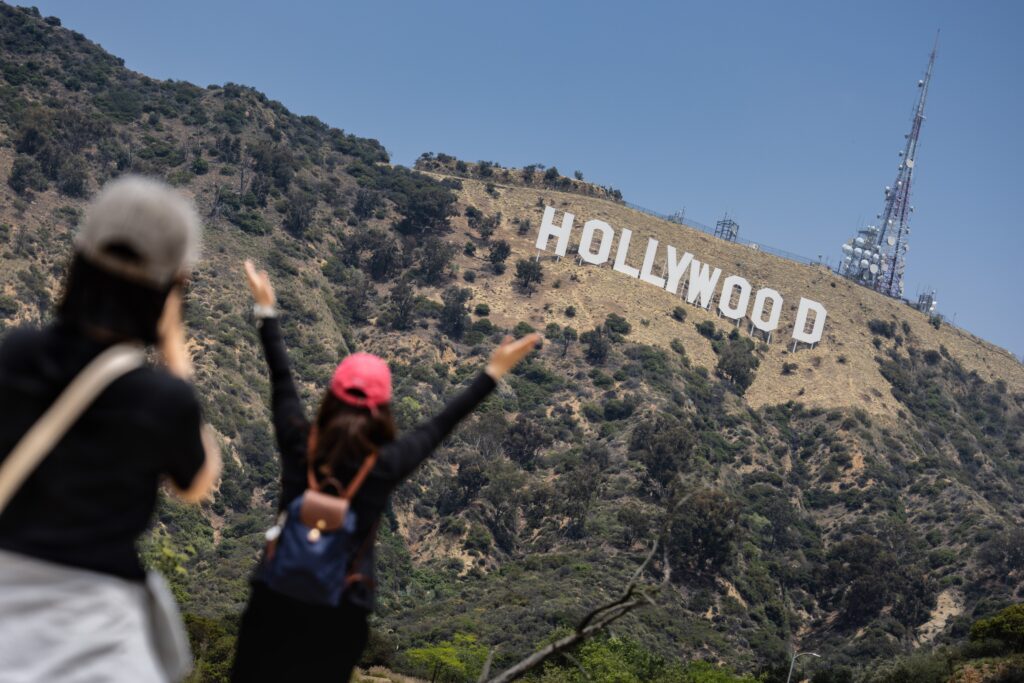
Nowhere is this more vivid than Los Angeles, where Hollywood — the city’s defining industry — is in slow motion collapse. The effects are being felt not by celebrity actors and influencers but by the carpenters, costumers, sound engineers, camera operators, editors, drivers, caterers, dry cleaners, prop houses and small businesses that once formed one of the world’s great industrial clusters.
The numbers are stark. One report found Los Angeles shoot days fell from 36,792 in 2022 to 19,694 in 2025. Motion picture employment in Los Angeles County fell from about 142,000 at the end of 2022 to roughly 100,000 two years later. Another report estimates film, television and sound jobs fell by nearly 30 percent between 2022-25.
Hollywood is still the symbol, the brand, the mythology. And it still houses the big studios that have produced most of the world’s greatest entertainment for almost a century. But thanks largely to high taxes, costs and regulations, the work has moved elsewhere — to Georgia, New Jersey, Toronto, London and Warsaw. Michael Lynton, who ran Sony Entertainment, told me that the big studio lots look like ghost towns now, with tens of acres of soundstages and recording studios where nothing is happening. He said Los Angeles is becoming “a sunny version of Detroit.”
Consider this simple fact: According to Fortune, none of the 10 films nominated for Best Picture this year were primarily produced in Hollywood. Los Angeles still hosts the Oscars. But increasingly it does not actually make the movies being honored there.
For years, Democrats in California have governed without real competition. The recent primary results suggest that even in deep-blue territory, voters are restless. They are not becoming Republicans. But they are asking a reasonable question: Why does a state with so much money, talent and promise make life for ordinary people so hard?
The post How California became a case study in failed governance appeared first on Washington Post.