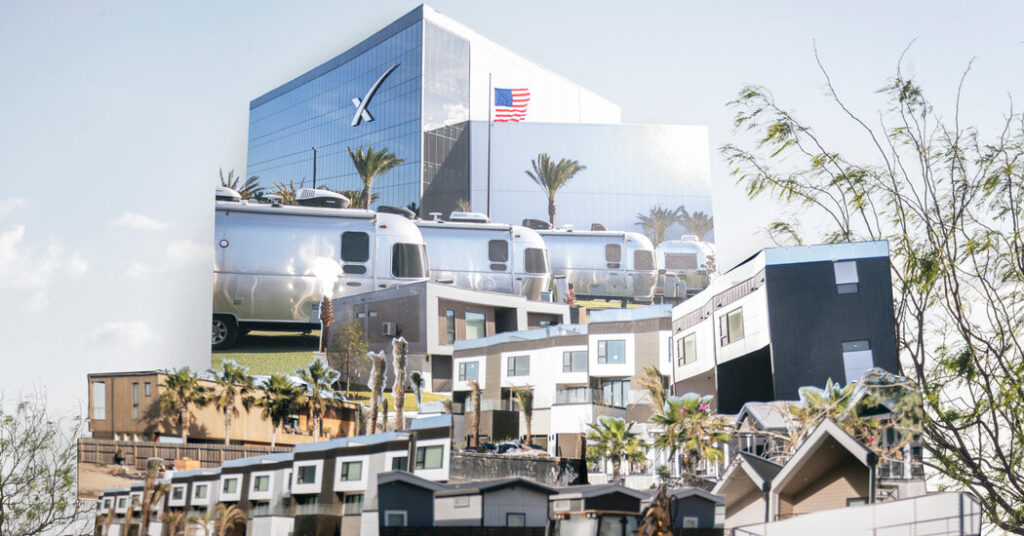
The gleaming new city checks every box: school, medical center, recreational center, sushi bar. There’s even a dog park with hoops and climbing toys. But you and your dog are not welcome; “Private” warns the sign at its entrance. And don’t even think of stopping by for a tuna roll: The streets of black-and-white houses are blocked off by electronic access gates that encircle the city like a medieval moat. I watched a man who made the mistake of wandering inside the minimart get escorted out by armed guards in tactical gear.
In this town, almost every communal space is private property. A company controlled by the world’s richest man owns nearly all of it. He shapes its future.
This is Starbase, Texas, the city that Elon Musk built on America’s ragged hem at the southern border as the home for SpaceX, his aerospace and artificial intelligence company. Locals describe a highly secretive environment overseen by a company-affiliated city commission that rubber-stamps Mr. Musk’s vision, a place where even kindergartners are guided by his philosophies. Starbase is the newest manifestation of Mr. Musk’s political power. It is a beta test for a rising oligarchy that seems intent on transforming America from the inside out.
Soon, there may be more spaceport cities just like it, thanks to the huge infusion of cash that will flood SpaceX’s coffers when it makes its debut as a publicly traded company on Friday. SpaceX, which aims to raise a record-shattering $75 billion, says it’s worth $1.75 trillion.
That valuation makes sense only through rapid growth. On May 12, Mr. Musk announced on social media that “SpaceX is considering several locations domestically and internationally to build the world’s most advanced spaceports!” His announcement came on the heels of reports that a large parcel of land in coastal Louisiana may have been acquired by an anonymous aerospace company, widely rumored to be SpaceX.
These spaceports will allow Mr. Musk to create his own reality for other people to live in. He doesn’t need Mars. Mr. Musk has already built a colony of his own.
Mr. Musk often cites “Star Trek” as inspiration for founding SpaceX. “We want to make ‘Star Trek’ real, OK?” he said in January. But Starbase bears less similarity to the enlightened wonderland depicted in that 1960s television show than it does to the autocratic company towns of the 19th and early 20th centuries. Like Mr. Musk, the industrial titans of that era built their own private fiefs, not only to cement control over workers, but to realize their vision of an ideal society.
Perhaps the most grandiose company town of them all was Fordlandia, the sprawling city that Henry Ford built in the Brazilian rainforest to grow rubber trees. Fordlandia was Ford’s personal Utopia, an expression of his social views, his personal predilections and even his vegetarianism. Workers were forced to subsist on a diet heavy on brown rice, oatmeal and canned peaches, as detailed in Greg Grandin’s “Fordlandia: The Rise and Fall of Henry Ford’s Forgotten Jungle City.” For amusement, there was square dancing — Ford loved square dancing — and poetry readings.
Fordlandia’s ghost haunts Mr. Musk’s colony. Corporate control is so all-encompassing at Starbase that a warning on the menu at its Astropub restaurant alerts diners to the “confidentiality and proprietary nature” of the fare. Students at its private Ad Astra school are guided on “hands-on experiential missions.” The interplanetary mission is even written into the job description for a facilities supervisor overseeing waste management and janitorial needs.
Fordlandia was a hierarchical microcosm in which Brazilians did hard manual labor in punishing conditions, overseen by American managers who lived in their own community with Cape Cod-style bungalows. Starbase rolls out amenities to attract the highly skilled engineers, technicians and welders SpaceX needs. It’s another story for the longtime residents who don’t work for SpaceX or the third-party contractors who are building out Starbase at breakneck speed. The residents I spoke with do not feel welcome there.
There is one important difference between Fordlandia and Starbase, and that’s the sheer scale of the money involved and the speed with which it’s been transmuted into political power. Henry Ford’s net worth in today’s dollars would be equivalent to about $200 billion. Mr. Musk is on track to become the world’s first trillionaire, if the I.P.O. delivers. Over more than a decade, he has used his riches to lobby Texas’ governor and lawmakers and to elect judges, who have granted him near-total control over his spaceport city — and any new spaceports to come.
On the surface, Starbase resembles other small Texas towns. It is run by a city commission headed by a mayor who was voted into office to serve a one-year term in May 2025. At their monthly meetings, the mayor and two elected commissioners conduct garden-variety municipal business, like voting to approve ordinances and starting the process to hire a police chief.
But this American town functions very differently than most. From what I can tell, every conclusion the commission reaches seems to be a foregone conclusion, and every measure it enacts seems to benefit SpaceX. To date, all votes the commission has taken since the city was incorporated have been unanimous.
Mr. Musk, who serves as SpaceX’s chairman, chief executive, chief engineer and chief technology officer, does not hold elected office in Starbase. I can’t see why he’d bother. The mayor and one commissioner are SpaceX executives; the other commissioner, a SpaceX spouse. The city election scheduled for last month was canceled because no one stepped up to challenge the current town officials.
In 2011, Mr. Musk went shopping for an oceanside site for a new launch facility. Brownsville, on the Gulf of Mexico, fit the bill. Over the years that followed, he bought out longtime residents and hundreds of acres of undeveloped land in and around Boca Chica, an unincorporated community surrounded by a wildlife refuge, through SpaceX and its limited liability company.
The village of Boca Chica got a multimillion-dollar glow-up. Its rundown streets were landscaped, the dilapidated ranch houses were remodeled in glossy SpaceX black and white and E.V. chargers were installed for the Tesla Cybertrucks that now fill Starbase’s roads. At the same time, Mr. Musk contributed millions of dollars to PACs that support conservative candidates for Texas’ legislature and courts. He dispatched a dozen lobbyists to the State Capitol and cultivated a close relationship with the Texas governor, Greg Abbott.
Starbase became a Texas city in May 2025, after an electorate made up overwhelmingly of SpaceX employees and their significant others voted 212 to 6 to incorporate. In June, electronic gates went up on every road leading into the village, barring the public from (technically public) streets.
One new Texas law makes interfering with Starbase’s operations potentially punishable with jail time. Another allows the company to shut down the highway into town and to the beach at the mayor’s discretion. Another shields SpaceX, and by extension Starbase, from lawsuits by neighbors over nuisance caused by its rockets. The laws are so protective of Starbase that critics fear they could be wielded to criminalize any protests near it. (Louisiana lawmakers just enacted a package of similar aerospace incentives and tax breaks in a charm offensive aimed at Mr. Musk.)
From a certain angle, life within Starbase’s gates looks pretty awesome. A YouTube video — since removed — shows Starbasers rocking out at a dance party as D.J.s spin tunes in the shadow of its Rocket Garden. There are farmers’ markets and concerts in the beer garden, and Starbase bartenders are rumored to make a mean old-fashioned, to take the edge off those long days spent working out the kinks of humanity’s multiplanetary future. Many employees have received stock and stock options as part of their compensation over the years; some will become millionaires when the company goes public.
Starbase’s darker realities are confided in whispers. Injury rates there far exceed the space industry average, according to a 2024 Reuters report. On May 15, Jose Luis Bautista Jr., a 25-year-old construction worker employed by an outside contractor, was killed in a dawn accident at the site where its Gigabay Starship assembly building is being erected. Brownsville’s fire chief told The San Antonio Express-News that an ambulance was dispatched to Starbase but turned around after SpaceX officials said their own emergency medical services were handling the accident. The incident is under investigation by the Occupational Safety and Health Administration, which looks into workplace fatalities.
At Starbase, 12-hour workdays are common. A real estate agent told me a prime motivation for SpaceX employees to move to Starbase was to spend what little free time they have with their families instead of commuting. One of his clients had to be hospitalized for chugging too many energy drinks to stay alert after working 38 days straight.
SpaceX, which owns nearly all the real property within city limits, is building hundreds of townhouses and apartments for its booming population, which is projected to grow to over a thousand residents this year, from 582 in the fall of 2025. These homes are not for sale. They are almost all rentals, available only to SpaceX employees. A former SpaceX worker told Rolling Stone that when employees were fired, they were evicted in short order.
Those who live outside the gates of Starbase Village — the town’s center, where most of its amenities are — often feel shut out. Amber Pompa said her father, Homer Pompa, a disabled veteran who lives near Starbase Village, has no access to the restaurants or any other buildings there. And as Starbase expands, new gates have gone up in other parts of town. “There’s a huge building that’s supposed to have a market and a restaurant and Rio Grande River views right by my dad’s — they built it and then they put up a gate,” Ms. Pompa said.
There are a handful of non-SpaceX employees, including Mr. Pompa, who cling to their homes inside Starbase but outside the village. One longtime resident described how SpaceX bulldozers and heavy machinery have torn up the road to his home and made it hard to get to his property. But he hasn’t complained to the city. SpaceX’s people are in control, he said. If he speaks out against SpaceX, he fears the city could pass an ordinance that would create havoc for him. It’s like living in a dictatorship, he said. (SpaceX and Starbase’s city commission did not respond to requests for comment.)
I thought of him as I wandered through Starbase before a recent public meeting — the only time when the electronic gates retract to let in hoi polloi.
City commission sessions, held in a SpaceX facility, seem choreographed, a Kabuki performance by actors who wear Starbase baseball caps instead of kumadori face paint. At the meetings I attended, the mayor and two commissioners sat on a stage with a black-and-white honeycomb backdrop modeled on the hexagonal heat-shield tiles for SpaceX’s Starship rocket. They didn’t answer questions from members of the public, nor spend much time discussing the measures before them.
The city also serves as a useful stage for Mr. Musk, whose wealth was founded in no small part by the cultivation of a large fan base via social media. The YouTube celebrity MrBeast, who has 499 million subscribers, swung by in December to declare the Starship factory “arguably the coolest thing humanity has ever built.” A month later, Secretary of Defense Pete Hegseth paid a visit. SpaceX holds billions of dollars in government contracts with NASA and the Department of Defense. During a joint event, Mr. Musk described his goal to send “epic futuristic spaceships” to distant galaxies “where we may meet aliens,” and Mr. Hegseth responded with a “Star Trek” Vulcan “V” salute.
If the SpaceX I.P.O. delivers Mr. Musk’s trillion-dollar payday, it will validate the alternative reality that he has created at the tip of Texas and empower him to replicate it at scale. But here’s the thing about titans of industry who try to bend the world to their will — sooner or later, the world snaps back. Witness the blowback of Mr. Musk’s adventures in Washington on the reputation of his company Tesla. What works in deep-red Texas may not fly elsewhere.
Fed up with yet another meal of brown rice and other frustrations, Fordlandia’s workers staged a lunchtime revolt in 1930 that blossomed into a full-blown uprising. They smashed time clocks, destroyed trucks and equipment, set fire to the machine shop. Ford’s managers and their families fled by boat, or sought refuge in the jungle. Eventually order was restored. Then the rubber trees died. Planted too closely together, they were killed by pests and blight. Fordlandia was abandoned.
Mr. Musk’s bid for planetary reach is about to be turbocharged with billions of dollars of rocket fuel. Who will suffer the fallout if it all blows up?
Amy Gamerman is the author of “The Crazies: The Cattleman, the Wind Prospector, and a War Out West.” Tam Stockton is a photographer.
The Times is committed to publishing a diversity of letters to the editor. We’d like to hear what you think about this or any of our articles. Here are some tips. And here’s our email: [email protected].
Follow the New York Times Opinion section on Facebook, Instagram, TikTok, Bluesky, WhatsApp and Threads.
The post Elon Musk Is Colonizing Earth appeared first on New York Times.