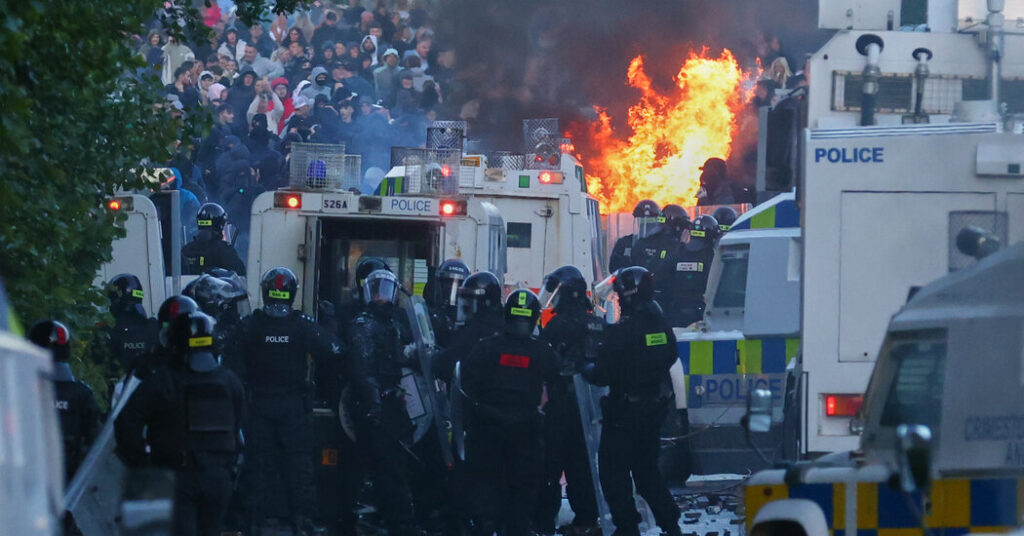
Paul Sharkey lived through decades of sectarian violence between Protestant and Roman Catholic communities known as “the Troubles,” but thought that bloody phase of Northern Ireland’s history was over.
Then, on Wednesday evening, he heard a loud noise near his house on the Antrim Road in Glengormley, on the northwest edge of Belfast. When he looked out of his window, a burning van was hurtling toward his home.
“It was heading toward me — I was panicking,” Mr. Sharkey, 71, said.
An empty home opposite was also ablaze, he said, while young men with balaclavas covering their faces were “running all over the place like rats.”
The violence erupted after a brutal stabbing attack in Belfast on Monday, after which the authorities charged Hadi Alodid, a 30-year-old Sudanese refugee, with attempted murder. Graphic footage of the assault spread quickly online and was amplified by far-right activists, who called for protests and shared plans for roadblocks and locations for demonstrations.
On Tuesday night, violence broke out in parts of the city, with masked rioters setting fire to a bus, cars and garbage cans. Emergency responders had to escort immigrant families, including a parent with a 2-month old baby, from homes that had been set ablaze in one area of Belfast, the police said.
Violent demonstrations continued on Wednesday night, in spite of calls for calm, including from the family of Stephen Ogilvie, the victim, who remains in the hospital.
During the unrest, a group of masked men tried to reach a hotel that houses asylum seekers near Glengormley. They confronted a line of police officers in riot gear, hijacked a parked van, set it alight and pushed it in the direction of the police. The van veered off toward Mr. Sharkey’s house, where it crashed into a wall.
“I lost my teenage years to the Troubles. I thought moving out here I had got away from them — from the bombs and bullets, all the rest of it — and moved to the suburbs,” Mr. Sharkey said as the crumpled vehicle was removed. “Never did I think I was going to witness that.”
The disorder, with its ominous echoes of Northern Ireland’s violent past, has left Belfast on edge, with anxiety high among minority communities. On Thursday, a trade union, Unison, reported that a nurse had been chased by masked men on her way to work at a Belfast hospital, in what the organization called a “racist attack.”
Hilary Benn, the British cabinet minister for Northern Ireland, described the riots as “racist thuggery.” In an interview with Sky News on Thursday, he said people had been “intimidated, burned out of their houses by masked thugs on the basis of the color of their skin.”
Twasul Mohammed, an antiracism organizer at Participation and the Practice of Rights, a Belfast-based human rights group, said, “Everyone is afraid, everyone in the community, all Black and brown people are afraid.”
Since the riots began, she has not taken her children to school, she said. “It’s a really difficult time for all of us and it’s only bearable because of the support we are getting from the community,” she said.
Around 400 volunteers were helping, with some accommodating around 12 families who had to be evacuated from their homes on Tuesday night, Ms. Mohammed said. On Wednesday, there was more alarm when a list of addresses that might be targeted by protesters circulated online.
In total, about 200 individuals have had to be accommodated, added Ms. Mohammed, who is originally from Sudan but has been in Northern Ireland for more than a decade.
Businesses closed early on Wednesday and some staff stayed home. Health and social care leaders said that it was completely unacceptable that employees should be “intimidated or feel too frightened to come to work.”
Anti-immigration sentiment has been on the rise across Europe, fueled by populist right-wing political parties and social media. In Northern Ireland, which has a relatively low immigrant population, there are social and political factors too, including a housing shortage and areas of deep poverty.
And, despite a largely successful peace process, paramilitary groups still exist. Some argue that has made Northern Ireland susceptible to organized violence.
“The people who burned houses were marching in gangs; it was something organized. It was not random kids, it was a group of masked men wearing black,” Ms. Mohammed said.
Ryan Henderson, assistant chief constable of the Police Service of Northern Ireland, said on Thursday that he had “no evidence to say that the violence is being coordinated by loyalist paramilitaries,” referring to groups that favored the use of force to remain part of the United Kingdom and resist a united Ireland.
He added, however, that there had been “significant coordination from online social media activity, some from people within Northern Ireland — and some from outside.”
On Lendrick Street, where violence broke out on Tuesday, three charred vehicles and several blackened and boarded-up houses were still visible on Thursday. An acrid smell of burning filled the air.
Martin Craigs, a former aviation executive who was born in England but has lived in Northern Ireland since 1969, said that the disorder was “a new chapter of violence and a new chapter that is deeply saddening when we thought we were moving away from street conflict, burned-out cars, car bombs and shootings.”
The troublemakers were “only a tiny proportion of people,” he said, but he added that he believes the incitement is unlikely to go away quickly unless people take a stand against the violence.
“It’s too easy to fan flames online and through all the modern communication tools that are a blessing in so many ways but a curse in this way,” Mr. Craigs said.
The Rev. Jacob Mercer, 37, a minister in the Church of Ireland in Glengormley, said that he had witnessed the disorder near the hotel housing asylum seekers and that he had noticed that many demonstrators were not from the local community.
He also said that the violence reflected some of the simmering resentment within the Protestant community that wants to safeguard its place in the United Kingdom.
“There are a number of highly deprived communities who feel they are not being listened to or cared for by the authorities and for them, that’s in contrast to people who get a free hotel to stay in and free food,” Mr. Mercer said.
Some locals think, rightly or wrongly, he said, that “it feels like the government cares more about looking after the immigrants than after us.”
Such sentiment has increased with the rise of right-wing populist parties, including Reform U.K., led by Nigel Farage, and a new far-right rival, called Restore Britain, Mr. Mercer added.
“I think the rise of Reform and Restore and other political parties and popular nationalist leaders has given a focal point to people who feel that there is someone now who represents them politically,” Mr. Mercer noted.
That makes things uncomfortable for some people of color who have lived in Northern Ireland for most of their lives.
Masood Alam was born in Pakistan and has lived in Northern Ireland since 1973, navigating the Troubles and once owning a clothing business.
In earlier decades, he said, “if you went to Belfast city center, it was a purely white city” and it was rare to meet anyone of color.
But he recalled being able to visit both Catholic and Protestant districts without any difficulties.
“In the Troubles we were safe, we had no problem,” Mr. Alam said. “None of the Asians took any part in the local politics, so we were more or less welcomed on both sides.”
Now, things feel less secure.
“I do feel concerned,” he said. “I have been here 53 years, but when the crowd is all charged up, if you are not white you are a target.”
The post Anti-Immigrant Riots Leave Belfast on Edge: ‘Everyone Is Afraid’ appeared first on New York Times.