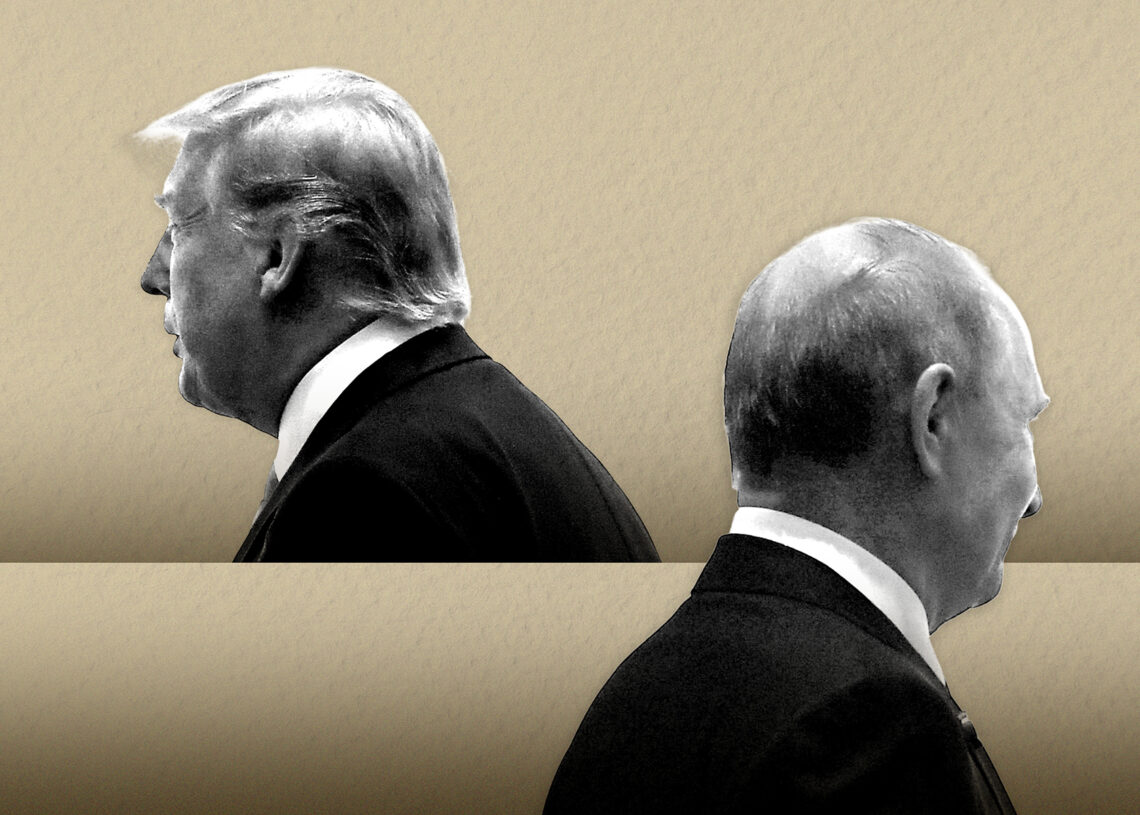
Look at our battered world, and you see two presidents, Donald Trump and Vladimir Putin, caught in wars that they are struggling to finish. There’s a common theme with the Iran and Ukraine conflicts that we might call “the power trap.” These two men can’t escape the consequences of their mistakes.
Both leaders thought their enemies would capitulate in weeks. Both ignored advisers who warned that victory wouldn’t come so easily. Both still believe they can dictate the outcome, even as the chances of full success recede. Both have isolated themselves in bubbles of adulation and ignorance.
The closer each gets to retreat, the more they seem to think that they’re winning.
Trump’s entrapment becomes more obvious every day. It’s written on his face, as in his snarling tantrum before he stormed off the set of his interview last weekend with NBC’s Kristen Welker. He’s clearly so frustrated in his effort to find an exit ramp from Iran that he claims he doesn’t even “consider” the standoff in the Strait of Hormuz a war. “I don’t think about it,” he claimed to Welker. His demeanor said the opposite, as did his return to offensive military operations this week.
Putin is his twin in denying reality. He still calls the Ukraine conflict a “special military operation.” He believes he can dictate terms and compel Kyiv’s compliance. His Kremlin advisers increasingly whisper their doubts, but they don’t dare confront him directly.
“No one can afford to express doubts to Putin,” explained Tatiana Stanovaya, a well-informed analyst with the Carnegie Endowment for International Peace, in an interview this week. “People understand perfectly well that such a conversation would provoke a cold and dismissive reaction. You risk being seen as no longer fully on board and, by implication, aligned with hostile thinking.”
Leaders caught in this power trap are dangerous. They can’t bear to admit their earlier mistakes and correct them, so they press on. They live on flattery. They disdain “soft power,” and thereby squander it. They alienate old allies even as they keep making new enemies.
Caught in the Iran snare, Trump oscillates between threatening to extinguish Iranian civilization and offering Tehran terms so generous that they worry Gulf allies such as Saudi Arabia and the United Arab Emirates. He seems ready to jettison his Iran war partner, Israeli Prime Minister Benjamin Netanyahu. His dismissive comment — “he’ll do whatever I want him to do” — has become a meme for the Israeli opposition.
Putin’s Ukraine strategy is a meat grinder. Russia is suffering more than30,000 dead and wounded a month, intelligence analysts say, and he keeps sending more troops to their deaths at the front in hopes of a breakthrough. He won’t declare a general mobilization because it would hit comfortable Russians in Moscow and St. Petersburg and perhaps turn them into dissidents. His next grisly tactic may be saturation bombing of Kyiv and other cities this summer, Ukrainian officials tell me.
Trump’s struggle to avoid failure in Iran is evident in his near-daily social media posts and sessions with reporters, where he sometimes shifts positions by the hour. Putin’s flailing is less visible but, in many ways, similar. Like Trump, he has enforced discipline within his party by ignoring or intimidating critics. But as frustration with the war grows, debate in Russia is becoming more open.
An early dissenter was Dmitry Kozak, Putin’s close aide since the 1990s and the Kremlin’s deputy chief of staff until he resigned in September. At a meeting of Russia’s Security Council on Feb. 21, 2022, three days before Russia invaded, Kozak “is supposed to have argued against military action,” according to Vladimir Solovyov of the Carnegie Russia Eurasia Center. A transcript of that meeting shows he was the only attendee who didn’t advocate Russian annexation of the eastern Ukrainian regions of Donetsk and Luhansk, Solovyov writes.
Putin froze out his critics for four years, but the ice is beginning to break. Dmitri Trenin, the president of the Russian International Affairs Council, said in an April interview with Kommersant: “Our own ignorance or misunderstanding of our neighbors will create completely unnecessary problems. … Ukraine demonstrates how dangerous such an approach can be.”
The sharpest criticism came in a May article by Vasily Kashin, who runs a center at the Higher School of Economics in Moscow. “The goal of ‘liquidating the anti-Russian regime’ in Ukraine is fundamentally unattainable at this stage without a complete, long-term military occupation of the entire country. … For Russia, this is technically impossible,” he wrote.
Trump may eventually get an Iran deal with the help of Qatari mediators. But from what sources tell me, it will largely mirror terms of the 2015 Iran nuclear deal that he scuttled — making the Iran war a costly military campaign that achieved very little.
Putin and Trump march on. They can’t admit failure in Ukraine or Iran, but they can’t find a path to victory, either. The costs of these “endless wars” grow month by month — and now they have spawned the beginnings of political revolts in Moscow and Washington.
Both leaders rail at media critics. Putin has tightened controls on the internet and suppressed the app Telegram. Trump, meanwhile, rarely lets a day pass without attacking journalists, as in his tirade to Welker against “the fake dirty press, the crooked press.” But there are limits: Trump, for all his fulmination, can’t stop journalists from critical reporting; Putin has to worry that if he chokes the internet too hard, he will spawn a revolt.
The wars in Iran and Ukraine will probably go down in history as epic mistakes, like the U.S. invasion of Iraq in 2003. Democracies have a way of correcting such errors, and you can already see that course correction at work in the United States. But Russia is a boiling pot with a tight lid. Once, Trump might have cut a Ukraine deal that could have rescued Putin from his folly, but Putin was too greedy to accept, and the moment has probably passed.
These two leaders both came to power with a vision of making their countries great again. Each now suffers the consequences of launching unnecessary and inconclusive wars that have brought little but pain to all sides.
The post Why Trump and Putin can’t escape their mistakes appeared first on Washington Post.