Japan led the world in robotics for decades.
More than 50 years ago, Japanese researchers captured imaginations with the first robot capable of grasping objects and walking on two legs. In 1984, a team in Japan built one that could read sheet music and play the piano. When Honda unveiled its first humanoid in 2000, it seemed to cement the country’s lead.
But now, just as tech investors, start-up founders and government officials around the world are betting that artificial intelligence will spur growth for robots, that lead no longer belongs to Japan.
It belongs to China.
Last month at the Humanoids Summit, a robotics conference in Tokyo, what could have been a victory lap for an industry built on decades of development and investment instead centered on a different topic: how Japanese companies can break through in a market increasingly dominated by Chinese rivals.
Investors urged Japanese companies to find niches where they could compete even if they couldn’t match Chinese firms on price. A dancing robot from China’s Unitree Robotics drew the largest crowds. Two Japanese firms also used Unitree robots to demonstrate their software.
Chinese manufacturers dominate the humanoid robot supply chain. Start-ups like Unitree are producing thousands of humanoids that sell for less than $5,000 each, a pace and price that competitors in Japan and elsewhere struggle to match. Chinese robots once depended on Japanese and other foreign suppliers for components such as sensors and joints. But these days, those parts are made in China, too.
It has become nearly impossible to build a humanoid robot without parts from Chinese companies, said Ming Hsun Lee, the head of greater China autos and industrials at BofA Global Research, a unit of Bank of America.
“The component cost in China has gone down way too fast — other countries can’t compete,” Mr. Lee said.
But making humanoid robots has proved easier to achieve than finding a purpose for them. Even robotics executives acknowledge that today’s models are far from performing the types of jobs that have fueled the industry’s excitement.
And though the promise of humanoids remains unfulfilled, China has established a commanding lead in a segment of the robotics industry that is economically useful: factory automation.
China has been making and installing factory robots at a pace unmatched by any other country. In 2024, more than two million robots were operating in Chinese factories, and another 300,000 were installed — more than in the rest of the world combined. Industrial robot installations declined in each of the next largest markets: Japan, the United States, South Korea and Germany.
Earlier this month, Chinese regulators announced a campaign to encourage local governments and state-owned firms to identify industrial use cases for humanoid robots.
China’s lead in the race to build robots that move and act like humans is closely tied to the rise of its electric vehicle industry. China has become the largest E.V. exporter through decades of government investment and a strategy focused on producing nearly every component domestically, from screws to lithium-ion batteries.
Now, many companies that manufacture parts for electric vehicles are supplying robot makers, too.
“If a company can make auto components, then probably it can also do humanoids,” Mr. Lee said.
Tesla, the American electric car company, kicked off China’s E.V. boom with its giant factory in Shanghai. The supplier network that grew around Tesla also serves the company’s robotics business.
Although Tesla had pushed to build a separate supply chain for customers outside China, it still relies on Chinese manufacturers for at least 70 percent of its components, Mr. Lee said.
The factory floors of China’s electric vehicle makers, including BYD and Xiaomi, have also become among the first places to deploy humanoid robots for simple tasks like carrying items.
Some of those robots were built by UBTech. In Shenzhen, the center of China’s tech industry, the company is surrounded by suppliers, many of which once made parts for electric vehicles before moving into robotics. UBTech can source almost any part within hours, said Michael Tam, the company’s chief brand officer.
Many parts are 3-D printed. “I can send a design map by 9 a.m. and get the printed components by noon,” Mr. Tam said. “If one supplier tells me they’re fully booked, I just call another.”
More than 90 percent of the components in UBTech’s robots come from Chinese companies, Mr. Tam said. The main items it still imports are computer chips to control the robots’ movements.
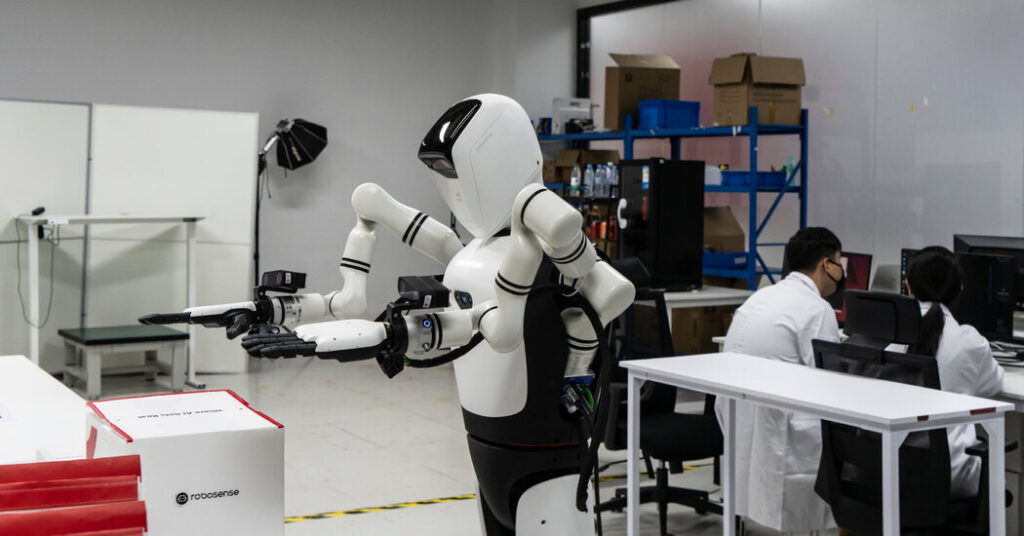
Nearby in Shenzhen, RoboSense, a maker of light detection and ranging, or lidar, sensors for assisted-driving systems, started a robotics business in 2024.
Yang Xiansheng, the company’s vice president of robotics, said RoboSense would have looked to Japanese firms in the past for parts for its automated production lines.
“That’s no longer the case,” Mr. Yang said. “Chinese suppliers now offer far more choices.”
Chinese investors poured over $5 billion into humanoid robot start-ups in 2025, equaling the total amount over the previous five years. In the first five months of this year, investment in the industry exceeded last year’s total by nearly $1 billion.
The surge underscores a growing belief that humanoid robots could become one of the most significant ways artificial intelligence takes physical form in the world. Dozens of Chinese start-ups are working to capitalize on that vision.
In March, Unitree filed to go public in Shanghai. The company said last week that it had passed a regulatory review that could put it on track to start selling shares within weeks. The offering is expected to be one of China’s largest this year, and nearly 50 other robotics-related companies are waiting to list shares in Hong Kong.
Last year, UBTech produced 1,000 humanoids. This year, it intends to make 10 times as many.
Founders and investors envision humanoids handling dangerous tasks like monitoring factories for chemical leaks and carrying heavy loads.
But the robots currently struggle to adapt to the changing world around them. The humanoids that have drawn international attention for dancing in sync at events like China’s televised Lunar New Year special were following preprogrammed scripts.
Chinese companies have also struggled to build software capable of simulating the real world well enough to train robots how to think and act. For that, many rely on simulation software from Nvidia, the American chip maker. Last month, Jensen Huang, its chief executive, announced a partnership with Unitree on a line of robots that will use Nvidia chips and software for reasoning and decision making. The robots are expected to be available in October.
Most of the humanoids that Unitree has sold in the past two years have gone to universities, laboratories and other research settings, where developers are exploring how software interacts with robot hardware. Few are performing actual labor.
Some UBTech robots carry boxes and perform basic manual labor in electric vehicle factories. But they remain far less productive than humans. The robots, said Mr. Tam, the UBTech executive, are currently only about 30 percent as efficient as human workers, though the company hopes to raise that figure to 50 percent this year.
At the Humanoids Summit in Tokyo, Xiaoli Chen, a director at Unitree, said creating robots capable of complex decision making in rapidly changing settings remained a challenge.
“Unitree has gotten a lot of attention and had a lot of events, but this is not productivity,” he said. “The long horizon of doing jobs in complicated environments is still not solved yet.”
Xinyun Wu and Ruoxin Zhang contributed research.
The post Why It’s Nearly Impossible to Build a Robot Without China appeared first on New York Times.