President Trump began Thursday by threatening to bomb Iran for a third consecutive night and then seize Kharg Island, Iran’s main oil export hub in the Persian Gulf, an escalation that risked opening a deadly new chapter in the monthslong war.
Hours later, he abruptly reversed course. In a post on social media, he said he had called off the strikes planned for Thursday night based “on the fact that discussions with the Islamic Republic of Iran have been brought to the highest level of Iranian leadership and approved.”
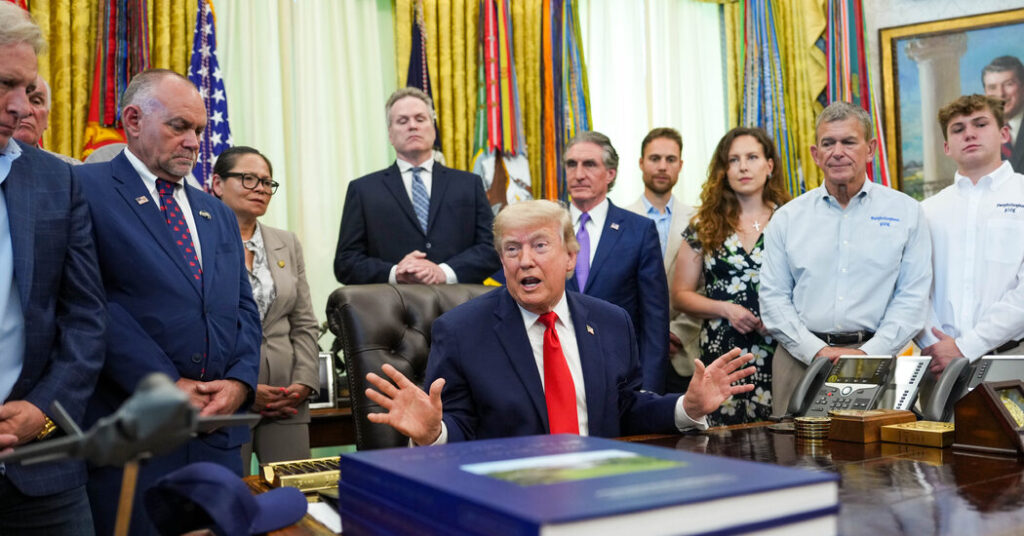
At an event in the Oval Office on Thursday afternoon, Mr. Trump said the United States and Iran had agreed to a deal, “subject to finalization of documents,” and that it could be signed in Europe as soon as this weekend, at a ceremony with Vice President JD Vance.
“It’s a very strong memorandum of understanding that is a little conceptual,” Mr. Trump said.
But a spokesman for Iran’s foreign ministry, Esmail Baghaei, pushed back on Mr. Trump’s assertion that both sides had reached an agreement.
“The claims which have been made regarding the agreement are speculative and nothing has been finalized,” Mr. Baghaei said, according to Iran’s state broadcaster.
Mr. Trump’s pivot was the latest in a dizzying pattern by the president, alternating between threats to escalate the war and claims that Iran is close to signing a peace deal.
Shortly before he called off the strikes on Thursday, Mr. Trump spoke to Pakistani officials, who have been mediating between Washington and Tehran. The Pakistanis told Mr. Trump that “we have a deal” with Iran, according to a senior administration official.
Mr. Trump also spoke to his partner in the war, Prime Minister Benjamin Netanyahu of Israel, “about the emerging memorandum of understanding with Iran to enter negotiations,” Mr. Netanyahu’s office said in a statement.
Israel is not a party to the agreement, the statement said, but Mr. Netanyahu thanked Mr. Trump for promising that once a final deal is reached, it would compel Iran to give up its highly enriched uranium, dismantle its nuclear program, limit its missile production and end its support of militias in the Middle East.
Mr. Trump said that once the deal was signed, Iran would reopen the Strait of Hormuz, the critical oil shipping route, and the U.S. military would lift its blockade on ships entering and leaving Iranian ports.
Mr. Trump added: “They will not have a nuclear weapon — they have agreed to that.” It was not clear, however, if Iran had agreed to any changes in its nuclear program.
So far, multiple rounds of talks over the past two months have failed to produce an agreement to end the war, restrain Iran’s nuclear program and reopen the Strait of Hormuz, and Mr. Trump did not offer any details to support his claims of a breakthrough.
Before Mr. Trump retracted his latest threat to attack Iran, Iranian and American forces had exchanged attacks on two consecutive nights this week, raising fears around the region that the fighting in the Middle East might become impossible to contain.
After striking Iran on Tuesday night in retaliation for the downing of an Army Apache helicopter, Mr. Trump and Defense Secretary Pete Hegseth approved another round of attacks on Wednesday night that, they said, was meant to pressure Tehran to agree to peace on the president’s terms. As Mr. Hegseth put it, “If we need to negotiate with bombs, we’ll negotiate with bombs.”
Riccardo Alcaro, an Iran expert at the Institute of International Affairs in Rome, said that Iran was unlikely to ratchet back its strikes on U.S. bases in the region as long as it is under attack.
“If the Iranians perceive this military power is to force them to accept concessions they are unwilling to accept, they are much more likely to respond by escalating than by giving in,” he said.
The fighting has unfolded against the backdrop of an April cease-fire that was meant to usher in talks to reopen the Strait of Hormuz and permanently end the conflict.
But Iran’s foreign ministry said on Thursday that the U.S. strikes this week had rendered that cease-fire — which had already failed to stop repeated attacks by both sides — “meaningless.”
Mr. Trump has at times seemed wary about escalating a war that is unpopular with Americans, according to polls. But he started Thursday with a social media post declaring that the United States would hit Iran “VERY HARD TONIGHT,” and then turn its sights to a more ambitious goal.
“At some point in the not too distant future, we will be taking Kharg Island, and other oil infrastructure points, and assume total control of their Oil and Gas Markets, much like we have with Venezuela,” he wrote.
In an interview on “Fox & Friends” on Thursday morning, Mr. Trump sounded more ambivalent about taking the island.
“I don’t know that America has the stomach for it, to be honest with you,” he told the show’s hosts. “You know, you’d make a fortune. But I don’t know that America has the stomach. I think they’d like to see us come home.”
And then hours after that, he had changed his tone entirely.
Storming the island would be difficult, analysts said, and could expose American ground troops to attacks.
A coral outcrop in the northern reaches of the Persian Gulf, Kharg Island sits roughly 15 miles off the Iranian coast. Before the war, about 90 percent of the country’s crude oil exports transited through the island, which is surrounded by water deep enough to allow large oil tankers to dock.
Iran is believed to have bolstered its defenses on the island, including moving more military personnel there this year.
After Mr. Trump issued his threat to take the island on Thursday, Iran’s lead negotiator with Washington, Mohammad Bagher Ghalibaf, warned the United States on social media that “impulsive decisions will reset the entire board for the worse, explode energy infrastructure and markets and create an endless quagmire that you will be stuck in for years.”
Because Kharg Island is some 400 miles away from the Strait of Hormuz, even U.S. dominance of the island would do little to stop Iran from controlling the flow of commercial ships in the waterway. It could also cause oil prices, which are up about 30 percent since the start of the war, to soar even further — especially if Iran retaliated by attacking oil infrastructure in the Persian Gulf.
Reporting was contributed Lara Jakes, Eric Schmitt, Maggie Haberman, Chris Cameron, Pranav Baskar, Sanam Mahoozi and Shirin Hakim.
The post Trump, in Latest Pivot, Retracts Threat to Strike Iran Again and Widen the War appeared first on New York Times.