On my second visit with Nancy Wexler at her Manhattan apartment, she had a gift for me. It was a copy of her newly published memoir, “My Life, My Science: Pursuing a Cure for Huntington’s Disease.”
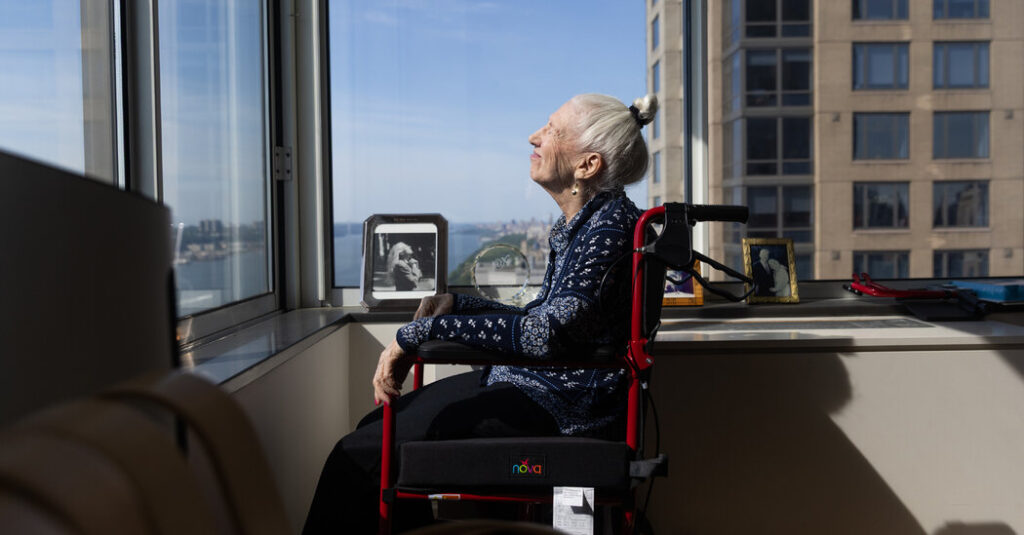
It had been signed with a stamp of her signature — she isn’t able to sign it herself. Nor could she rise from her brown faux-leather recliner to greet me — she can’t get up unassisted. Speaking requires effort. She can manage at most a few badly slurred words or phrases or, with great difficulty, a short sentence.
On that bright windy afternoon, Nancy and her sister, Alice Wexler, sat side by side in recliners, their backs to windows that offered a stunning view of the Hudson River far below. Alice lives in California, but she visits Nancy every other month.
At age 80, Nancy Wexler has Huntington’s disease, a dreaded brain disease that destroys a person’s ability to control movements. There is no treatment. There is no cure.
The disease is inherited: Nancy’s grandfather, three uncles and mother had it. Alice, however, does not: If a parent has Huntington’s, each child has a 50 percent chance of getting it. Their mother attempted suicide, a path that others with the disease have chosen, but ultimately died from Huntington’s.
Nancy is not just any Huntington’s disease patient. For decades, she led a research effort in a remote area of Venezuela that found the gene responsible for Huntington’s. That work yielded a blood test that enable at-risk people to find out if they are destined to get the disease. In honor of this work, Nancy has garnered numerous accolades and prizes, including two Lasker awards, among the most prestigious in science. She devoted her life to understanding what it’s like to be at risk for Huntington’s disease, what it’s like to have it.
What she did not know, though, was that she would get it herself. After helping lead the crucial research that allowed those at risk to find out if they would contract this terrible disease, Nancy chose not to be tested.
Now that the disease has progressed long past the point where she can keep contributing to the fight against Huntington’s, it is natural to wonder: How would her life and research have been different had she made the other choice? If your fate is sealed, is it better or worse to know?
Huntington’s disease was first described in a paper published in 1872 by an American doctor, George Huntington. It affects an estimated 41,000 people in the United States. Symptoms start slowly, with clumsiness or a stumbling walk; patients are often thought to be drunk as they stagger down a street. As years go by, patients become plagued by constant involuntary movements.
Huntington described the misery in unsparing detail: “If the patient attempt to protrude the tongue it is accomplished with a great deal of difficulty and uncertainty,” he wrote. “The hands are kept rolling — first the palms upward, and then the backs. The shoulders are shrugged, and the feet and legs kept in perpetual motion; the toes are turned in, and then everted; one foot is thrown across the other, and then suddenly withdrawn, and, in short, every conceivable attitude and expression is assumed, and so varied and irregular are the motions gone through with, that a complete description of them would be impossible.”
Patients and family members, Huntington added, spoke of the disease “with a kind of horror.”
Nancy’s acquaintance with that horror began in 1968. After graduating from Radcliffe College, she was in Europe on Fulbright fellowship when she was called home to learn her mother had the disease.
She had grown up in luxury in Pacific Palisades, Calif. — her father, Milton Wexler, was a psychoanalyst to Hollywood stars. Her mother, Leonore, had a master’s degree in zoology from Columbia University and a teaching certificate, but did not work. She did, however, have a secret that she kept from her children and even from her husband: Leonore’s father had Huntington’s disease.
Leonore didn’t mention it even when her three brothers — Nancy’s uncles — started exhibiting the telltale signs: clumsiness, a stumbling walk, sudden jerky movements.
When his wife’s slide into the disease could no longer be denied, Milton called both sisters home and sat them down in his bedroom. The 50-50 chance now hung over both of them, too. He gave them some advice they never forgot: Don’t waste your life.
Alice decided to ignore Huntington’s and her own risk. “I didn’t want to have anything to do with it,” she told me. She became a historian.
Nancy had a different reaction. She would make Huntington’s the focus of her life, getting a Ph.D. in clinical psychology from the University of Michigan. Her thesis subject: the experiences of people with Huntington’s, and of those at risk for getting it. She thought of that choice as a way of coping with her situation. She wrote that it was a version of something the American Psychiatric Association called implosion theory — “a technique used in behavior therapy where the client is flooded with experiences believed to be relevant to the client’s fear.”
“I could talk about Huntington’s without seeming selfish and whiny,” she explained. “I could talk about how people felt in the context of helping them.”
Nancy’s father started a chapter of the Committee to Combat Huntington’s Disease, or CCHD, which later became the Huntington’s Disease Foundation. Its express goal was to find the Huntington’s disease gene and search for a cure. Nancy started a chapter in Michigan and also worked with her father in California.
Her first job, at age 29, was at the New School for Social Research in New York where she continued her studies of Huntington’s sufferers and those at risk. But she never told her academic colleagues about her own risk. Her work, she later wrote, “taught me how a genetic condition such as HD can shape the ways people see and react to you.”
She added: “I also learned the high emotional costs of keeping it hidden.”
On frequent trips to California, Nancy was also helping her father lead the Huntington Disease Foundation. The group’s gatherings couldn’t be further from the staid scientific meetings that are the main staple of academic life. There were no traditional talks, no slides. Instead, Nancy and her father invited creative scientists — who may or may not have ever thought about Huntington’s before — to brainstorm about ways to find the gene, scrawling their ideas on a whiteboard. The meetings always included a Huntington’s patient, or the family member of a patient, so the scientists could understand what was a stake.
Back in New York, as part of her social science work, Nancy held hearings with Huntington’s disease families and people who worked with them, including social workers, neurologists, insurance representatives, police, teachers, nurses and other public officials.
What she heard was all too familiar. She had, she wrote, experienced almost everything the families had told her: “the stigma and silence surrounding Huntington’s; the ignorance of most doctors about the disease, including about the hereditary pattern; the denial on the part of family members who knew about the disease but refused to discuss it; the fear and anxiety suffered by those at risk waiting for years to see if symptoms would emerge; the anxiety that should a predictive test be developed, it could reveal future onset but do nothing to forestall or prevent it; the divisions within families over how to respond to the illness; the sense of belonging to a tainted lineage; the shame and embarrassment about relatives with the symptoms; the tremendous financial burden of care; and the sense that there was nowhere to go for help.”
As part of her research, Nancy asked people who had Huntington’s in their families whether they would have a test for the gene if one were developed. Two-thirds said yes.
Nancy thought she’d want to be tested too.
The search for the gene began in earnest in 1980, focusing on three communities around Lake Maracaibo, Venezuela, that had the greatest prevalence of Huntington’s disease in the world. The researchers traced the disease there to one woman, Maria Conception, who lived in the area early in the 19th century. Maria apparently had Huntington’s disease, and passed it on to generations of descendants who called it El Mal.
Huntington’s was so feared that the residents of those communities had been isolated and ostracized. They ended up intermarrying, increasing the likelihood that the gene would be passed on.
Nancy led the research team, returning to Venezuela regularly for 22 years and collecting more than 4,000 blood samples from Venezuelans. She cared deeply for them, and even helped establish a nursing home for Huntington’s patients.
Three years after the gene search in Venezuela began, that question — would you want to be tested? — was no longer hypothetical. The researchers found a marker, like a flag on DNA, that was present only when someone had the Huntington’s gene. It wasn’t the actual gene — that would come later — but it could be used to tell people if they had the gene.
The decision to be tested, though, turned out to be a more difficult one than it might seem. Is it better to know you are doomed, or to hope you are not?
In Nancy’s doctoral thesis, she had cautioned that when a test became available, many who thought they’d want it would change their minds. She hadn’t realized that she would be one of them.
Huntington’s is one of just a handful of diseases — others include early onset Alzheimer’s, as well as some prion diseases — in which a positive genetic test takes away all hope of escaping your fate. With other genetic diseases, a test can only signal a likelihood, not a certainty, that a person will get the disease. In both cases, people often opt not to be tested. In colon cancer, for example, a recent national study found that only 3.7 percent of those with a mutation that increases risk actually had the genetic test.
The phenomenon of avoidance is so common that I.V.F. clinics offer a special test to couples at risk for a hereditary disease: examining each embryo for the disease gene and implanting only those that don’t have it, without informing the prospective parents about the result.
In her book, Nancy explains that she had been too cavalier about the idea of testing before there was actually a test.
“I realized I hadn’t thought through all the ramifications, both psychological and social, of what a positive test might mean in my life,” Nancy wrote, adding: “I wasn’t sure I could live with the foreknowledge that one day the dreaded symptoms would emerge. I preferred to meet the devil when he was on my doorstep.”
Alice had a similar reason for declining the test. “How would I live with a positive test result?” she asked herself. “I thought the idea of ambiguity, uncertainty, was kind of appealing. I thought I could live with that.”
And, she told me, “once you have that knowledge you can’t take it back.”
In 1996, after Nancy’s research effort helped find the gene, Alice began noticing little abnormal movements in her sister.
Nancy was just 51, two years younger than her mother had been when a policeman saw her weaving as she walked down a street and accused her of being drunk.
But Nancy denied anything was wrong. She had an active life; she felt fine. She met her partner, Herbert Pardes, a psychiatrist and executive vice-chairman of New York-Presbyterian Hospital, late but had a happy relationship. (He died in 2024.)
Yet friends and colleagues started asking Nancy if she had Huntington’s, watching her closely. She was furious and upset. How dare they try to diagnose her? They weren’t her doctors.
Nonetheless, Nancy was startled to see herself in videos making sudden jerky movements. She hadn’t realized she was doing that.
She worried about impulsive behavior — telling Alice that she couldn’t seem to stop buying things she couldn’t afford. (Impulsivity is a hallmark of Huntington’s.)
By 2015 she had lost a lot of weight, as is typical in Huntington’s, because of the constant involuntary movement. And she was unsteady when she walked.
Finally, in 2019, there was a clinical trial of an experimental Huntington’s drug. Nancy wanted to participate — but she would have to have a Huntington’s diagnosis to do so.
She asked a neurologist, Linda Lewis, to tell her the truth. Did she have Huntington’s?
“Yes, Nancy, you do,” Dr. Lewis said.
She was too old for the trial, but the researchers were willing to make an exception for her. Before she could start taking the drug, the trial was halted: It was making people worse.
There remains no treatment for Huntington’s disease.
Now, in retrospect, I asked Nancy and Alice, would it have been better to have had had the test?
The answer, for each, is a resounding no. Neither lives a life of regret.
As Alice sees it, testing does not resolve the big questions. “While the test was marketed as a choice between certainty and uncertainty, for me it always seemed more a choice between one form of uncertainty — will I get Huntington’s? And another — when will I get Huntington’s?” she said.
After all that uncertainty, Alice escaped the family disease. I asked whether she felt survivor’s guilt. “More than guilt, I feel the injustice of it,” she replied. “How unfair it is that she has Huntington’s and I don’t. Just cruel arbitrary luck of the draw.”
The only reason she might have wanted to be tested, Alice said, was so that, if she did not have the gene, she could have biologic children. She had not wanted to take a chance on passing the gene on to another generation. But she was in her mid-40s when a test was available — too late for her.
Nancy’s answer was briefer, but succinct: “The predictive test would not have helped. It would have been too threatening,” she said, struggling to get the words out.
Nancy, too, longed for children. She tried the in vitro fertilization method that allowed her to avoid knowing if any embryos were affected. But she did not succeed in having a baby.
Now, being cared for by full-time assistants, confined to her apartment, unable to feed or bathe herself, robbed of her charismatic personality by her struggles to speak, I asked what life is like for her.
“It’s not so scary,” Nancy replied.
The post The Researcher Who Decided Not to Know appeared first on New York Times.