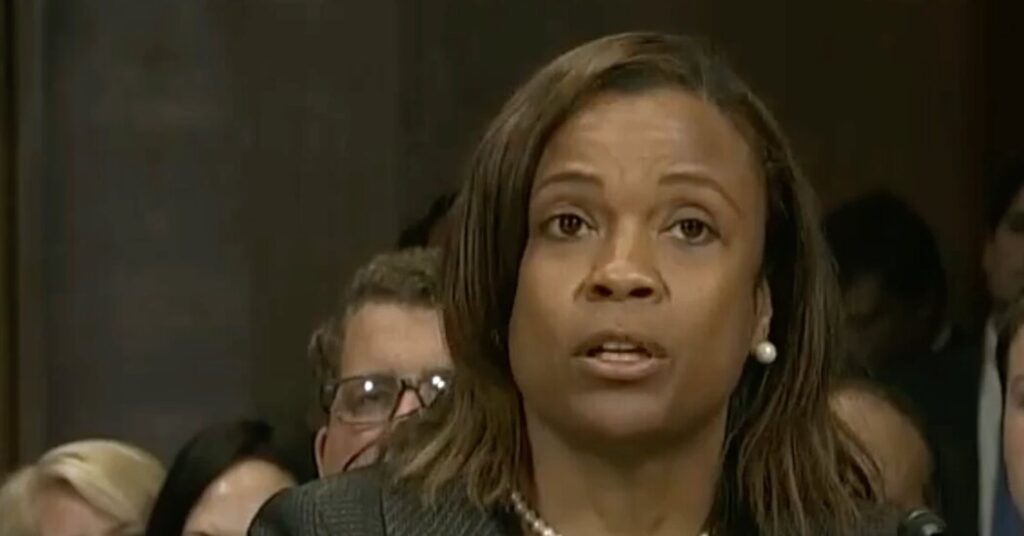
For years, Judge Eleanor Ross’s secret was passed down from law clerk to law clerk.
They whispered about the sultry jazz music that emanated from her chambers when a uniformed police commander, a man they called her “visitor,” disappeared into her private office. The clerks could sometimes hear the unmistakable sounds of sex from behind the door.
They chalked it up as one of the burdens of working for Judge Ross, who routinely rubber stamped their draft orders and added little else before issuing them as rulings. But the clerks in the Atlanta courthouse felt helpless: Do you report your married boss, a federal judge no less, for having a clandestine in-office affair with a law enforcement officer?
One day last year, a clerk did exactly that.
The complaint triggered a monthslong judicial investigation that involved courthouse interviews and the seizure of a beige office couch cushion that was tested in a lab for bodily fluid.
The ensuing investigative report is a chronicle of sex, lies and ethical breaches, much of which is cloaked in secrecy because America’s federal court system affords judges broad deference. The report, which became public last month, did not include Judge Ross’s name, gender or location. Details of the anonymous judge’s case soon rocketed through the clubby, decorous world of the judiciary.
The New York Times confirmed it was Judge Ross through interviews with three of her former clerks and two people familiar with the matter, and obtained a signed apology letter that she wrote as part of a judicial reprimand.
Now, Judge Ross is under fire from all three branches of the federal government. Some Republican members of Congress are calling for her impeachment. The Justice Department is urging her to recuse herself from a high-profile election integrity case. Some of her fellow judges say the punishment she received has been too lenient. And the Atlanta Police Department says it is investigating the accusations involving one of its top-ranking officers.
Judge Ross’s conduct “strikes at the heart of judicial integrity,” said Aliza Shatzman, an attorney who runs the Legal Accountability Project, a nonprofit group that advocates for court clerks. “It harms public trust in the federal courts to see this type of misconduct not taken seriously.”
Judge Ross, who was nominated to the bench in 2014 by President Barack Obama, did not respond to requests for comment. Chief Judge William H. Pryor Jr., of the U.S. Court of Appeals for the 11th Circuit, which handed down her punishment, declined to comment.
The 20-page report from a judicial committee documented Judge Ross’s yearslong affair with a high-ranking police officer. It also concluded that she had improperly attended a campaign event for an unnamed district attorney. Details outlined in the investigation, as well as two people familiar with the matter, identified her as Fani Willis, the Fulton County district attorney.
The committee also found that Judge Ross had initially lied to her fellow judges by blaming the clerk who reported her misconduct, suggesting that he was retaliating against her by making “outrageous” and “baseless” claims.
The findings sparked scorn in the legal world, but it was, perhaps, the punishment she received — a private reprimand and an agreement to not be promoted to chief judge of her district court — that drew even more ire. It sparked questions of accountability in the justice system and concerns that federal judges with lifetime appointments can misbehave with little consequence, all while doling out serious sanctions to those who appear before them.
Jeremy Fogel, a retired federal judge who consults with judges on ethics questions, said some in the judiciary disagreed with how Judge Ross’s case had been resolved. “Many of the sitting judges with whom I’ve spoken believe the findings as a whole warranted a more significant sanction,” he said.
The judicial committee cited Judge Ross’s “otherwise exemplary service” in issuing her a private reprimand, which meant that her identity was supposed to remain a secret. In general, judges rarely face serious punishment.
Other federal judges have committed serious offenses and received private reprimands. They include one who pursued a relationship with an assistant who then accused him of sexual harassment, one who made an antisemitic remark during a trial, and another who harassed a Black salesman passing through her neighborhood. All of those offending judges remained on the bench and their identities were never disclosed.
In fact, only three out of 1,857 complaints against federal judges last year were referred to a special committee for examination, including Judge Ross’s.
In her case, the judicial committee wrote that her on-the-clock sexual liaisons had “cast a pall” on the workplace and left her open to being blackmailed. She eventually admitted the affair to the committee, saying it had run from roughly late 2022 to sometime around the fall of 2025.
Three of Judge Ross’s former clerks, each of whom were interviewed by investigators, spoke with The Times on the condition of anonymity, fearing reprisal.
The accounts reveal how the once-respected jurist began to falter, making errors in judgment and distressing the employees whom she and other judges depended on the most: clerks.
Judge Ross spent years prosecuting crime in Atlanta before she became a state court judge. She received Mr. Obama’s nomination after two and a half years on the local bench, and also won the endorsement of Georgia’s two senators, both of whom were Republicans.
Judge Ross emphasized her principles during the confirmation process.
“The most important attribute of a judge is integrity,” she wrote. Her husband, a lawyer who is now a Georgia state court judge, sat behind her during her confirmation hearing.
She soon settled on the 17th floor of the federal courthouse, in an office with two couches, a meeting table and windows that overlooked the Atlanta Falcons’ stadium.
Among the décor in her chambers was a picture of Justice Ruth Bader Ginsburg with a quote from a Beyoncé and Drake song overlaid: “All them fives need to listen when a ten is talking.” Elsewhere, she hung an apology letter from a lawyer she had chastised for being underdressed and underprepared in court.
In their first year of the prestigious two-year clerkship, Judge Ross’s clerks would sit at a desk just feet away from the door to her office. In addition to their legal work, they were tasked with greeting visitors, and they kept a small CCTV screen nearby to see who was outside.
So it was odd when they would see a uniformed police officer walk down the hallway toward the back door of Judge Ross’s office.
The walls were thin, and the clerks could sometimes hear music and the judge and officer chatting. Then the music would continue, and the talking would stop. Other times, what they heard was more explicit.
The three clerks told The Times that their stomachs churned when they realized what was taking place. But, coupled with her other actions, it also represented something fundamentally painful to them: that a person with a role they revered, a person whose job it was to decide America’s laws, seemed not to care the way they cared.
One clerk said it felt like their belief in the legal system had been yanked out from underneath their feet, and that they wondered whether to continue working in law.
While the clerks said they might have been willing to overlook isolated personal foibles, they were more broadly disturbed by the lack of attention Judge Ross paid to the civil disputes that came before her.
While Judge Ross was engaged on her criminal cases, the clerks — often fresh out of law school — told investigators that she largely let them decide how to rule on key motions in lawsuits. It was not unusual to go weeks without hearing much from her except for a brief email — “Please docket.” — a few minutes after they sent her a draft order, three clerks told The Times.
They estimated that she provided edits on roughly 5 percent of the civil orders that they drafted in her name, and even then mostly just for grammar or typos.
Judge Ross later disputed the clerks’ account to the judicial committee, saying that she made edits to 30 to 40 percent of drafts.
Ultimately, the committee required the judge to send apology letters to the six law clerks who spoke to investigators.
The committee said the letters “should be sufficiently specific so as to make clear to the recipient the sexual misconduct for which the judge is apologizing.”
The letters she sent, dated May 27, were three sentences long and identical.
“Thank you for your contributions to our court during your clerkship,” Judge Ross wrote, according to a copy obtained by The Times. “I convey my deepest apology for not taking steps to ensure that it was a more positive experience. I wish you all the best in your future legal endeavors and in life.”
The three former clerks who spoke to The Times said that they viewed the letter as offensively vague. One decided to share it with the chief judge of the 11th Circuit, believing it didn’t comply with the committee’s order.
Judge Timothy C. Batten, Judge Ross’s former colleague in the U.S. District Court for the Northern District of Georgia, worried that her misconduct would affect how courts and judges were viewed by the public.
“I’m really sorry this happened and reflects poorly on the court,” he said in an interview. Judge Batten retired last year as chief judge of the district court and said he had never gotten wind of Judge Ross’s misconduct.
Now, some in the Atlanta legal world wonder if Judge Ross’s career will survive.
“I don’t know where you go from here,” said Don Samuel, a criminal defense lawyer in Atlanta who has long known, and respected, Judge Ross.
“There’s so much snickering going on by everybody that I can’t imagine what it will be like to be on the bench and wonder what everybody’s thinking,” he said.
Sean Keenan contributed reporting. Sheelagh McNeill and Georgia Gee contributed research.
The post Sex, Lies and Secrets: A Federal Judge’s Trysts Go Public appeared first on New York Times.