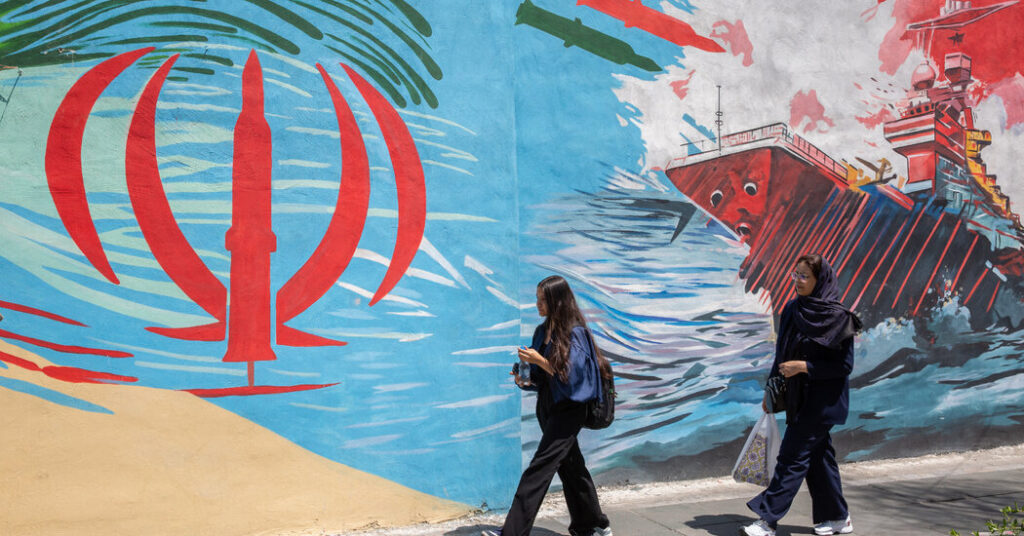
As Iranian drones and missiles bombarded Gulf Arab countries over the past few months, killing civilians and damaging critical infrastructure, the public has responded with outrage.
But few commentators or officials in these authoritarian monarchies have mentioned the awkward fact that the Iranian government has kept repeating in justifying its attacks: The targeted countries host sprawling U.S. military bases and thousands of American military personnel at a time when the United States is waging war against Iran.
“There is this weird omertà almost about stating the obvious ,” said David B. Roberts, a Gulf expert at King’s College London.
“They feel that they need these bases as a mechanism of fundamental defense,” he explained. “At the same time, it creates this vector of insecurity that we are seeing at its fullest extent right now. They don’t know what to do.”
The U.S.-Israeli war with Iran has highlighted a contradiction in the Gulf countries’ dependence on the United States.
They host American military bases partly in an effort to deter Iranian attacks. But now, Iran claims that those bases are the very reason it is attacking them, spraying thousands of missiles and drones at U.S. allies like the United Arab Emirates, Saudi Arabia and Kuwait.
That dilemma was laid bare this week when a fragile cease-fire broke down. As the United States and Iran began trading strikes, Kuwait and Bahrain announced that they, too, had come under attack by Iran.
On Thursday, Bahraini authorities said an 11-year-old was injured and a residential area had been set ablaze as a result of “sinful Iranian aggression.”
In a statement on Thursday, the Iranian foreign ministry argued the opposite: that its Arab neighbors had brought the war to their doorsteps because they were either unwilling or unable to stop the United States from launching attacks on Iran from their territories.
“The continued use by the terrorist U.S. military of the territory and facilities of certain regional countries to prepare and carry out aggressive operations against Iran has placed those countries alongside the aggressors,” Iran’s foreign ministry said on Thursday. It called for regional countries to remember “their legal and moral responsibility” to prevent the U.S. military and Israel from using their territories to attack Iran.
The Bahraini government and Kuwait’s army did not respond to requests for comment about whether they had allowed U.S. forces to launch attacks from their countries. The Pentagon also did not respond to a request for comment about whether it had launched attacks from Bahrain or Kuwait in recent days.
In general, Gulf governments have denied that they are allowing their land or airspace to be used to attack Iran. Yet President Trump has repeatedly made statements to the contrary, claiming that almost all of the Gulf countries have fought alongside the United States.
Most of Gulf governments prefer to draw as little attention as possible to their U.S. bases and the role they play in the region.
“It’s one of these obvious things that we all just ignore,” Mr. Roberts said, calling it “slightly farcical.”
The war has made that silence increasingly difficult to maintain.
U.S. troops have been killed and injured in Iranian attacks in Saudi Arabia and Kuwait. After Iran inflicted heavy damage on U.S. bases, many American troops relocated to hotels and office spaces in the region, according to military personnel and American officials.
When Mr. Roberts wrote an essay last month suggesting a pathway in which U.S. forces could gradually withdraw from the region while Gulf countries built up their own military capabilities, he said he was “roundly mocked in the region” for what was seen as an ill-timed idea.
To counter the threat from Iran, several Gulf countries, particularly the United Arab Emirates, are actually doubling down on their alliances with the United States.
“Gulf leaders are not stupid,” Mr. Roberts said.
Behind the scenes, they are preparing as much as they can to reduce their dependency on a single foreign protector — by diversifying their alliances and developing their own defense industries.
But for now, he said, they are trapped in a “vice that they don’t know a way out of yet.”
The post Iran’s Attacks on Gulf States Underscore Their Dependence on U.S. appeared first on New York Times.