Democrats and environmentalists are shifting their approach to climate change, as the economic fallout from war in the Middle East has reshuffled the politics of energy.
With voters worried about spiking gas prices and inflation, some of the party’s leaders argue that they should stop trying to throttle oil and gas, which heat the planet when burned. It’s a rejection of the approach taken during the Biden administration, which treated climate change as an existential threat and tried to stop new drilling and pipelines.
The most recent example came in California, where Tom Steyer, a champion of fighting global warming, was edged out of this month’s gubernatorial primary by Xavier Becerra. Mr. Becerra, a moderate Democrat, questioned the state’s most stringent climate goals, like ending sales of new gasoline-powered cars by 2035, and received donations from oil and gas companies.
Across the Northeast, Democratic governors have started to consider gas pipeline expansions, once unthinkable in the most climate-conscious states in the country. Even climate hawks in Congress have shifted their tactics, lawmakers said in recent interviews. And though the co-sponsors of the Green New Deal in 2019, Senator Ed Markey of Massachusetts and Representative Alexandria Ocasio Cortez of New York, still rail against the fossil fuel industry, they rarely emphasize their once-influential plan to mobilize the U.S. economy to fight climate change.
The result could be a less ambitious climate agenda if the party returns to power in Washington.
During the 2024 election, Republicans accused Democrats of wanting to ban gasoline-powered cars and gas stoves and cast themselves as the party of lower prices and consumer choice. Pledging to “drill, baby, drill,” President Trump derided climate change as a hoax, promised to cut Americans’ energy bills and claimed that renewable energy would drive up costs.
Now many Democrats argue that the path back to power means abandoning some of their most aggressive stances on climate change. When they do promote renewable energy, they frame it as a way to lower electric bills and avoid the gas pump, not because of the effects on the planet.
Some environmental activists are muting their demands to keep fossil fuels “in the ground,” a rallying cry that had defined the climate movement for more than a decade.
“It’s something we are struggling with,” acknowledged Cassidy DiPaola, a spokeswoman for Fossil Free Media, a nonprofit group that wants to rapidly end the use of coal, oil and gas. “We are still committed as a movement to the ideas of keeping it in the ground, but as a campaign message, it’s more effective to talk about building clean energy.”
That’s a far cry from 2020, when activists pressured Democratic presidential candidates to forswear oil and gas donations, blackball anyone with a fossil fuel past from cabinet positions, and commit to eliminating the nation’s planet-warming emissions in just a few decades.
Democrats are trying to figure out how to talk about a problem that many voters still say they want to see the government tackle, but without opening candidates to attacks from Republicans calling them out of touch.
Mr. Markey said he isn’t abandoning the Green New Deal and legislation he has sponsored to prohibit new federal oil and gas leasing. But these days, he said, “I talk about the positive vision for what clean energy represents as a solution to the affordability crisis.”
A recent Economist/YouGov Poll showed that just 5 percent of Americans say climate change is their top voting issue. By contrast, 29 percent say their top priority is inflation and prices, and 13 percent cite jobs and the economy. A number of strategists have urged Democrats to stop talking about the issues that excite already-committed voters and broaden their appeal.
Still, voters want solutions. In February, a YouGov poll found that 57 percent of Americans thought the United States should do more to address climate change. A quarter of Republicans agreed, as did 58 percent of independents. Among Democrats, 90 percent of voters wanted to see more action to curb global warming.
Rather than pushing green solutions only, many Democrats say they have a better way to bridge the gap: Be the party of yes to all forms of energy. After all, they argue, wind and solar power are often the cheapest forms of electricity and the fastest to deploy. On an even playing field, they say, renewables would beat fossil fuels.
“We shouldn’t be against the domestic oil and gas industry, but we have to be for the energy transition,” said Simon Rosenberg, a Democratic strategist. “Democrats should be running toward that instead of away from it.”
A Biden-era battle over fossil fuels
The Biden administration’s signature climate achievement was the 2022 Inflation Reduction Act. The law offered hundreds of billions of dollars in incentives for wind, solar, nuclear, electric vehicles and other nonpolluting technologies.
Yet Mr. Biden also faced enormous pressure, particularly from young climate activists, to aggressively end the use of fossil fuels.
“Some of the extremist voices on the climate side were saying, ‘You can simply say ‘no more drilling’ or ‘no more fossil fuels,’” said Amos Hochstein, who served as a senior energy and foreign policy adviser to Mr. Biden. “This was a battle that existed inside the administration.”
In response, Mr. Biden promised “no new drilling, period,” on federal lands and waters. He canceled the Keystone Pipeline to bring oil from Canada; sealed off millions of acres in Alaska from oil and gas exploration; supported a California plan to ban the sale of new gas-powered cars by 2035; and stopped construction of new liquefied natural gas export terminals for nearly a year.
Biden administration officials hoped their positions would not only help the planet, but also pay off with young and climate-minded voters. It didn’t work out that way. Young people, especially men, turned away from the Democrats in 2024.
After Mr. Trump won the White House and Republicans claimed both chambers of Congress, they systematically dismantled most of Mr. Biden’s climate policies.
Mr. Trump also promoted fossil fuels and waged war on wind and solar power, leaving little to show for Mr. Biden’s ambitious climate agenda less than two years after he left office.
‘We Want to Win’
Almost immediately after the 2024 election, some strategists argued that Democrats should stop talking about the threat of global warming altogether. A growing number of Democratic politicians agree.
Senator Ruben Gallego of Arizona said recently he and many others aren’t discussing climate change during the midterm election season because “we want to win.”
Rahm Emanuel, the former congressman, chief of staff to President Barack Obama and mayor of Chicago who is exploring a 2028 White House run, said Democrats need to focus on household budgets, specifically electric and gas bills.
“I’m not against talking about climate policy, but you’ve got to talk about it as energy and energy prices,” Mr. Emanuel said, “and you talk about it as it relates to protecting ratepayers.”
He argued that Democrats “were talking to the faculty lounge and to another Aspen conference on climate change,” and added, “That’s not how you win political arguments.”
That sentiment isn’t universal; many Democrats said they are still firmly committed to raising alarm about a planet that has already warmed by about 1.3 degrees Celsius since the Industrial Revolution.
Senator Sheldon Whitehouse, Democrat of Rhode Island, has criticized “climate hushing” — downplaying the changing climate to avoid perceived political backlash, a tactic he says leads to a self-reinforcing cycle. “When leaders don’t talk about something, enthusiasm falls among voters,” Mr. Whitehouse warned on social media recently.
Saad Amer, a climate activist and founder of the consultancy Justice Environment, said he believes voters still want to know how politicians will tackle the crisis.
“The folks who are saying we shouldn’t talk about climate change are unimaginative hypocrites who don’t have any vision of what a future should look like,” Mr. Amer said.
But even lawmakers who have been committed for decades to the climate fight said the party should move away from calls to ban fossil fuels.
“It may be emotionally satisfying to shut down something bad,” said Senator Brian Schatz, Democrat of Hawaii. “But if we’re going to effectuate the transition, it’s all going to take over a decade. We have to get serious about what that looks like.”
A shift on oil and gas
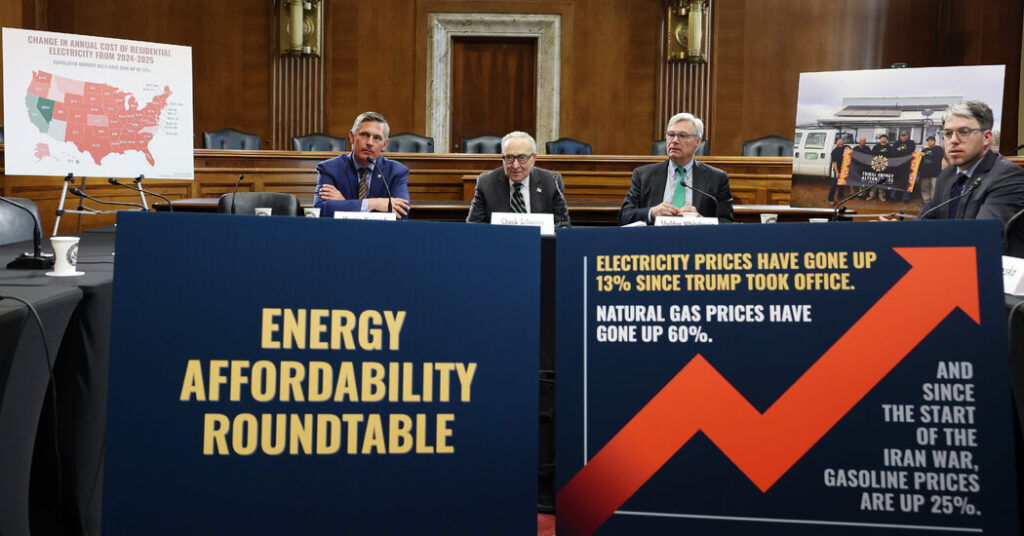
Democrats said they are coalescing around a future agenda that begins with immediate relief for families. That includes bolstering programs Mr. Trump has tried to eradicate that provide federal aid for heating, cooling and utility emergencies. They also are exploring ideas like paying states to freeze or lower electricity rates, or banning utility shut offs for low-income families.
Most of those ideas aren’t directly related to climate change. But after those short-term steps, they’d also restore investments in wind, solar, electric vehicles, battery storage and other clean energy products that Republicans wiped out, and champion upgrades to the nation’s transmission lines to handle more renewables.
At the state level, some Democrats in the Northeast have recently supported expanding natural gas pipelines, acknowledging that renewable energy alone can’t meet domestic demand cheaply.
“We have growing energy needs in this country, and that’s why we need to embrace an all of the above approach,” said Governor Maura Healey of Massachusetts. “Gas is still an important part of our portfolio.”
Senator John Fetterman, a Democrat from the energy-rich swing state of Pennsylvania, said the party should embrace all forms of energy, a notion supported by research on voter attitudes.
“We’re going to need more energy,” he said. “Democrats — we were, in my opinion, pretending that we are not going to need fossil fuels like natural gas, and the Republicans, they canceled wind, and that’s crazy.”
The idea of an “all of the above” energy policy used to be more closely associated with the Republican Party. But Mr. Trump has largely abandoned that approach, attacking solar and stifling offshore wind farms partly because he doesn’t like the way turbines look. His war on wind has cost states thousands of jobs and imperiled energy security, analysts said.
Peter Maysmith, president of the League of Conservation Voters, said that while his group continues to oppose new oil and gas projects, environmentalists should pay more attention to efforts to expand clean energy right now.
“Something that is quintessentially American is choice and freedom, and the whole notion of bans often runs counter to that,” he said.
Activists and lawmakers acknowledged that an increase in wind and solar energy without a concurrent drop in fossil fuel use might not cut U.S. emissions as quickly.
But, they said, it could lead to policies that endure longer than the Biden administration’s efforts.
The post Democrats Once Vowed to Stop Oil and Gas. Now They’re Not So Sure. appeared first on New York Times.