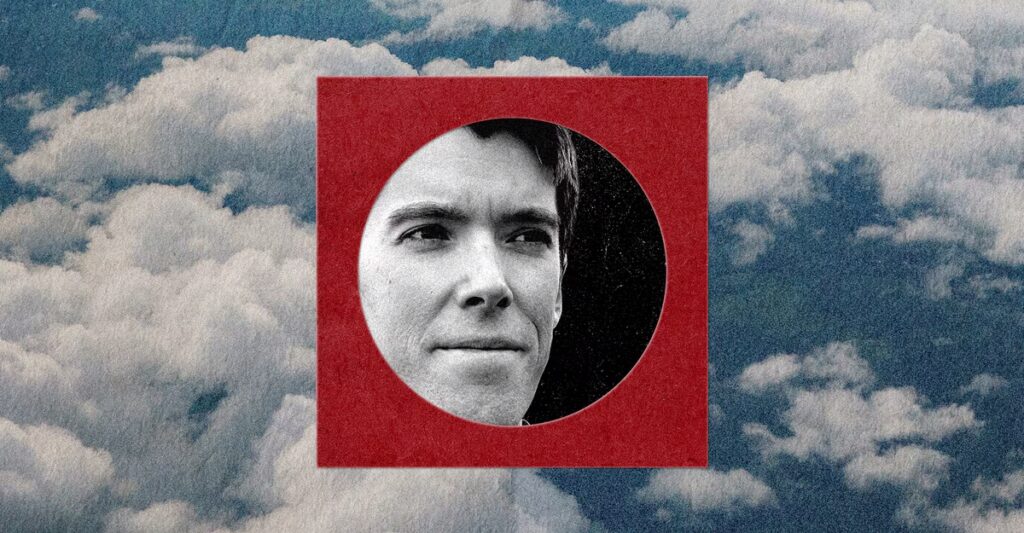
The success of the climatologist Daniel Swain rests on a simple foundation: His specialty has long been how global climate change messes with local weather. Many climatologists focus on subjects that seem arcane: mean global temperatures registered in Celsius, radiative forcing, the reflectivity of clouds. Swain, in contrast, talks in plain English—constantly, really, in interviews with CBS, NBC, the Weather Channel, and The Washington Post, as well as on his own blog and YouTube channel, Weather West—about the wind and the rain and the temperature outside, and how they are influenced by the larger forces of the atmosphere.
“He uses language that is both precise and deep but very accessible, and that’s why you see him quoted everywhere,” Mark Hertsgaard, a longtime climate journalist who is the executive director of Covering Climate Now, told me. According to Swain’s own tally, he does more than 200 media interviews a year; he is, in other words, about as omnipresent as a weather guy can be in people’s lives. A climate scientist at the University of California Agriculture and Natural Resources’ research unit, Swain is not exactly a “weather influencer,” that breed of streamer who delivers breathless updates about the next big storm. But he has become one of the country’s most influential explainers of the weather’s relationship to the climate; you’ve almost certainly heard from him if you consume just a scintilla of climate-related news.
In January 2025, for instance, he was getting ready to publish a major paper as easterly winds were picking up across a Southern California landscape that was packed with grass after the previous, wet winter and worrisomely dry after a largely rainless autumn. The paper illustrated this phenomenon, which Swain had dubbed “hydro-climate whiplash.” The term describes how global warming will make extreme swings between above-average rainfall and drought more common, leading to damaging floods and destructive wildfires. Swain and his co-authors had taken several years to put the paper together, and as the publication date approached, Swain told the staff at Nature Reviews Earth and Environment that the very thing it warned about was set to come true. “It was a ‘Well, shit’ moment,” Swain told me recently. Two days before the paper’s release, in what Swain called an “eerie coincidence,” fires broke out in the hills around Los Angeles.
As the devastating fires blazed through neighborhoods, Swain hosted nine livestreams on his YouTube channel in the space of a week. Some of them lasted for hours. His phone and email inbox lit up with messages from reporters looking for someone who could coherently explain the disaster. NPR was calling; the Los Angeles Times wanted a quote; The Guardian was asking for a quick comment; CNN needed to know when he might be available. When he wasn’t on-screen talking to his YouTube followers, he was speaking with a journalist. “I did essentially continuous interviews—like, eight or 12 a day—for that period,” he said.
Swain, who is 37, grew up in Marin County, California, a place known more for its mild Mediterranean climate than for weather extremes. Despite (or perhaps because of) the Bay Area’s often-bland weather, he was fascinated with meteorology from an early age. He has a particularly strong memory of a winter storm in December 1995—“a violent, a truly violent storm, wind gusts over 100 miles an hour, really severe thunderstorms, continuous lightning”—that busted the windows of his home and knocked out the power for days.
He was hooked. On family vacations to the Sierra Nevada, he would bring along a battery-powered NOAA Weather Radio so that he could track any thunderstorm activity in the mountains; he was still in high school when he launched his Weather West blog.
Twenty years later, the site is still run on WordPress—it has a distinctly Web 1.0 aesthetic—and has 2 million unique visitors a year, he said. His stream-of-consciousness posts about the intersection of weather and climate change routinely garner thousands of comments. On his livestreams—which he professorially calls “office hours”—he presents a boyish persona with an academic’s seriousness, his cerebral monologues punctuated at times with a droll humor. “What happens in the tropical Pacific doesn’t stay in the tropical Pacific,” he said in a recent livestream about an impending Super El Niño.
Swain went to UC Davis to study atmospheric science, figuring he’d end up as a professional forecaster for the National Weather Service. He made his first splash in climate-change communication a few years later, while working on his Ph.D. at Stanford. He was writing a blog post about the drought then gripping California and searching for a snappy way of describing the high-pressure system that seemed permanently parked over the West Coast when he came up with the phrase ridiculously resilient ridge. The media ate it up, and his phone hasn’t stopped ringing since.
In hindsight, Swain admits that the alliteration was a bit corny. But corny can be catchy. “I just sort of embraced it because I’m like, Well, certainly more people are going to see this interview than read the blog,” he said.
Swain’s instinct for simple but resonant phrasing is a big part of his appeal. Take his research on hydro-climate whiplash (which the media has since shortened to “climate whiplash”). In a 2018 paper for Nature Climate Change about rainfall, he floated the term precipitation whiplash. According to Swain, both the editor and the peer reviewer nixed it on the grounds that it was “too visceral.” Swain thought, “What do you mean? That’s the whole point. I’m trying to be kinetic.” The published title used the more beige precipitation volatility. (Bronwyn Wake, the chief editor of Nature Climate Change, wrote in an email that such decisions about terminology “are guided by the goal of ensuring clarity, scientific rigour, and consistency with established terminology in the field.”)
Noah Diffenbaugh, a Stanford climatologist who served as Swain’s Ph.D. adviser, told me that Swain’s explanatory skills spring from his bona fides as a working climatologist. Some precincts of the ivory tower are suspicious of academics who become public figures. But Swain’s minor celebrity appears to have sparked mostly admiration from his colleagues. If anything, he’s become an object of emulation for up-and-coming climatologists, a model for how to balance deep research with public communication. “I’ll hear from prospective Ph.D. students, and when they tell me what their long-term goal is, they’ll say, ‘I really want a job like Daniel Swain has,’” Diffenbaugh said.
There are, of course, other climatologists who have risen to public prominence. Often, their climate communication tips into political advocacy, their urgency fueled by what they know about the state of the atmosphere. The scientist James Hansen, for example, has long been involved with climate-advocacy organizations; Katharine Hayhoe, a professor at Texas Tech and a sought-after public speaker, is now the chief scientist for the Nature Conservancy. Swain, in contrast, sticks mostly to the weather. His goal is to stay in science-explainer mode.
Still, that hasn’t insulated him from the uglier parts of the climate debate. He told me that he receives “an exceptionally large volume of unsolicited feedback” via email and social media, as well as letters, parcels, and calls to his personal phone. Occasionally, someone confronts him in person. Much of what he hears is positive or at least neutral, he said, but some of it is threatening. People write to him about how he and other meteorologists control the weather, make chemtrails, or work for either Big Green or Big Oil. At this point, he said, he is most disturbed by the messages from people who seem to think that climate scientists are trying to mislead the public for financial gain or at the behest of some foreign power: “It’s tragic that so many people right now genuinely believe that a lot of the folks working hard to improve the way things are in the world—sometimes at considerable personal expense—are trying to do the opposite.”
Swain’s own hard work obscures another personal difficulty: the pain and fatigue he deals with from an autoinflammatory condition called Yao syndrome. Although he has found a way to manage it thanks to “some pretty heavy-duty medication,” he is still frequently knocked out, he said: “It kind of feels like you have the flu several times a month, just forever.”
Living with a rare genetic disease has strongly influenced how Swain thinks about extreme events such as the January 2025 fires. He sometimes shares a slide during public presentations that shows a generic bell curve with a red arrow at the tail end of the distribution that reads, Me, apparently!—an illustration of his whole life being an outlier. “A lot of people will say, ‘A 98 percent chance something won’t happen? That’s great; we can ignore it.’ For me, a 1 percent chance is not really that low,” he said. “It makes me think differently about how we should be thinking about risk and unlikely-but-really-high-consequence events. That’s my experience—my whole life is an unlikely-but-high-consequence event.”
Swain’s health issues have also informed the way he talks about how society might try to manage climate change. He wants people to understand that terrible events do happen but that, in many cases, it’s possible to affect the odds or mitigate the consequences. He calls this “second-order optimism”—the ability to think about big, bad things but not get overwhelmed by them. He has warned us time and again, in simple language that is hard to misunderstand, that a storm is coming, and he still believes that we can do something about it. This sort of partly cloudy outlook is probably the best we can expect of a climatologist in the global-warming era.
*Illustration sources: Kevin Carter / Getty; Dan Kitwood / Getty; Jilmarie Stephens
The post America’s Go-To Climate Scientist appeared first on The Atlantic.