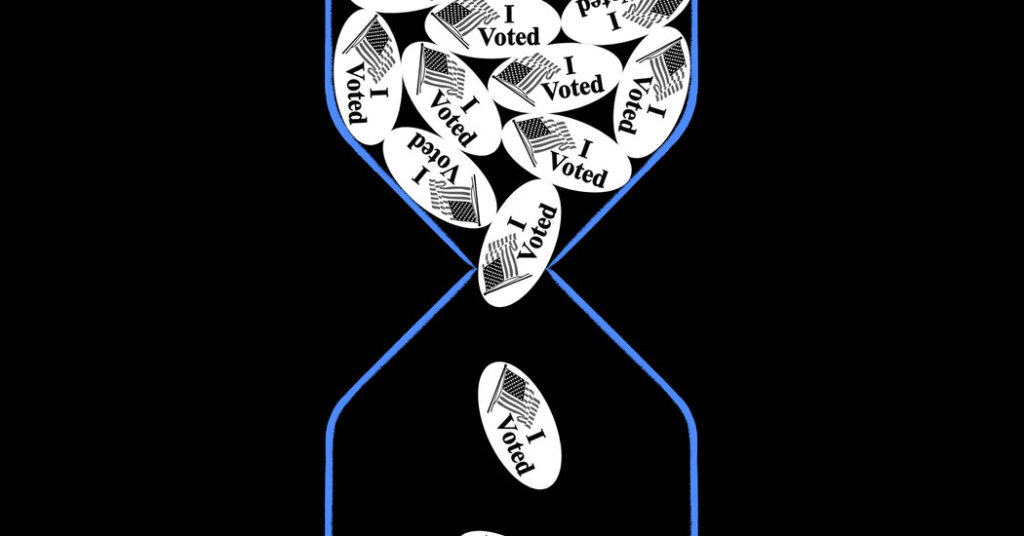
On Friday, three days after California’s primaries, the state had still failed to publicly report results for about 40 percent of ballots cast. By yesterday afternoon, almost a week after polls closed, nearly 15 percent of ballots remained unreported, and the outcomes of several races were unclear. This slowness is a failure of governance, and it should help inspire the creation of a better system.
There is no good reason that California takes so long to count votes. Most democracies around the world count votes quickly. So do most other large U.S. states, including Texas, Florida, Michigan and Virginia. Until the past decade, California itself counted votes quickly.
California has since adopted an approach to election administration without meaningful benefit and with substantial downside. It makes the state government look incompetent. It fails to increase voter turnout. It creates needless uncertainty about results (as has been the case with several races this year). It confuses ordinary voters and serves the interest of conspiracists, including President Trump, who spread lies about election fraud that is in fact virtually nonexistent. Even Gov. Gavin Newsom of California has written, “We must acknowledge that the longer the voting count takes, the more mis- and disinformation spreads.”
With California refusing to change its system and a few other states having similar problems, the appropriate remedy is a federal law. That law should establish Election Day as the deadline for mail-in ballots to arrive and set basic standards for efficient vote counting. Congressional Democrats have long supported promising election reform bills, but they have generally opposed sensible deadlines for the arrival and counting of ballots. That is a mistake. Electoral reform is a natural issue for Democrats as they plan a legislative agenda for a possible House majority in 2027 and beyond.
Insisting on a rapid counting of votes is the right thing on the merits, and it would send a signal that Democrats care about government efficiency and transparency. It would present a contrast with Republicans, whose preferred election bill, known as the SAVE America Act, is mostly an effort to make it harder to vote by creating onerous identification standards. Democrats can instead be the party pushing for secure and accessible voting, followed by competent and fair counting.
In an era of skepticism about government, political leaders should look for ways to build confidence in it, and they should avoid practicing voluntary ineptitude.
California’s leisurely approach to vote counting is a recent phenomenon. Before 2015, the state required that mail-in ballots arrive by Election Day. It now allows them to arrive seven days later so long as they are postmarked by Election Day. The state also uses a burdensome process for confirming voters’ signatures. Lawmakers say they are prioritizing accuracy and access, but states that tabulate results quickly have elections that are neither less accurate nor less accessible than California’s.
Aggravating these problems, many local governments in the state do not allocate enough resources to vote counting. Last weekend, most election offices took a break and stopped reporting results even with large piles of uncounted ballots. Some of the laggards are affluent areas, such as Marin County, north of San Francisco, which as of Monday afternoon, six days after the election, had counted less than 60 percent of its votes.
California officials offer myriad excuses for their slowness. None are persuasive. California officials have conflated the length of a bureaucratic process with its efficacy.
The entire country has an interest in insisting that slow-counting states catch up to almost every other advanced democracy in the world. In November, Americans may spend days waiting to know who has won control of Congress while California and possibly Arizona, Nevada and Washington State take their time. (New York, which was once slow, did better in 2024.) The delays undermine confidence in the democratic process, especially because many Americans understand that they are unnecessary.
The solution can start with Congress establishing a national deadline of Election Day for the arrival of mail-in ballots, as 35 states already require. If that sounds strict, remember that a deadline is unavoidable. The only question is when it should be — Election Day or days later. The variety of state approaches over the past decade makes clear that a later deadline does not increase turnout or eliminate late ballots. Regardless of when the deadline is, a small fraction of people will miss it.
A federal election reform bill should also make it easier for people to vote in advance. It should set national standards for access to early voting and mail-in voting. Previous bills supported by Democrats — such as a 2022 bill named for John Lewis, which passed the House but failed in the Senate — contained these provisions. Colorado can serve as a model. It mails ballots to all eligible voters, offers several convenient ways to return them and requires nearly all ballots to arrive by Election Day. After Colorado adopted this system more than a decade ago, turnout rose and is substantially higher than California’s turnout.
Ensuring that military troops and other Americans overseas can vote is obviously important. But an Election Day deadline can be consistent with this principle. Federal law already requires states to mail ballots at least 45 days in advance to overseas troops. Most states then allow these voters to return their ballots electronically, by email or fax.
In addition to setting Election Day as a national deadline, Congress should push states to count nearly all votes that day. It can help by making clear that states are permitted to begin counting early ballots as soon as they arrive. Some states have laws barring such counting. The biggest obstacle to efficient counting, however, is indifference. Many states count more than 90 percent of their ballots by the end of election night, allowing the resolution of all but the very closest races.
The Supreme Court may act on this issue before Congress has a chance. In March, the justices heard arguments in a case challenging a Mississippi law that allows ballots to arrive five business days after Election Day. The plaintiffs challenging the law argue that old federal statues require Election Day to be the deadline.
As a matter of law, that argument seems to be a stretch. In our view, current federal law does not provide a clear answer, which means that states would retain the freedom to decide. We believe both that the Supreme Court should not establish Election Day as the national deadline for ballot arrival and that Congress should.
As with so many issues today, Mr. Trump looms unhelpfully over the debate. His repeated lies about election fraud — stretching back more than a decade and continuing through outbursts this week about California — make many Democrats want to embrace any policy he opposes. He presents a genuine threat to American democracy, and not only because of his election falsehoods. Yet his immorality and illegality do not mean that every Democratic policy is a wise one.
In the case of vote counting, California Democrats are defending the indefensible. The rapid counting of ballots was the norm for more than a century and remains the norm in other democratic countries. It is time for California to catch up to its own past.
Source photograph by Getty Images.
The Times is committed to publishing a diversity of letters to the editor. We’d like to hear what you think about this or any of our articles. Here are some tips. And here’s our email: [email protected].
Follow the New York Times Opinion section on Facebook, Instagram, TikTok, Bluesky, WhatsApp and Threads.
The post Taking a Week to Count Votes Is Doing It Wrong appeared first on New York Times.