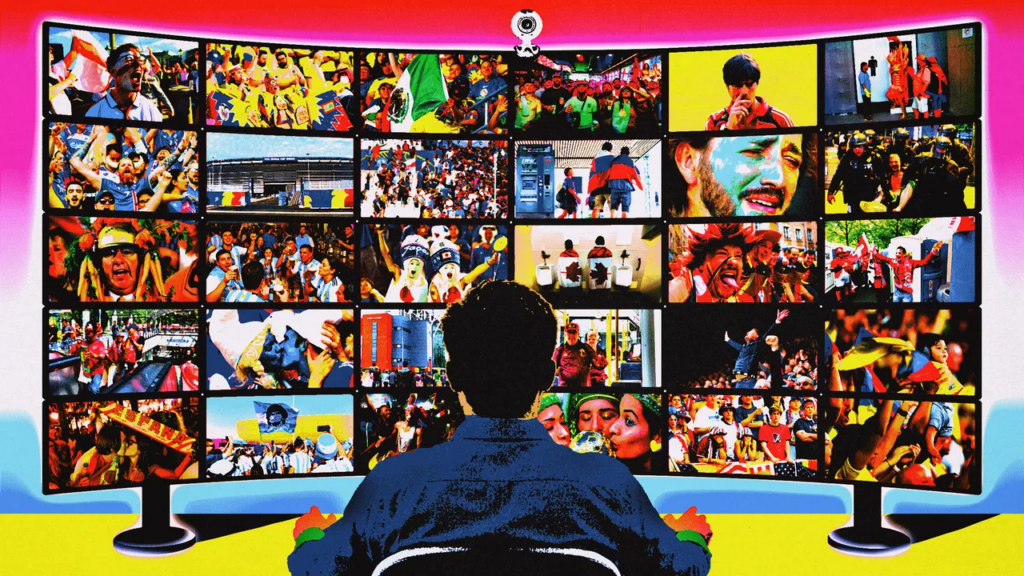
More than 5 million fans are expected to attend the 2026 FIFA World Cup taking place this summer across 16 venues in the United States, Canada, and Mexico. The stakes are high—and not merely on the pitch.
Experts have warned that heightened terrorism concerns linked to the war in Iran could be used by the Trump administration to justify the deployment of invasive surveillance technologies without adequate safeguards. Moreover, there are concerns that US Immigration and Customs Enforcement, which has an array of advanced surveillance technologies in its arsenal—from face recognition to spyware—could carry out aggressive immigration enforcement during the tournament.
Human Rights Watch, in turn, has urged FIFA to seek an “ICE truce” for the duration of the event, even as ICE’s eventual role remains uncertain.
“Security is often used as an excuse for agendas that have nothing to do with security at all—and in the Trump administration, that often means using surveillance systems to assist in the administration’s abusive and lawless deportation drive,” Jay Stanley, a senior policy analyst at the American Civil Liberties Union, tells WIRED.
Here’s WIRED’s complete guide to the 2026 FIFA World Cup.
The ACLU led a coalition of over 120 groups that issued a travel advisory for foreign nationals attending the World Cup in the United States, warning, among other things, of “increased surveillance.” Indeed, the list of surveillance technologies set to be deployed at the tournament is extensive, with drone and counter-drone systems expected to play a leading role.
Fortem Technologies says it inked a “multimillion-dollar” deal with the US Department of Homeland Security to provide its kinetic counter-drone technology for the tournament’s US venues. In addition, Sentrycs has reportedly secured multiple contracts with federal, state, and local agencies to detect and neutralize drones. Axon’s counter-drone technology will also reportedly be deployed at some venues.
In January, DHS announced the launch of a new office specially dedicated to “rapidly procuring and deploying drone and counter-drone technologies,” as well as a $115 million investment in such capabilities to help secure the tournament and the country’s semiquincentennial celebrations. The Federal Emergency Management Agency has also awarded $250 million to the District of Columbia and the 11 states hosting matches through the new Counter Unmanned Aircraft Systems (C-UAS) Grant Program.
“Many types of C-UAS tech focus on disrupting or intercepting radio signals from control devices such as phones,” says Jake Laperruque, deputy director at the Center for Democracy and Technology’s (CDT) Security and Surveillance Project. He adds that “it’s important to have transparency about what if any interception of phone data might be occurring, and how the government will treat such data if it is collected.”
In response to WIRED’s request for comment, a DHS spokesperson says that “federal resources will be deployed alongside the 11 host cities to ensure the security of each match.” The spokesperson adds that the agency is “working around the clock with federal, state, local, and international partners to ensure a safe and secure environment for players, fans, and communities hosting these events.”
AI-driven surveillance is also expected to play a central role during the World Cup.
Boston Stadium is rolling out AI-powered face recognition ahead of the tournament, allowing registered fans to enter the stadium and make purchases using their face. Other World Cup venues deploying similar technologies include Miami Stadium, and Atlanta Stadium.
Moreover, two AI-powered camera-equipped robot dogs will be deployed at the tournament’s International Broadcast Center in Dallas, while another two will be assigned to New York New Jersey Stadium.
In anticipation of the tournament, Kansas City announced last year it would pilot face recognition on local buses.
“The expansion of facial recognition technology ahead of the 2026 FIFA World Cup reflects a broader global trend of using major sporting events to normalize biometric surveillance in everyday life,” says Clara Lilley, senior digital campaigns officer at Privacy International, which recently published a report on the global deployment of this technology in soccer.
During the 2022 World Cup for example, more than 15,000 cameras monitored soccer fans across eight stadiums and on the streets of Doha.
Transparency around AI surveillance varies significantly by state and operator. Many venues do not clearly disclose whether face recognition is being used, whether systems are run by police or private contractors, or whether biometric data is retained after events.
“If facial recognition is being used for broad crowd scanning, that raises more serious concerns, given how often facial recognition systems make mistakes,” says CDT’s Laperruque.
Other types of technologies to be deployed during the World Cup include real-time intelligence and command platforms. Lenovo, FIFA’s official technology partner, will deploy an Intelligent Command Center using digital twins—virtual models of venues—to monitor crowd movement and manage operations in real time. Meanwhile, Booz Allen Hamilton stated that it would roll out its Sit(x) situational awareness platform at select venues, combining drone-collected data with real-time tracking of officers, vehicles, aircraft, and drones to support emergency response and crowd management.
Laperruque stresses the importance of knowing what types of tools these systems will use and what type of data will be collected. “Will there be use of IMSI-catchers, automated license plate readers, facial recognition, or other biometric identification systems? If data is being collected with these or similar tools, how long is it being retained, and how is it being used?”
In the other two World Cup host countries, there are concerns about the deployment of invasive technologies and the expansion of surveillance measures.
In Canada, Toronto unveiled a new CAD 12.5 million ($9 million) police command center and is expanding the use of body cameras for subway station staff, while Vancouver has installed 200 surveillance cameras as part of expanded security measures for the tournament. The surveillance measures prompted Ontario’s and British Columbia’s privacy watchdogs to urge officials in both cities to comply with laws governing surveillance systems during the event.
In Mexico’s Nuevo León state, meanwhile, authorities have deployed robotic security dogs around Monterrey Stadium to support patrols and crowd surveillance ahead of the tournament.
The 2026 FIFA World Cup comes after a heavily militarized tournament in Qatar that generated significant business for defense contractors. In 2017, the UK and Qatar announced plans for a “joint operational fleet” ahead of the 2022 World Cup, alongside Qatar’s $6.8 billion purchase of 24 Eurofighter Typhoon jets from BAE Systems.
Very little has been disclosed about security contracts for the 2026 tournament. However, a significant portion of the overall security budget could have gone to major defense contractors such as Anduril, Palantir, Lockheed Martin, and L3Harris.
“Defense companies are using major sporting events as a global showcase to normalize often battlefield-tested surveillance tools—such as facial recognition technology—for civilian life as safety solutions, turning stadiums into laboratories for technologies that were never designed with our rights in mind,” Ilia Siatitsa, lead of the Militarization of Tech Project at Privacy International, tells WIRED.
Analysts say the lasting threat lies in the permanence of supposedly temporary security measures. Surveillance technologies deployed for the World Cup can remain long after the final match—further dissolving the boundary between defense infrastructure and ordinary public policing.
“Our major concern, as always, is the potential for this technology to chill people’s civil liberties and the fact that surveillance infrastructure is just that: infrastructure,” says Matthew Guariglia, senior policy analyst at the Electronic Frontier Foundation. “It will outlast the current World Cup and leave cities with drastically more surveillance to be used on a day-to-day basis.
Clara Lilley of Privacy International agrees. Surveillance measures introduced during exceptional moments such as large sporting events often have lasting power. “These systems rarely remain limited to their initial purpose and could be used by the current or another administration to suppress civil liberties and human rights in the future.”
The post Soccer Fans, You’re Being Watched appeared first on Wired.