You’re reading Margin of Victory, a newsletter on the 2026 midterm cycle. Click here to get the full newsletter in your inbox, including Henry Olsen’s latest election analysis.
Henry Olsen is a senior fellow at the Ethics and Public Policy Center.
The early list of potential 2028 Democratic presidential nominees is pretty familiar. Former vice president Kamala Harris and California Gov. Gavin Newsom lead early polls, though Pennsylvania Gov. Josh Shapiro and Rep. Alexandria Ocasio-Cortez (New York) capture attention, too. Former transportation secretary Pete Buttigieg is young and politically talented, as is Sen. Jon Ossoff (Georgia). Like Ossoff, Kentucky Gov. Andy Beshear has proved he can win on red terrain.
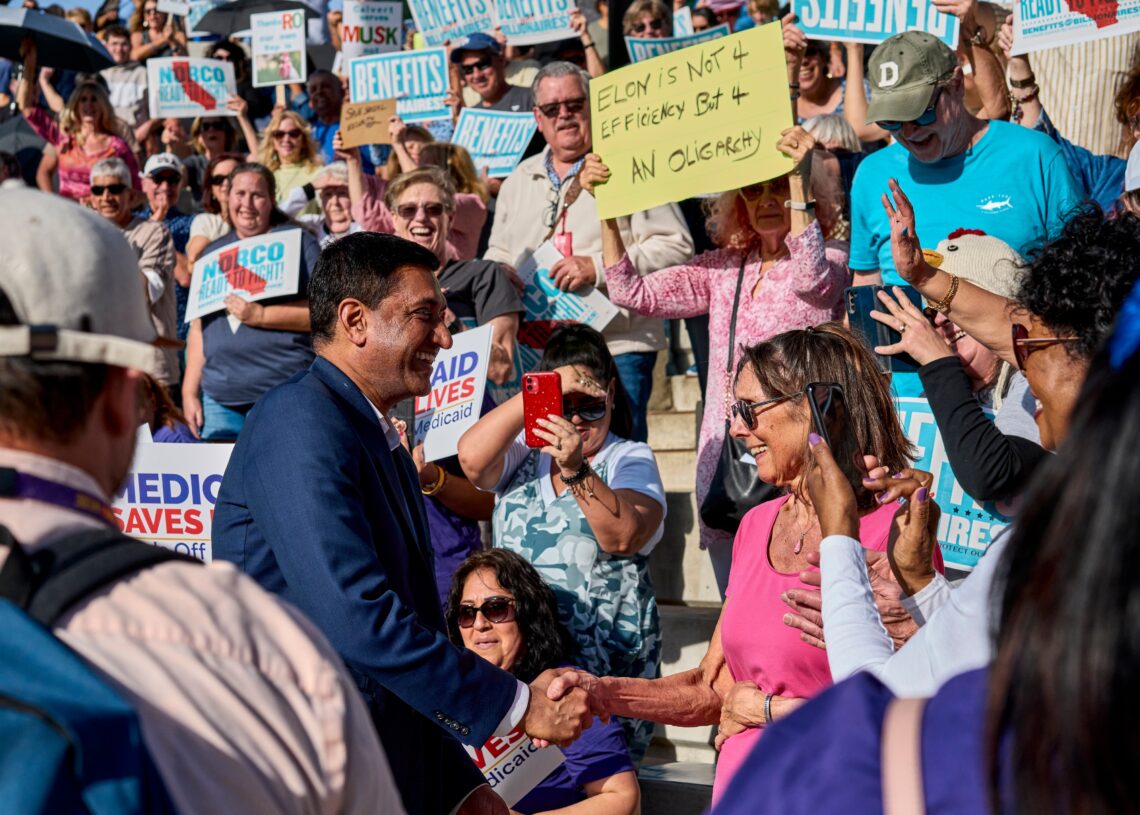
There are several others, but here’s a tip: Keep an eye on Ro Khanna, because his time in the sun is coming.
Khanna is a transparently ambitious, ultraprogressive congressman from Silicon Valley. He first ran for Congress in 2004, at 27, against long-serving Rep. Tom Lantos, and got annihilated. Many young men would leave the arena after such an uninspiring debut, but not Khanna. Instead, he picked himself up, cultivated ties among the Valley’s tech elite and served in President Barack Obama’s Commerce Department.
He found his opportunity for reentry in 2014. Once again challenging a longtime incumbent, San Jose’s Mike Honda, Khanna raised millions of dollars from industry titans such as Facebook’s Sheryl Sandberg. He lost narrowly, then handily won a rematch in 2016, and has served in the House ever since.
From there, Khanna could have followed a familiar, inside-game path, drawing on the important companies in his district to win clout in the halls of power. Instead, he almost immediately started to build a national reputation as an outspoken progressive advocate. Over years of appearances on Sunday talk shows, he has established a large national profile that’s rare for a junior House member.
His presidential ambitions have been no secret, and Khanna recently said he would consider a run after the midterms. He’s been extremely active in endorsing and campaigning for progressive candidates across the country, exactly what one would expect a potential candidate to do. He’s also broadened his appeal by teaming with archconservative Rep. Thomas Massie (R-Kentucky) to push for disclosure of investigative files on Jeffrey Epstein.
Democrats have not nominated someone coming out of the House for president since 1896, when progressive firebrand William Jennings Bryan (Nebraska) enthralled the party’s convention with his “Cross of Gold” speech. Modern campaigns reward those with national name recognition and fundraising ability, advantages that normally accrue to politicians who have served in the Senate or as a governor or vice president.
Khanna, however, already has those attributes. His fundraising prowess is stunning: He raised over $9 million last year, putting him behind only Speaker Mike Johnson (R-Louisiana), Democratic leader Hakeem Jeffries (D-New York) and progressive superstar Ocasio-Cortez in the House. He currently has nearly $17 million in his House bank account after adding $6 million this campaign cycle. That’s money he could roll over into a presidential bid.
But his biggest advantage is the wide-open lane on the party’s left. The front-runners are all straddling the line between the party’s center-left and left-wing factions, while people like Shapiro, Beshear and former Chicago mayor Rahm Emanuel look likely to campaign as centrists. No one has seized an unabashedly progressive message seeking to represent what 2004’s surprise contender, former Vermont governor Howard Dean, called “the Democratic wing of the Democratic Party.”
That lane is large and growing larger. Strongly progressive House candidates are popping up and performing well across the country. Chris Rabb and Adam Hamawy are the two most recent examples of victorious democratic socialists or ultraprogressives who won House primaries in safe seats, and many others are likely to do so over the next few months. Even losing candidates like Illinois’ Kat Abughazaleh and Junaid Ahmed won over 25 percent of the vote.
Each cycle’s surprise candidate typically emerges from a large party faction in search of a champion. In 2016, Donald Trump was the sole person campaigning against a stale party orthodoxy. Vermont Sen. Bernie Sanders’s emergence came from the Democratic left. In 2008 and 2012, respectively, then-Arkansas Gov. Mike Huckabee and former Pennsylvania senator Rick Santorum leaped to the forefront of the Republican race as unabashedly religious candidates. In 2008, Sen. Barack Obama (Illinois) found an electric “hope and change” lane in a year when a Democratic front-runner named Clinton appeared destined to succeed a Republican president named Bush.
This time around, all the evidence shows that perhaps as many as 40 percent of Democratic primary voters want an unabashed progressive at the top of the ticket. Khanna will be knocking on an open door if — when — he enters the race.
Ocasio-Cortez is his main obstacle. She is better known than Khanna, and her fundraising prowess dwarfs even his. If she got in, she would immediately own the progressive lane. But fortune favors the brave, and if Khanna plunges into the race in January while Ocasio-Cortez dawdles, he could steal much of her constituency before she makes up her mind.
And don’t underestimate Khanna’s chances of winning the nomination should he capture the left’s imagination. The establishment only beat Sanders in 2020 when center-left candidates like Buttigieg and Sen. Amy Klobuchar (Minnesota) dropped out right before Super Tuesday to give Joe Biden an opportunity to consolidate that lane.
I doubt Harris, Newsom and Buttigieg would make such a pact before the early contests, and they may all do well enough to give them reason to stay in through Super Tuesday. Under the Democratic Party’s delegate-allocation rules, a progressive candidate who wins 35 to 40 percent in big contests against a fractured field could build a nearly insurmountable lead by mid-March.
Perhaps this is what former Biden insider Ron Klain sees, too. Politico reported this week that he has been advising Khanna, which can only have national implications given Khanna’s safely Democratic House seat. Expect to see other savvy party insiders make similar moves if AOC remains unclear about her 2028 intentions.
Plenty of candidates have looked good on paper but stumbled trying to make the leap to the big stage. But this much is clear: There is a big lane in the 2028 Democratic presidential nomination race that’s still open to an ambitious and talented politician, and Khanna has never been shy about taking risks to meet the moment.
The post Harris, Newsom, Buttigieg, Shapiro … Early polls overlook a name. appeared first on Washington Post.