First Ukraine assembled an arsenal of millions of drones that, along with Russia’s own buildup, turned a 25-mile-wide strip along the front line into a killing ground. Then Kyiv expanded its reach deep into the Russian heartland as it targeted oil infrastructure and military factories, making long-range violence in the war a two-way street.
Now, Ukraine is focusing on the middle ground — the critical roads and railways, in some cases more than 100 miles from the front, that feed Russian troops and matériel into battle. Kyiv is calling the effort a “logistics lockdown,” and it is systematically reshaping the battlefield, at least until Russian forces find a way to adapt.
Ukraine is wreaking havoc on unarmored trucks and trains in the battlefield’s rear, using drones with upgraded engines and batteries, integrated Starlink communication systems and new artificial-intelligence capabilities. The ramped-up attacks are causing fuel shortages, complicating troop rotations and reducing Russian military activity on the front.
May was the first month since 2023 in which Russia suffered a net loss of territory, according to the Ukrainian research group DeepState. On Monday, Gen. Oleksandr Syrsky, the top Ukrainian military commander, said Ukraine had reclaimed in May nearly 40 square miles more than it lost.
The attacks on Russian logistics are part of a synchronized, multilayered campaign that covers the close-in “kill zone,” the midrange resupply zone in Russian-occupied parts of Ukraine, and the territory far inside Russia where Ukraine has hit sites producing crucial weapon technology.
“That’s what’s new, and that’s what is really hurting the Russians,” said Mick Ryan, a retired Australian general who is a fellow at the Lowy Institute, a research group in Sydney.
The coordinated campaign has made it hard for Moscow to generate momentum, with its spring and summer offensives so far failing to achieve notable results.
Ukraine produces so many drones from its own factories that it can now launch more than 5,000 mid- and deep-range strikes every month, according to Ukrainian officials. Late last week, Ukraine’s defense minister, Mykhailo Fedorov, said that Ukrainian forces last month carried out twice as many strikes at least 30 miles from the front line as they did in April.
The Institute for the Study of War, a Washington think tank, found in a recent assessment that such strikes were helping to push the conflict into a new phase.
As the forces operate systems “capable of disrupting Russian forces throughout their operational depth,” according to researchers at the think tank, Ukraine has a “unique and time-constrained opportunity” to mount the sort of mechanized offensives that have become very difficult because of the threat of drones.
Jack Watling, a senior fellow at the Royal United Services Institute, a research group in London, wrote in Foreign Affairs that the war had reached a turning point, arguing that as Russia’s battlefield performance worsened, Ukraine had a chance to push Moscow toward a cease-fire.
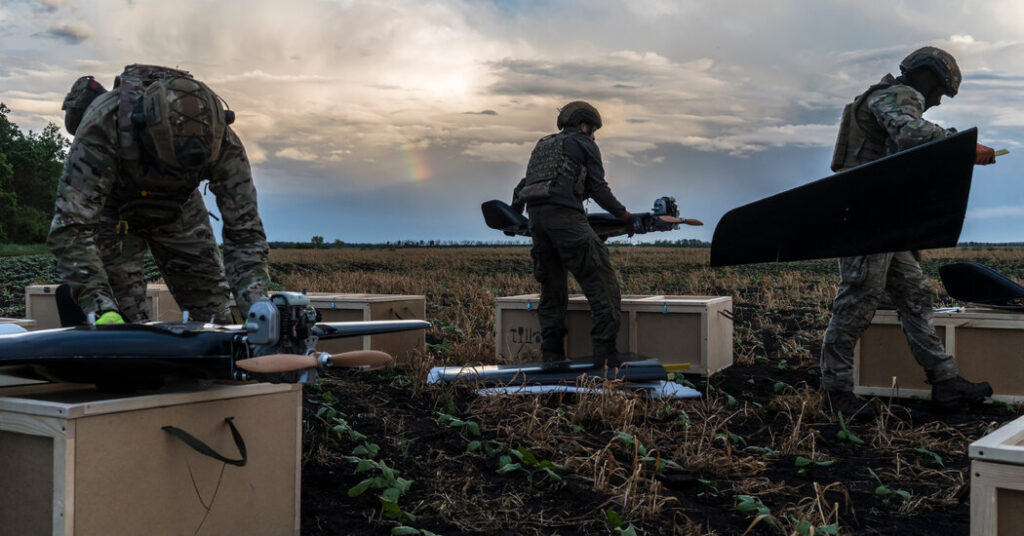
In a field in Ukraine late last month, the commander of the Second Battalion of the First Separate Unmanned Aerial Systems Center said it was critical to seize the moment because the Ukrainian military’s advantage might not last.
As long as it does, “the main idea is for Russia to truly feel war, to know that distance does not provide safety,” said the commander, who under Ukrainian military protocol gave only his call sign, Whale.
As he spoke, soldiers scrawled messages of retribution on the wings of a dozen drones, each packed with thermobaric explosives.
The next day, Ukraine’s General Staff announced successful strikes on Russian oil refineries, warehouses and air-defense systems in Russia and in occupied Ukraine.
Even as Ukraine finds itself in a hopeful moment, steep challenges remain.
Russia continues to ravage the cities in eastern Ukraine that make up the spine of its defense of the Donbas, the region most coveted by the Kremlin. After an intense campaign of strikes on Ukraine’s energy infrastructure last winter, Ukraine is concerned about a humanitarian catastrophe if the war drags into another brutal winter.
President Volodymyr Zelensky warned recently that Ukraine’s dwindling supply of Patriot air-defense interceptors had reached critical levels and that Moscow was taking advantage of that vulnerability to pummel Kyiv and other cities.
Ukraine’s ability to maintain its momentum, soldiers said, depends on continuing to scale up weapon production.
The defense minister, Mr. Fedorov, announced plans in May to spend more than $113 million to develop weapons for the “logistics lockdown” campaign.
More broadly, European nations have allocated $1.63 billion to Ukrainian drone production this year, outstripping the financing for all of 2025, according to the Kiel Institute, a German think tank.
For years, Ukraine begged its allies for weapons that could strike from a distance. But the Western platforms it received were limited by scarce ammunition, geographic restrictions intended to avoid escalation, and a technical inability to track and strike moving targets.
So Ukraine focused its energies on developing a homegrown defense industry.
An executive from the Ukrainian company that makes the Bars jet-powered drone said that in 2024, the company received a contract to produce 112 long-range strike drones that year. Its most recent contract, he said, is for 25,000 drones capable of long- and midrange strikes.
The official, who spoke on the condition of anonymity out of concerns for his safety, said that, critically, Ukrainian companies had all agreed to share technological and tactical advances through a mechanism set up by the Ministry of Defense.
The campaign aimed at Russian logistics is having its most visible results along the southern front, where geography favors the Ukrainians.
The area includes Russia’s so-called land bridge to occupied Crimea, and Moscow relies on a roughly 185-mile stretch of exposed highways to supply its forces. On Monday, the Ukrainian military said its drone operators had established aerial control over a section of the land route used by Russian forces, significantly complicating “logistics related to supplying the Russian Army and fuel deliveries” to Crimea.
The only other connection between Russia and Crimea is the Kerch Bridge, which has come under repeated Ukrainian attack.
At the start of this year, Ukraine formulated a plan to isolate Russian forces, the commander of unmanned-systems forces in the First Azov Army Corps said in a statement.
By spring, he said, he was able to see the captured city of Mariupol — more than 60 miles from the front — through the lens of a piloted drone.
The Ukrainians modified a drone known as the Hornet to target Russian logistics. Because Hornets carry relatively small explosive payloads, they cannot penetrate heavily fortified or underground Russian ammunition warehouses. But, unlike missiles and bombs, the drones are controlled by a pilot, allowing Azov operators to target unarmored transport trucks and trains.
Fortified sites are attacked by other weapons, like powerful glide bombs. Ukraine recently announced the first successful test of a domestically produced glide bomb, which it said was capable of hitting targets, including fortified ones, “dozens of kilometers” away. Russia has used such bombs to devastating effect as it has razed Ukrainian cities.
The Ukrainian military claims to have struck hundreds of midrange targets over the past month. An independent Ukrainian open-source investigative project, Tochnyi, geolocated 130 strikes in May on military vehicles and supply-chain structures about 20 to 100 miles from the front.
The Azov commander said it was impossible for Russia to stretch out its air defenses and soldiers over the ever-growing distances that Ukrainian piloted drones could travel.
Liubov Sholudko contributed reporting
The post A Twist in Ukraine’s Drone Campaign Is ‘Really Hurting the Russians’ appeared first on New York Times.