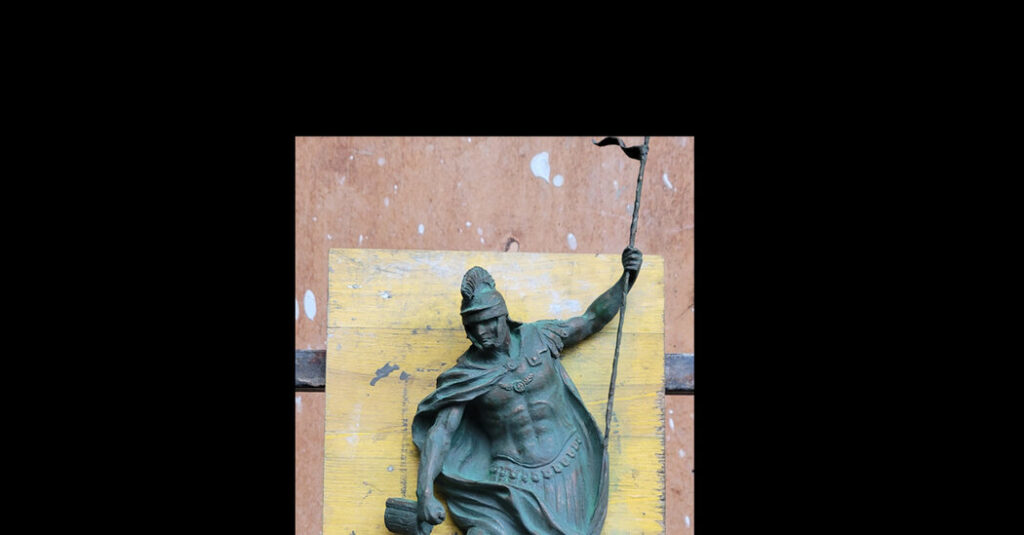
As a gleaming new police and fire headquarters took shape last year in Quincy, Mass., Mayor Thomas Koch prepared to unveil what he considered a perfect finishing touch: towering bronze statues of St. Michael and St. Florian, patron saints of emergency responders, to stand at the building’s entrance.
Intent on his vision of municipal grandeur, Mr. Koch had not sought approval from voters before he commissioned an artist in Italy to craft the 10-foot figures, at a cost of $850,000 in city funds, and booked their trans-Atlantic passage.
Their arrival in Quincy, a diverse city of 100,000 just south of Boston, did not go exactly as he had hoped.
After a local newspaper, The Patriot Ledger, published the mayor’s plans for the statues in an article last year, 200 people showed up at a City Council meeting to voice their displeasure. More than 1,500 signed an online petition opposing the statues’ installation. A group of 19 local clergy members, representing Lutherans, Jews, Methodists, Catholics and other faiths, issued a statement of concern.
“No single religious tradition should be elevated in a publicly funded facility,” they wrote. “Erecting these statues sends a message that there are insiders and outsiders in this community.”
The uproar — which soon led to a lawsuit against the city, filed by a dozen residents and backed by the American Civil Liberties Union — reflected growing frustration with Mr. Koch, who has been mayor since 2008. Once dominated by working-class Italian and Irish immigrants who labored in its granite quarries, Quincy has welcomed waves of Asian immigrants since the 1980s. Nearly half its population is nonwhite, 40 percent of students in its public schools are Asian and the student body speaks more than 60 languages.
Mr. Koch, a Catholic who left the Democratic Party in 2018 over its support of abortion rights, has recently been embroiled in a string of controversies, and has increasingly been seen by critics as tone-deaf and out-of-touch. Last fall, voters ousted five city councilors viewed as his allies; Mr. Koch was not on the ballot.
“People have been digging in their heels, and not making space for newer people,” said Maggie McKee, a newly elected council member who is half Asian and half white. “Now folks who have been here, who have never felt excluded, are seeing some resistance to what they want to do, and it’s very scary and threatening to them.”
The plaintiffs in the lawsuit include a former Catholic who is now an atheist; a Harvard Divinity School graduate; a Jewish resident who said the statues would make her feel “excluded from the ‘in group’”; and a practicing Catholic who said she resents the city for putting her in the uncomfortable position of having to speak out against her own church’s symbols.
The suit argues that displaying the statues in front of a city building would violate the State Constitution — written largely by Quincy’s most famous son, John Adams — by promoting one religion over others and “religion over nonreligion.” A lower court temporarily blocked the statues’ installation last fall; they have been exiled to a suburban warehouse while the Massachusetts Supreme Judicial Court considers the case.
Still, the statues have plenty of supporters. Hundreds of Quincy police officers and firefighters of various faiths consider them unofficial mascots, and many older, longtime residents say that alone should be reason to support them.
“I’m all for it,” said Margaret Notrangelo, a retiree and Quincy native who was shopping for groceries one recent evening near the new public safety building. “I’m Catholic, but it’s not about religion. It’s about what the statues represent to the police and firemen.”
In a brief filed in support of the city, Tom Bowes, the president of the Quincy firefighters’ union, said that St. Florian embodies “the virtues that are most important in our work: honor, courage, bravery.” The statue depicts the saint as a caped figure dousing a fire with a pitcher of water; its bronze counterpart, St. Michael, is raising a sword as he steps on a demon.
A lawyer for the police and fire unions asserted in the brief that banning the statues would prioritize a secular viewpoint over that of residents who value the saints’ symbolic or religious meaning.
The controversy is the latest to entangle Mr. Koch, 63, the longest serving mayor in Quincy’s history.
Last year, he paid to settle a state claim that he took illegal campaign donations; he also apologized for characterizing abuse by Catholic clergy as “homosexual problems, not pedophilia.” In 2024, he faced outrage after the City Council granted him a 79 percent raise — to $285,000, more than the current New York City mayor’s salary — starting in 2028. (The mayor later proposed a smaller increase.)
A spokeswoman for the mayor referred questions to a spokesman for the law firm defending the city in the lawsuit, who said Mr. Koch would not be available for an interview. Neither responded to follow-up questions.
The firm, the Becket Fund for Religious Liberty, has played a prominent role in a flurry of recent cases around the country asserting religious rights.
In a hearing last month before the Supreme Judicial Court, Joe Davis, a Becket Fund lawyer, argued that the two saints depicted by the Quincy statues are not primarily religious symbols when displayed in a public safety context, because of their long association with police officers and firefighters.
“They have a significance that has transcended religious lines,” Mr. Davis said.
Frank Gaziano, a justice on the court, questioned if the average citizen would know their secular relevance, or would more likely see “this big angel smiting a demon” and regard it as “overwhelmingly religious.”
Another justice, Scott Kafker, noted that recent rulings by the U.S. Supreme Court have vigorously protected religious freedom. “We can’t allow more hostility to religion than the Supreme Court would tolerate,” he said.
“Government neutrality is not the same as hostility,” said Jessie Rossman, the A.C.L.U. legal director representing the plaintiffs.
The new police and fire complex, an imposing, four-story building fronted by soaring columns and ornate lanterns, cost the city $175 million. It opened to the public in March.
Conevery Valencius, a college history professor and Quincy resident who is a plaintiff in the lawsuit, said she wanted the building to feel welcoming to everyone, including new immigrants.
A devoted Episcopalian, she said that her childhood church, named for St. Michael, taught her to “respect the dignity of every human being,” a standard she believes the statues’ presence would violate.
“When people are scared and they need help,” she said, “they need to know that place is for them.”
The post A Catholic Mayor Commissioned Statues of Saints. Residents Revolted. appeared first on New York Times.