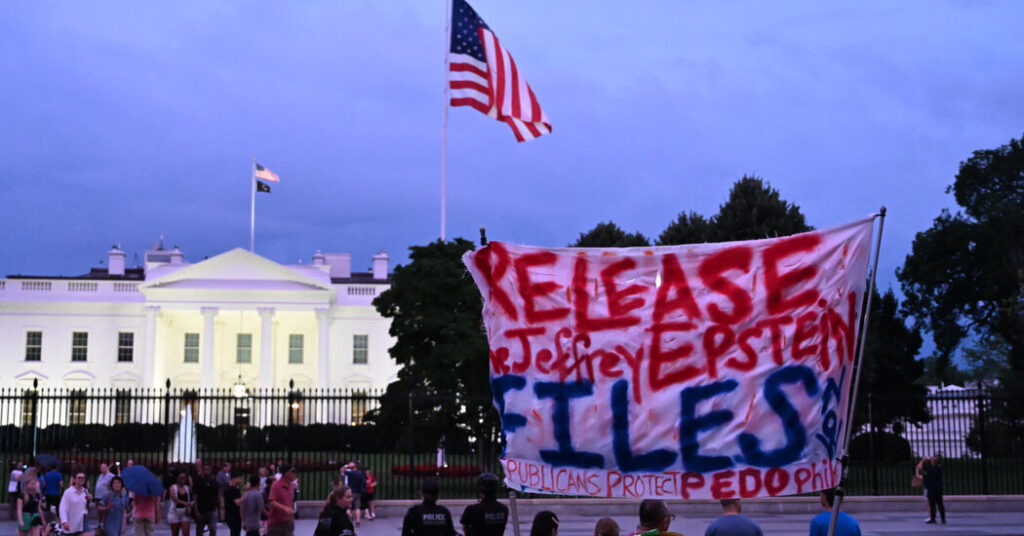
Last summer, as pressure mounted on the Trump administration to release material it held on Jeffrey Epstein, the president’s top advisers gathered in a series of meetings, many of them in the White House Situation Room — typically used during national-security crises — as they struggled to contain a scandal engulfing Donald Trump himself. The discussions included the vice president, JD Vance; the White House chief of staff, Susie Wiles; the White House counsel, David Warrington; the deputy attorney general, Todd Blanche; and the F.B.I. director, Kash Patel, among others.
The reporting, which documents many previously undisclosed conversations and conflicts, is drawn from our forthcoming book “Regime Change: Inside the Imperial Presidency of Donald Trump.” We discovered how the Epstein files consumed and often paralyzed the highest levels of the Trump administration, far more than the public knew.
Here are six takeaways from the article in The Times Magazine.
The government’s national-security bunker became an Epstein war room.
The secure Situation Room complex, where President Obama and his team monitored the raid that killed Osama bin Laden, became the setting for a string of meetings in which the Trump administration’s most senior officials gathered — without the president — to manage the fallout from public fury over their failure to release the Epstein files. To their surprise, much of that backlash was coming from what they had considered the reliably loyal MAGA base.
As the calls for disclosure grew louder, Trump’s inner circle spent more and more time in the Situation Room, which became inseparable from the crisis — a guarded space used not to weigh a foreign threat but to steer the president around a political problem concerning a notorious dead pedophile.
The officials knew that prominent people, including Trump, were named in the records of F.B.I. agents’ interview notes with witnesses, some of whom were Epstein’s victims. While many of the claims made in the notes were not corroborated evidence, releasing them was, for most of the president’s advisers, a nonstarter.
The president wanted the whole thing buried.
Trump made clear to his aides that he had no interest in releasing anything related to Epstein. He snapped at anyone who raised the issue, and his staff mostly learned to avoid the subject in front of him. They were left to worry and plan among themselves. The president’s refusal to acknowledge that a crisis existed, let alone that it was growing, complicated every path his team wanted to take.
As The Wall Street Journal prepared a damaging article about his relationship with Epstein, the president tried to kill it. He called News Corp.’s chief executive; its owner, Rupert Murdoch; and the paper’s editor in chief, Emma Tucker. The president, practically shouting as he threatened to sue, told Tucker, who is British, that she must “hate America.” When his efforts to stop the article failed and his advisers settled on a limited gesture of transparency, the president went along grudgingly.
Vice President JD Vance wanted to release all the files — even the unsubstantiated material about Trump.
Within the White House itself, no one was more vocal about releasing the Epstein material than the vice president. “This is a huge problem,” Vance told colleagues in the Situation Room. Others thought he appeared panicked about how the issue was splintering the MAGA coalition. Wiles would later describe the vice president to associates as an Epstein conspiracy theorist.
Vance pressed repeatedly for the administration to release everything — even unsubstantiated material about Trump — arguing that Congress would force the issue eventually and that getting ahead of it would earn the White House credit for transparency.
He floated the idea of enlisting Tucker Carlson to interview Ghislaine Maxwell, Epstein’s longtime girlfriend and co-conspirator, in prison, and fretted to colleagues about how the crisis was alienating the young, low-propensity voters who had backed the Trump-Vance ticket in 2024. But the vice president’s suggestions were far from popular with the core Trump team, and most of them went unheeded.
Expletive-laden blowups fractured the top of the Justice Department.
The lingering distrust between Pam Bondi, then the attorney general, and the F.B.I.’s top two officials — Kash Patel and Dan Bongino, then his deputy — exploded over the Epstein controversy.
The day the Justice Department released a memo intended to put the Epstein matter to rest, Bongino marched into a daily meeting and erupted at Bondi. He and Patel told White House officials that Bondi should resign; at a later meeting, the two said they suspected that she had leaked damaging stories about them. When Wiles accused Bongino of a leak of his own, he stormed out of the Situation Room complex. Bongino privately warned associates that the Epstein crisis would become “President Trump’s Iran-contra.”
Advisers found themselves having a surreal debate over an unverified allegation about Mr. Trump.
At an August meeting in the Situation Room, one of the president’s senior aides raised an uncorroborated and secondhand claim that had been made nearly a decade earlier, about Trump aggressively flicking and sucking a young woman’s nipples until they “looked incredibly painful.”
The claim about Trump had surfaced in 2024 in unsealed court filings from a civil suit unrelated to him, and when the matter was raised by another official, Vance argued for including this and many other accusations on the Justice Department’s website, saying that it would show maximum transparency and that Trump wouldn’t mind, given that he had been accused of worse. Wiles shut that down, saying the president would not, in fact, be fine with releasing it. One official later said it was “surreal” to be debating the nipple accusation in the White House Situation Room.
More than a year later, the files were still damaging the president.
In late March 2026 — a full year into the White House efforts to manage the fiasco — a confidential memo from Trump’s pollster, Tony Fabrizio, summarized responses from focus groups conducted with voters earlier that month, in which the Epstein files ranked as the sixth most important political issue, ahead of crime, the military and being pro-working class. The memo flagged the Epstein issue as “a real negative with some of these voters.”
The post 6 Takeaways From the Story of How the Epstein Files Paralyzed the White House appeared first on New York Times.