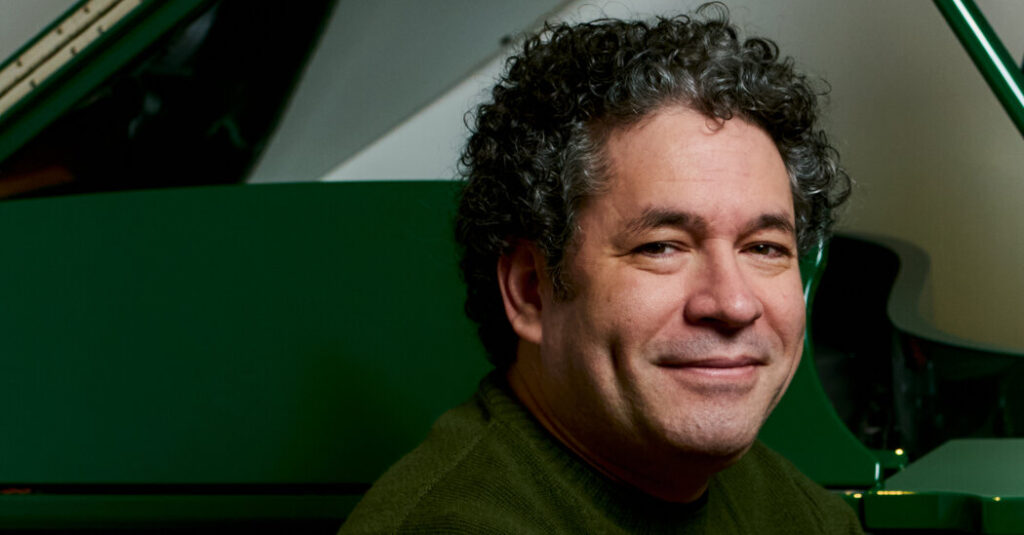
There was “Bravo Gustavo!,” a musical tribute that John Williams wrote for his friend Gustavo Dudamel, the outgoing music and artistic director of the Los Angeles Philharmonic, which premiered the piece while Williams cheered from his fifth-row seat at Walt Disney Concert Hall.
There was a new production of Wagner’s “Die Walküre,” led by Dudamel and with sets by Frank Gehry, another friend and collaborator of the conductor’s.
And last week, the audience laughed and clapped as Dudamel nestled his head onto the shoulder of the cellist Yo-Yo Ma (also a friend) as they sat together and played music boxes during the premiere of Angélica Negrón’s concerto “Mundillo.”
In all, Dudamel’s farewell to Disney Hall was a three-week extravaganza of concerts, operas, stage-filling choruses, poetry, commissions by new composers (with an emphasis on Latino artists), favorites by old composers and a blur of curtain calls that ended on Sunday. It was an appropriately frenzied encapsulation of his time in Los Angeles, 17 years in which he established himself as a force not only in music, but also in the life of this city.
“All of these three weeks embrace — are a symbol — of all of what we have been doing these years,” Dudamel said in a recent interview between rehearsals. “This orchestra is a very virtuosic orchestra with a very warm sound, open to be flexible to play all styles of music. Maybe that can be part of the legacy that I can leave, and also what is coming from the past.”
At the concert on Sunday, Dudamel received an ovation — from the crowd, his players and the chorus — that lasted for nearly 12 minutes. He wove through the orchestra, hugging and shaking hands, before blowing a final kiss to the players, waving to his audience and exiting to the left of the stage.
Dudamel has another goodbye to come at the Hollywood Bowl in August, with his truly final concerts concluding an exit that has stretched out for nearly three years. Soon after those performances, he will officially begin his tenure as music and artistic director of the New York Philharmonic.
For whatever questions there may have been when the Los Angeles Philharmonic took a chance on Dudamel, a 28-year-old Venezuelan, in 2009, he has left a major imprint on the orchestra. He has appointed 54 of the orchestra’s 106 members. He helped established the Youth Orchestra of Los Angeles as a beacon for young aspiring musicians, particularly from the less wealthy parts of the region, and a source of pride for their families. (Six current and past members of the youth orchestra appeared at Sunday’s concert to recite “América,” a work of prose and poetry by the Mexican novelist Guillermo Arriaga.)
Dudamel has embraced canonical, audience-favorite composers like Mahler, Mozart and Beethoven. But he championed with perhaps even more fervor adventurous composers such as John Adams, Philip Glass and Ellen Reid, who wrote “Earth Between Oceans” for both the Los Angeles Philharmonic and the New York Philharmonic this season.
“Some musicians or conductors might have felt afraid of the way the piece is sort of crazy,” she said. “He leaned into the energy of it. And the orchestra threw it back to him — in both cities. He is striving to make different pathways for people, to keep the music alive and keep it contemporary in all the way he can.”
And from Dudamel’s first year in Los Angeles, when he presented the Americas and Americans festival, he has highlighted music by Latino composers, such as Roberto Sierra and Gabriela Ortiz — who has received nine commissions from the orchestra under Dudamel, including “Mujer Arena,” which premiered on Thursday.
“He has been remarkably open to ideas, out-of-the-box ideas,” said Esa-Pekka Salonen, Dudamel’s predecessor, who led the Philharmonic from 1992-2009 and was in the audience on Sunday. “If you look at his legacy, apart from very great concerts, there were lots of commissions, a really intense commitment to new music and new composers. His support for Latin American composers has been stunning. He’s going to leave a very, very vibrant, dynamic orchestra to his successor.”
And Dudamel, with his unusually high profile — a celebrity in a city filled with celebrities — changed the way people thought about classical music in Los Angeles. He challenged the elitist stereotype of the intimidating orchestra leaders; Salonen said that when Dudamel once took him barhopping on the east side of Los Angeles, ending at a bar vibrating with salsa music, “everybody knew him.”
“The Latino community,” Salonen added, “people talk to him, and with such pride.”
Dudamel had his critics, who suggested that he was more flash than substance, a celebrity on a classical stage who never really evolved. In The Wall Street Journal, the critic David Mermelstein wrote that Dudamel’s “youthful enthusiasm remains intact” but questioned the depth of his accomplishments at the podium and lamented a “hype machine that ceaselessly sings his praises.”
“Mr. Dudamel seems not to have matured on the podium,” Mermelstein wrote. “His strengths — the excitement and bold orchestral colors — and his weaknesses — an unfortunate lack of narrative cohesion and distinctive point-of-view — remain little changed from when he arrived.”
But Eric M. Garcetti, the former Los Angeles mayor, who played piano with Dudamel at a Disney Hall concert featuring Moby, said Dudamel had established himself as a cultural pillar of the city. “When he first came here he was a young, enthusiastic Latino in a Latino community,” he said. “I don’t think the newness of Dudamel ever wore out.”
Dudamel said that from his earliest days, Los Angeles audiences proved receptive to music that swerved beyond the comfortable classical diet. By the time he steps down, he will have conducted 62 premieres of works commissioned by the Philharmonic, and led programs featuring Latino music, jazz, salsa and pop. He collaborated with the Deaf West Theater on a production of Beethoven’s opera “Fidelio” for both hearing and deaf operagoers.
“When I came here, a lot of this music was kind of exotic,” Dudamel said. “And I think it’s not anymore exotic. Right now, it’s something that has become part of the repertoire.”
Dudamel and the Philharmonic performed at the Coachella Valley Music and Arts Festival in 2025, sharing a bill with, among others, LL Cool J and Dave Grohl of the Foo Fighters. He took the youth orchestra to the Super Bowl in 2016, playing with Coldplay at halftime.
“Gustavo can give you a Mahler from memory at Disney Hall any time,” said Emmanuel Ceysson, the Philharmonic’s principal harp. “And the next day he is giving you Carlos Vives at the Hollywood Bowl with the same involvement and joy. And it doesn’t feel wrong or disingenuous in any way, doing the light stuff. I admire that so much.”
Sunday’s concert suggested the range of Dudamel’s interests: Adams’s “Harmonium” and “Cantata Criolla,” a work by Dudamel’s countryman Antonio Estévez based on a Venezuelan poem.
Deborah Borda, the Philharmonic’s former president and chief executive, who recruited Dudamel for the job (and brought him to his next job in New York), said that Dudamel had “broken down barriers and placed the L.A. Phil in the hearts of Angelenos.”
Kim Noltemy, the orchestra’s leader today, said Dudamel’s successes at drawing new audiences had contributed to the Philharmonic’s financial standing. “He embraces the idea of working with all types of music,” she said. “That’s part of his DNA. Others do it; he has consistently done it over and over. It is a core part of his thinking.”
Still, even after four nights at the Hollywood Bowl this August, followed by a flight back to New York, Dudamel won’t really fade away from this philharmonic. He will be the orchestra’s artistic and cultural laureate, helping to plan future seasons and choose guest artists and conductors. He is set to lead the ensemble up to four weeks per season. And he said that he is planning to keep a home in Los Angeles.
“I feel part of Los Angeles after 17 years,” he said. “I am part of this community and will be part of this community as I’m going to New York. We can be a bridge between two coasts that are always like, ‘I’m better, you’re better, no I’m better.’ Let’s see more of the common things than the different things.”
Adam Nagourney is the classical music and dance reporter for The Times.
The post With an Extravaganza, the Dudamel Era in L.A. Approaches Its End appeared first on New York Times.