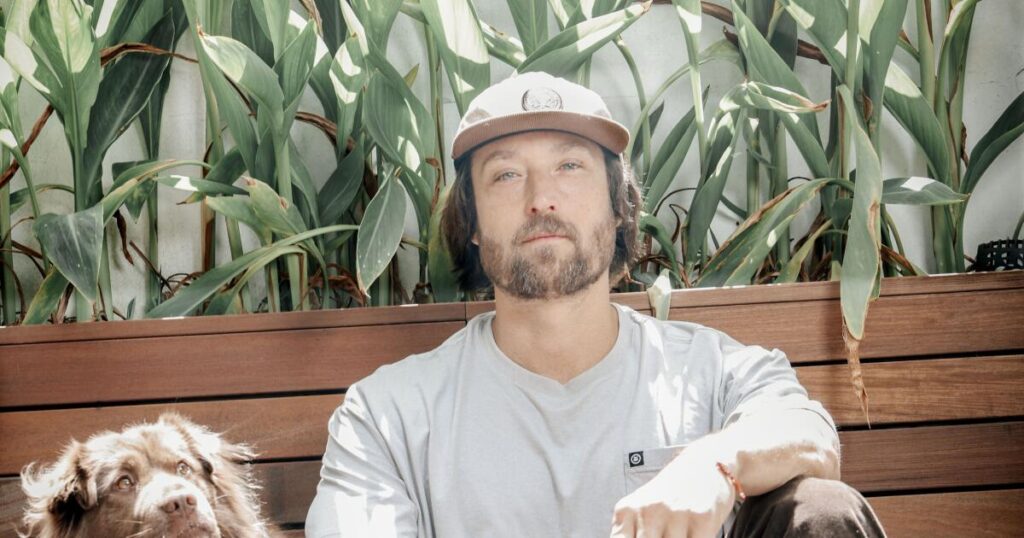
The SoCal reggae act Stick Figure is, in a way, glad the single “Run Run River” made a huge impression.
Stick Figure, founded by singer-songwriter Scott Woodruff in San Diego in the mid 2000’s, has earned billions of streams over eight albums as an independent act, with a lucrative touring career. In 2022, Billboard called Stick Figure “the world’s top selling living reggae artist.” When “Run Run River,” a composition by Woodruff and his writing partner TJ O’Neill, unexpectedly went viral in late April, it hit No. 2 on Shazam, suggesting tens of thousands of curious new fans. It racked up tens of millions of plays on streaming services and social media.
Except “Run Run River” wasn’t released by Stick Figure. It was an AI-manipulated version of the band’s 2019 single “Angels Above Me,” sped up with a tweaked lead vocal and a dance-music kick drum. Stick Figure wasn’t mentioned anywhere, but someone was making thousands of dollars off its viral success.
“They didn’t credit us. We were just being ripped off,” Woodruff told The Times. “Someone’s making all these royalties and we thought we would never be able to get ahold of this.”
Stick Figure’s team spent weeks swatting down “Run Run River” online and steering attention back to the actual artist. But the fake song’s uncanny popularity is a problem for musicians, labels and streamers. Records can now be manipulated by AI, at scale, and repackaged for profit without credit.
Streamers and social media can only catch so much fraud. Some are even embracing the practice with legal guardrails. Where’s the line between a fan’s AI-driven remix, and a scam?
“This is a song that we wrote. Real humans, real emotion. These are our melodies, these are our words, and it’s still connecting with people on a global scale,” Woodruff said about the viral fake track. “That’s kind of an honor, in one aspect.”
Cheaply made, often fraudulent AI music has deluged streaming services. Created on prompt-driven services like Suno and Udio, tracks are uploaded to YouTube, social media or Spotify through services like Tunecore or DistroKid. In April, the streamer Deezer estimated that 75,000 AI-created tracks are uploaded every day, 44% of all music added there. Eighty-five percent of those tracks are fraudulent and demonetized, the company said, even if they attract less than 3% of user streams.
“AI-generated music is now far from a marginal phenomenon,” Deezer’s chief executive, Alexis Lanternier, said in a statement. “We hope the whole music ecosystem will join us in taking action to help safeguard artist’s rights and promote transparency for fans.”
Last year, Spotify removed 75 million spam AI songs from its service. “AI can be used by bad actors and content farms to confuse or deceive listeners, push ‘slop’ into the ecosystem, and interfere with authentic artists working to build their careers,” the service said. “That kind of harmful AI content degrades the user experience for listeners and often attempts to divert royalties to bad actors.”
In March, in a first-of-its-kind case, Michael Smith of North Carolina pleaded guilty to a federal wire fraud charge, in a wide-ranging scheme where he built over a thousand accounts to automatically stream 100,000 AI-generated tracks he created, making $8 million in royalties from services like Spotify and Apple Music.
“Although the songs and listeners were fake, the millions of dollars Smith stole was real,” U.S. Attorney Jay Clayton said, announcing the plea deal. “Millions of dollars in royalties that Smith diverted from real, deserving artists and rights holders. Smith’s brazen scheme is over, as he stands convicted of a federal crime for his AI-assisted fraud.”
That maelstrom of slop can impact artists’ lives.
“It is growing and a real risk to artists and other rightsholders alike,” said Björn Lindvall, the co-founder of music-publishing giant Hipgnosis Songs and chief executive of the music-rights tech firm MusicInfra.“With the ability to modify or generate music, it may well be that we turn millions, or even billions, of people into music creators. However, the amount of data going through the pipes in the music industry will also explode.”
“Angels Above Me’s” zombified second life began in Pretoria, South Africa, where a popular local radio host began to play the soulful and yearning 2019 single. Stick Figure suddenly became a well-known act in South Africa.
This year, a South African TikTok user, @MDBHouse, uploaded a new version of the song, lightly edited to evade track-identification software, and retitled it with the song’s opening lyrics — “Run, run, river, carry me home to the ocean.” (MDB did not immediately respond to a request for an interview.) On YouTube, MDB describes their channel’s aesthetic — “You’ll find creative remixes, fresh edits, DJ-style reworks, and exclusive versions of tracks you know — all with the MDB sound.” They didn’t credit Stick Figure, but the edit spread into a network of AI-edited music accounts as it took off on social media.
Stick Figure’s managers at Ineffable Music saw a big problem, both for lost revenue and Stick Figure’s reputation as an artist. First, they had to lobby distributors and streaming sites to acknowledge the knockoff single was fraud, and not a formal cover or a remix.
“A derivative AI clone made in an unauthorized way can inherently not be a cover,” said Ineffable’s Thomas Cussins. “They took the original song, they tweaked the waveforms to bypass the very weak guardrails the AI companies put on their software to stop this, and uploaded it without any credit. If you’re using AI in an unapproved, unauthorized way that goes against the terms of service and all those companies, you’re starting from a place of trickery. ”
Stick Figure has performed cover songs themselves — they cut a version of Green Day’s “Boulevard of Broken Dreams” in 2023. But there are differences between putting your own spin on a composition, and using AI to plagiarize at scale, they said.
“You can make 10 new versions in a matter of minutes,” Woodruff said. “Why wouldn’t someone just sit there all day and just make many versions of a popular song and upload them to Spotify and YouTube and hope that one takes off, because there’s literally no costs involved. We used to spend weeks making a cover song and humans had to record it. It’s a different world now, but I don’t believe that you should be able to clone a song and monetize it.”
What bugged Woodruff the most, even more than lost revenue, is the sense that a meaningful song had been mangled.
“TJ [O’Neill] was going through a tough time then, so that song always had a special place in our hearts because he used this as guidance to get to the next stage,” Woodruff said. “It’s become a staple in the live show, for those who have lost loved ones in the past. So it’s interesting in the way it was just stripped and just kind of spit back out.”
As new versions of “Run Run River” sprung up like mushrooms across social media and streamers (“There were too many to count,” Ineffable’s Adam Gross said), Stick Figure’s team estimated they’d lost out on around 25 million monetizable streams of the fake single, along with millions of social media impressions using the track. Ineffable had a small team and relationships with these services, and Cussins is on the board of the National Independent Talent Organization. Should they spend time and resources sending copyright takedown requests everywhere they found the fake song?
“If we have to play whack-a-mole 24/7, just to stop the song that’s getting a viral moment from being completely stolen,” Cussins said, “I’m very scared that the next generation of artists and managers will no longer be able to stop it.”
They also considered that there may be a silver lining in a fake song going viral.
“There’s a lot of traffic pointing at the ripped-off versions on Spotify and YouTube and streaming platforms,” Woodruff said. “We could try to make deals with them, but you’re kind of making a deal with the devil. Should someone make 20% on this song that they just stole and uploaded illegally? Or do we say, as long as it’s properly credited, we’ll leave one version up?”
Gross said that “In the end, we couldn’t reach a deal” with MDB. “We also decided we didn’t want any AI versions of the song on streaming platforms.”
Instead, Stick Figure turned the tables on them, and cut his own similarly-vibed dance remix with David Guetta and Alok, now drolly titled “Run Run River (Angels Above Me).”
The song’s saga highlights how AI is scrambling music’s economy faster than distributors and streamers can respond.
Career-changing viral singles, like Noah Kahan’s “Stick Season,” now often debut as snippets of works-in-progress posted to social media. AI tools can use that small sample to write and produce a finished song that may drown out the original online.
They might even bypass the artist entirely — a recent phenomenon finds scammers using AI to generate fake songs, but crediting an artist so the tracks show up in their searches and profiles for visibility.
“It was this computer mimicking my voice,” singer-songwriter Murphy Campbell recently told Rolling Stone about a falsely-credited, AI-crafted record. “It feels so out of your hands: ‘Who did this?’”
Streamers are deploying tools like a new Digital Data Exchange standard, where AI use could be disclosed in song credits, if voluntarily. Apple has its own similar Transparency Tags feature, and Qobuz said it’s developing a proprietary AI-identification system.
Ineffable’s Adam Gross said that tech good enough to create a song with a prompt should identify them as well. “When there have been over a hundred versions of [Stick Figure’s] song uploaded, and you can re-create the song with a button, I would hope that technology then can also create a credit back to the folks that composed it,” he said.
He worries that conglomerates are strong-arming negotiations around AI music. “Independent music makes up a very large share of the total music that is consumed, somewhere near 40%,” Gross said. “Yet independent labels, managers and artists do not have a seat at the table for any of these conversations.”
The record industry is adapting to accommodate AI music. In November, Billboard altered its rules to allow AI “acts” like Breaking Rust and R&B “singer” Xania Monet onto it charts. Streamers and labels see AI-driven fan editing as potential revenue. On May 21, Spotify announced a deal with Universal Music Group, where fans can “create covers and remixes of their favorite songs from participating artists and songwriters. This groundbreaking tool will be powered by generative AI technology that will open up additional revenue streams and new ways to drive discovery,” the company said.
“Solving hard problems for music is what Spotify does, and fan-made covers and remixes are next,” Spotify’s co-CEO Alex Norström said, announcing the deal.
“The industry has, for the first time since the last paradigm shift of the streaming era, now got the chance of near-perfect attribution if it learns from the mistakes of the last era,” Lindvall said. “It is possible to identify AI-generated content and to report on it correctly, but it requires identification to be done at the moment of creation. The broader tech is promising, but the compensation models only work if the plumbing works. Right now, the industry is building faster cars on roads that weren’t designed for them.”
As befits a San Diego reggae dude, Woodruff is broadly chill about the whole incident now. Unlike AI scammers, he has a fanbase ready to spread the word about the real song.
“The fans have taken over comments on those videos,” Woodruff said, laughing. “They’re like, ‘Hey, give credits to the original songwriter, Stick Figure.’ Then all these people say, ‘Oh, I just listened to that version, too.’”
The post ‘We were just being ripped off’: Musicians lost thousands after AI bootleggers stole their song appeared first on Los Angeles Times.