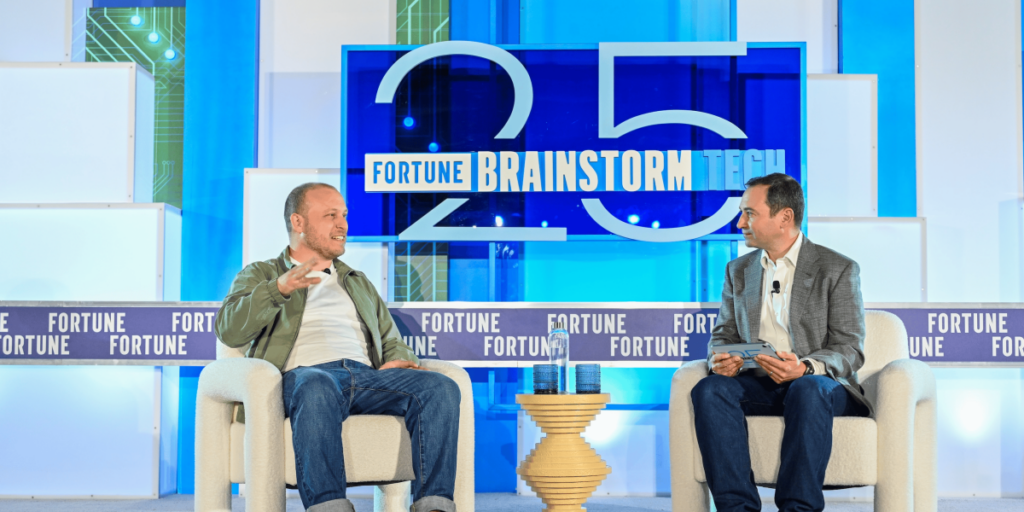
Good morning. Five years after its founding, Anthropic is preparing for what could be one of the largest IPOs in history. Its coding agent, Claude Code, is already generating an annualized revenue run rate exceeding $2.5 billion. At the Fortune Brainstorm Tech conference in Aspen on Monday, Boris Cherny, the architect behind Claude Code, made clear why that number is only the beginning—and why the implications extend well beyond engineering teams.
“In the past, there were 50 million people in the world who could code,” Cherny said during a conversation with Fortune AI editor Jeremy Kahn. “Now everyone is starting to be able to code. We’re only beginning to understand the implications.”
For CFOs, those implications are immediate—and financial.
Rethinking the ROI framework
The most actionable insight Cherny offered centered on cost justification. Early Claude Code customers balked at the price compared with $20-per-month AI subscriptions, wondering whether Claude was really different from other products.
“And then, six months later, everyone just kind of realized, ‘Okay, I guess it’s not the same exact thing,’” he said.
Cherny offered two pieces of advice. First, don’t compare the ROI to legacy coding tools because Claude Code is fundamentally different.
“Compare it to what the cost would have been if an engineer had done this work,” he said. “That’s the benchmark. That’s what you should be thinking about.”
As an example, he described a developer who recently rewrote an entire codebase from one programming language to another in six days—a project Cherny estimated would previously have required a year of engineering time. Salesforce, Ramp, and Airbnb have reported similar results, he said.
His second recommendation was to evaluate adoption through internal pilots: have one team use Claude Code and another work without it, then measure differences in speed, security, and output quality. Let the data make the case.
“I think this also helps build the ROI case internally,” he said.
The key, according to Cherny, is shifting the reference point. The comparison should be against the cost of engineering labor, not against other software subscriptions.
Managing AI agents at scale
Cherny himself manages hundreds—sometimes thousands—of AI agents on a given day. The key insight for operations-minded executives is that the bottleneck in any AI-augmented workflow is constantly shifting.
At Anthropic, once code generation was automated, code review became the constraint. The company responded by automating that process as well, deploying teams of AI agents with distinct personas to collaboratively review every pull request. Security scanning followed. Each solved bottleneck reveals the next—a dynamic familiar to any CFO focused on operational efficiency and continuous process improvement.
When asked what he has learned about himself through his work with AI, Cherny offered a candid response: “One thing that I’ve learned is I am just often wrong.”
At a time when long-held assumptions about building and managing engineering teams are being challenged, intellectual humility may be one of the most underrated competitive advantages.
“We take Claude and put it at the center of everything that we do, of every single process,” Cherny said. “When new people are onboarding at Anthropic, if they want to file an expense report, they don’t look it up in a wiki. They ask Claude: How do I file an expense report?”
The desired skill sets of new hires
Cherny’s hiring criteria are instructive for any executive building AI-native teams: generalists over specialists, low-ego collaborators, and empiricists who defer to customer data over internal conviction.
“We treat everyone on the team as essentially a CEO,” he said. “Their job is to talk to customers and gather signals to figure out what to build next. We’ve been rethinking every part of the engineering process, and it’s been humbling.”
Sheryl Estrada [email protected] *Quick note: Later this summer we’ll be publishing our third annual list of the 100 Most Powerful People in Business. Think you know someone who should make the list? Nominate them here! You can also learn more about our methodology and see last year’s list.
The post The man behind Claude Code says you’re comparing AI costs to the wrong thing appeared first on Fortune.