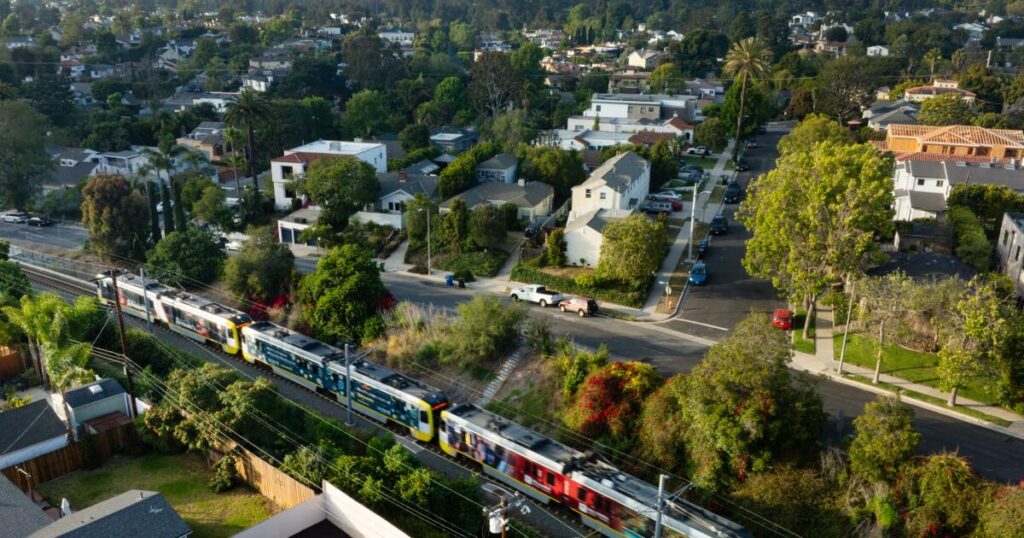
A new state law that allows denser housing development near major transit stops goes into effect in July, opening the door to construction of more than 1 million new units in California’s urban centers.
The law forces cities to approve taller apartment and condominium complexes around rail stops, ferry terminals and rapid transit bus stops, overriding local restrictions that might have stopped development in the past.
The Abundant and Affordable Homes Near Transit Act, also known as Senate Bill 79, is one of the most aggressive measures state legislators have taken to address California’s housing shortage in recent years.
Real estate developers are already cautiously planning to take advantage of the eased regulations and plan to announce new projects after the law goes into effect.
The bill was introduced in 2025 by Sen. Scott Wiener (D-San Francisco), who emphasizes that the state needs to take immediate action to address California’s housing shortage.
“This removes a bunch of uncertainty” about whether proposed projects will get approved, said Chief Executive Sean Burton of Cityview, one of the largest apartment developers in the state. “We’re very excited about it.
“This law limits the ability of local governments and officials to block new housing projects as long as you live within the parameters of the bill,” Burton said. “This should really accelerate the production of new housing in Los Angeles and beyond.”
The law preempts local control to legalize midrise and high-rise multifamily housing, unlocking zoning for up to 1.5 million new units in major cities, including Los Angeles. Developers may build housing up to nine stories tall for buildings adjacent to certain transit stops, seven stories for buildings within a quarter-mile and six stories for buildings within a half-mile.
Height limits are based on tiers. Tier 1 zoning, which includes heavy-rail lines such as the L.A. Metro B and D lines, allows six- to nine-story buildings, depending on the proximity to the transit hub. Tier 2 zoning — which includes light-rail lines such as the A, C, E and K lines, as well as bus routes with dedicated lanes — allows for five- to eight-story buildings.
Single-family neighborhoods within a half-mile of transit stops are subject to the new zoning rules.
The bill applies only to counties with at least 15 passenger rail stations, leaving eight: Los Angeles, Orange, San Diego, Alameda, San Francisco, San Mateo, Santa Clara and Sacramento.
The biggest effect probably will be felt in Los Angeles, which has an estimated 150 transit stops covered by the bill, according to the city’s preliminary assessment.
Los Angeles architecture firm SPF:architects has designed two proposed residential projects in Southern California that will be unveiled when the new law goes into effect July 1, said Renzo Pali, director of operations. He said he doesn’t want to name the exact locations yet to avoid tipping off officials who might try to stop them.
The bill allows cities to delay the new zoning law until 2030 if they add density on their own terms. If they haven’t adopted a density plan by July 1, they must abide by the terms of SB 79 until they have one. Proposals submitted before the plan is complete would still be subject to the bill, so there may be a rush of plans submitted to cities to get in under the wire, Pali said.
“Every city is now going to have some form of transit-oriented development plan, whether it is what SB 79 prescribes outright, or their own version of it, he said.
Los Angeles is among the cities that have moved to at least temporarily blunt the requirements of SB 79 after opposing it in a resolution last year that said the bill “undermines local governance, circumvents local decision-making processes and imposes unintended burdens on communities.”
In March, the City Council adopted a strategy to delay the effects of SB 79 citywide by upzoning 55 single-family and low-density areas, allowing four- to 16-unit buildings up to four stories tall. The 55 areas are mostly in Central L.A., West L.A., the Eastside and the San Fernando Valley.
Assuming there’s no pushback from Sacramento, the plan adopted by the City Council will allow L.A. to kick the proverbial can down the road, delaying SB 79 implementation until 2030.
Developers are miffed by the delay, Burton said. “You hear from the City Council that they want more housing, but then they oppose the laws that would create more housing.”
He does expect that new state laws, including SB 79 and last year’s partial rollback of the California Environmental Quality Act — known as CEQA — that made it easier to win approval for real estate developments, will lead to growth.
“You’re going to see a lot more additional housing built in California,” Burton said, “but I think a lot of that is gonna unfortunately skip Los Angeles city because of Measure ULA. That remains the major barrier to new housing development.”
Known as the “mansion tax,” Measure ULA levies an additional real estate transfer tax on high-value property sales that developers say limits their ability to build profitably.
“I think you’ll see Santa Monica benefit and Culver City benefit and Pasadena and Glendale benefit and West Hollywood benefit,” from new housing created through SB 79,” Burton said. “I don’t know how much benefit you’re going see in the city of Los Angeles because they didn’t deal with the biggest issue, the mansion tax.”
The Southern California Assn. of Governments recently released a preliminary map of transit hubs that would be included in the bill that follows Metro’s rapid transit map through Los Angeles County.
Reluctance among leaders of some California cities to intensify density around transit hubs shows why state intervention is warranted, said Jonathan Curtis, head of Glendale multifamily housing developer Cedar Street Partners.
“We’ve got a housing crisis on our hands, and other things haven’t worked,” Curtis said. “Cities may not like it, but the state mandates make sense.”
Billions of dollars have been spent on rail, he said, and “what’s missing is the density at rail stations. If you don’t take advantage of the transit stations, it’s just another lost opportunity.”
Times staff writer Jack Flemming contributed to this report.
The post New California law aims to trigger condo construction boom for transit commuters appeared first on Los Angeles Times.