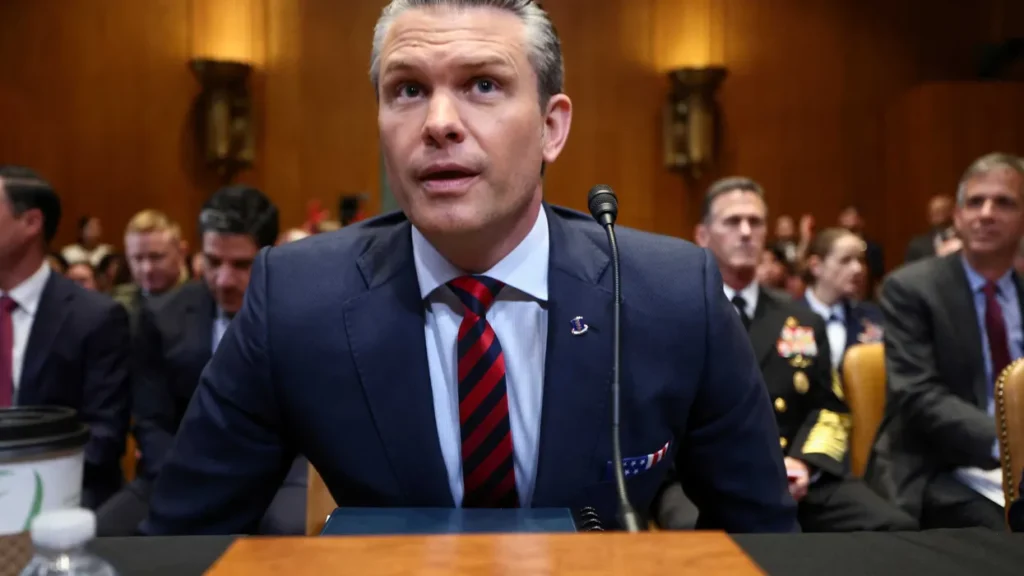
Defense Secretary Pete Hegseth has fired more than two dozen senior military officers since taking office, pushed out two service secretaries, and intervened directly in promotion decisions across multiple branches of the military – but he has refused to explain the dismissals to Congress.
The most high-profile ouster was Army Chief of Staff Gen. Randy George, a Purple Heart recipient with 42 years of service who commanded troops in both Iraq and Afghanistan, but CNN reported that Hegseth declined to offer specifics when pressed by lawmakers to explain.
“[It’s] very difficult to change the culture of a department that has been destroyed by the wrong perspectives with the same officers that were there,” Hegseth told lawmakers, according to CNN.
According to 15 current and former Pentagon officials interviewed by CNN, the firings have less to do with performance than with loyalty — and the perception of it.
Hegseth and close Trump allies had been skeptical of George from the start, partly because he had served as an aide to former Defense Secretary Lloyd Austin during the Biden administration — an apolitical military assignment that nonetheless marked him as suspect. Sources said there was little to no communication between Hegseth’s office and George before Hegseth intervened in Army promotion decisions, blocking four colonels from advancing to one-star general.
George requested an in-person meeting with Hegseth on April 1 to ease tensions and discuss the secretary’s priorities, but he was fired the next day.
Navy Secretary John Phelan was abruptly dismissed weeks later, and CNN reported he was still trying to confirm the firing was legitimate when the Pentagon spokesman announced it publicly on X. Sources said Hegseth had grown frustrated with Phelan’s pace on shipbuilding initiatives and suspicious of his direct relationship with President Donald Trump.
Pentagon officials told CNN the firings have produced a culture of paralysis inside the building, where survivability depends on avoiding Hegseth’s attention. Some troops have been required to sign nondisclosure agreements to learn about operations, and polygraph tests have become routine.
“Everything we did on a daily basis, we were calculating, ‘Is this going to keep the boss employed, or is this going to get him fired?’” a Pentagon official told CNN. “Every single day, every decision that we made, that was a planning factor. … It’s very unusual for that to be considered so heavily.”
That calculation, sources say, has begun affecting military readiness. During the lead-up to the war with Iran, for example, key military planners were kept at arm’s length from strategic decision-making, leaving some joint staff members with little visibility into the administration’s plans.
“A year-plus later, there is a lack of clear internal processes within the Pentagon … caused by mass paranoia,” the Pentagon official said. “Everything is a case-by-case basis because there’s no delegation, there’s no trust, and if there’s no delegation or trust, policy decisions can’t be made.”
Hegseth has not addressed those concerns publicly, and Trump has shown no inclination to rein him in.
“Secretary of War Pete Hegseth, central casting,” Trump said at a recent Cabinet meeting. “He loves war.”
The post Insiders sound alarm as Pentagon loyalty purge goes off the rails: ‘Mass paranoia’ appeared first on Raw Story.