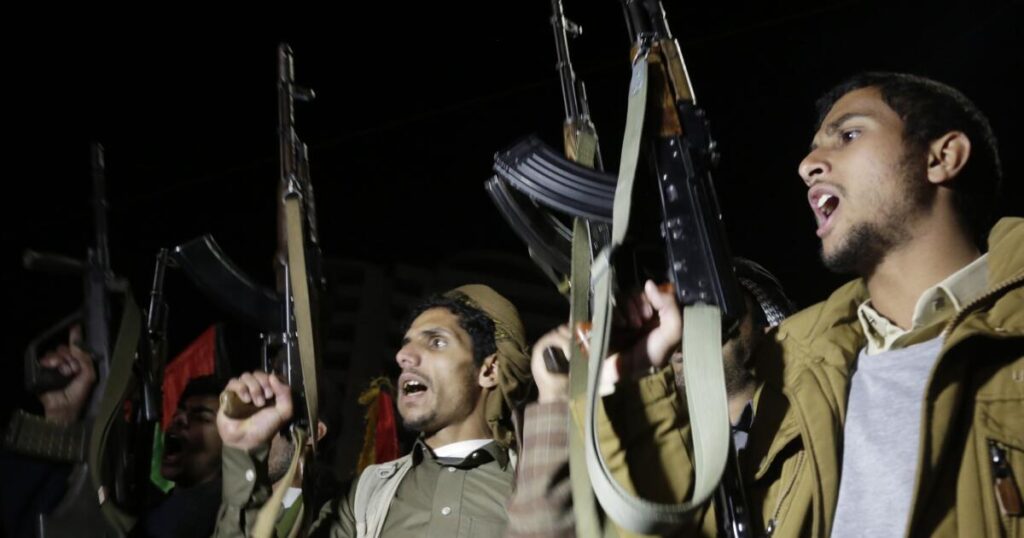
As the Trump administration weighs a diplomatic settlement with Iran, it would do well to pay close attention to the Houthis. Monday was a case in point: Responding to escalation between Israel and Hizbollah in Lebanon and the resumed exchange of fire between Israel and Iran, the Houthis fired missiles at Israel and threatened to target Israeli-linked vessels in the Red Sea.
Until now, Yemen’s Houthis have remained largely on the war’s sidelines, firing only a few symbolic shots at Israel. The Houthis have thus far held in reserve their most potent weapon: the ability to swiftly disrupt commercial shipping through the Bab al-Mandeb Strait, a maritime chokepoint between Yemen and the Horn of Africa that carries upward of 10% of global shipping trade.
Washington should not mistake restraint for passivity. If fighting between the United States, Israel and Iran resumes in force, the Houthis could quickly enter the fray to help their Iranian partners — which would dramatically worsen the economic fallout from the war and could further pressure President Trump to sue for peace. Their threat to target Israeli-affiliated ships is a significant step in this direction.
The Houthis will also closely study any potential deal Tehran extracts from its de facto control of the Strait of Hormuz, and may well seek to replicate it in the Bab al-Mandeb.
In some respects, Houthi restraint is puzzling, echoing Sherlock Holmes’s interest in the dog that didn’t bark. After all, the Houthis are Iran’s most powerful regional partner still standing after Israel’s devastating blows against Hizbollah and Hamas. As self-described members of Iran’s “Axis of Resistance,” the Houthis have a vested interest in Iran’s and Hizbollah’s survival — and a proven track record of coordinating with Iran and its proxies to oppose the U.S. and Israel.
During the Gaza war, the Houthis launched more than 250 attacks on ships moving through the Red Sea, claiming to act in defense of the Palestinians. They also tried, with limited success, to impose administrative control and, reportedly, to extract fees from transiting ships. Despite U.S. and Israeli military strikes in 2024 and 2025, Houthi leadership remains intact, and the group could resume attacks on shipping at any time.
Still, the Houthis have had four strong reasons to hold their fire since the U.S. and Israel began bombing Iran in late February.
First, the Houthis do not want to invite renewed U.S. military action. During last year’s Operation Rough Rider, Washington spent 52 days striking Houthi targets and degrading the group’s military capabilities. The campaign ended with an Omani-brokered truce that still holds. Israel’s strikes were even more damaging, killing key Houthi commanders and pushing the group’s leadership underground. For now, the Houthis appear focused on rearming and rebuilding.
Second and more important are Yemen’s domestic political realities. The Houthis remain intent on securing a deal with Saudi Arabia to end the Yemeni civil war on terms favorable to them politically and financially. Before the Houthis’ campaign against Red Sea shipping began in 2023, a Saudi-backed deal appeared within reach. Riyadh continues to hold out that possibility and is likely playing a key role in discouraging the Houthis from jeopardizing such a deal by joining the war on Iran’s side.
Third, the Houthis are mindful of public opinion. Mobilizing Yemenis in support of Palestine amid the Gaza war is far easier than rallying them to defend Iran or Hizbollah.
Finally, the Houthis may also have concluded, either independently or in coordination with Tehran, that closing the Bab al-Mandeb was simply unnecessary. The group’s leaders may believe that the Iranian regime has never been close to collapse and that the pressure on Trump generated by Iran’s threats to the Strait of Hormuz has been enough. As such, they are saving their strongest card for a future U.S.-Iran confrontation.
What could spur the Houthis to play their ace? Before the U.S.-Iran ceasefire in April, Houthi spokesperson Yahya Saree identified three somewhat vague triggers for military action: other actors joining the fight (probably referring to the Gulf states); U.S. or Israeli operations in the Red Sea; and further escalation against Iran and the axis.
As fighting in Lebanon and between Israel and Iran resumes, those thresholds remain relevant. Last week, the group’s leader, Abdulmalik al-Houthi, said they were ready for escalation and remained in “full coordination” with their regional allies. Then came their threat to attack Israeli-linked ships.
Renewed Houthi attacks on shipping would have swift economic consequences. Today, approximately 13% of world trade and 5% of seaborne oil trade pass through the Bab al-Mandeb. Closing this critical chokepoint amid the Hormuz crisis would compound pressure on an already fragile global economy and an already stressed U.S. administration.
Even the threat of resumed attacks will likely have a chilling effect on Red Sea traffic. After all, during the Gaza war the Houthis initially claimed to target only Israeli-linked ships, but they shot at vessels with little to no connection to Israel.
Regional states would bear the greatest costs of a renewed Houthi Red Sea campaign, including Egypt through loss of its Suez revenue and Saudi Arabia by cutting its vital lifeline of oil exports through the East-West Pipeline to the Red Sea port of Yanbu, which exports approximately 5 million barrels of oil per day.
Unsurprisingly, Gulf states — particularly Saudi Arabia and Qatar — are leading efforts to de-escalate the conflict. A wider war that draws in the Houthis would increase economic costs, deepen tensions with Washington and strengthen incentives for Gulf states to seek their own accommodation with Tehran.
None of this serves Washington’s interests. Facing uncertain military options, greater economic disruption and growing strains with his key regional partners, Trump is right to pursue a negotiated settlement. But any agreement must preserve the bedrock principle of freedom of navigation and avoid rewarding maritime coercion. If Iran wins direct financial concessions for reopening the Strait of Hormuz or imposes fees or tolls on it, groups like the Houthis will draw the obvious lesson: threatening global trade pays.
April Longley Alley is a senior fellow at the Washington Institute and a former senior political advisor to the U.N. special envoy to Yemen.
The post How the looming Houthi threat could turn the Iran war appeared first on Los Angeles Times.