The House on Tuesday narrowly voted to move forward with considering a budget bill that would end a four-month lapse in funding for immigration enforcement agencies, capping a fight that exposed tensions between President Donald Trump and congressional Republicans. A final vote on the measure is expected Tuesday evening.
The House voted 213-211 to pass the procedural measure, although it was held up for several minutes as two Republicans initially voted against the effort. House Speaker Mike Johnson (R-Louisiana) and his leadership team held animated debate on the floor, including with Republican Reps. Chip Roy (Texas), Tim Burchett (Tennessee) and Keith Self (Texas).
The Senate passed the funding bill Friday, sending the measure to the House after weeks of delays driven by Republican disputes over issues largely unrelated to immigration funding — including money for security tied to Trump’s ballroom project and the Justice Department’s fund for those who claim they were wrongly prosecuted.
Those fights transformed what began as a relatively straightforward effort to fund Immigration and Customs Enforcement and Customs and Border Protection into a broader test of the president’s influence over congressional Republicans, forcing leadership into a difficult negotiating process to resolve the revolt.
The big question Tuesday is whether moderate House Republicans — some of whom oppose the Justice Department’s $1.8 billion “Anti-Weaponization Fund” — will seek reassurance that the Republican-led House will not allow an iteration of the payout fund to exist, in exchange for their support of the funding bill.
Rep. Brian Fitzpatrick (R-Pennsylvania) is among those demanding that House GOP leadership ensure that the fund will not be allowed to continue in any shape. Fitzpatrick, alongside moderate Democratic Rep. Tom Suozzi (New York), introduced legislation last month that would prohibit the use of federal money for payments made through the “Anti-Weaponization Fund.” The legislation needs the support of 218 House members to be brought to the floor.
Speaking to CNN on Sunday, Fitzpatrick emphasized that the executive branch “does not have any money in their own right,” and any fund would require congressional approval. The Justice Department fund does not have the necessary support in Congress, he added.
“The votes are not there and will not be there to give a dime to this fund,” he said.
Rep. Kevin Kiley (I-California), who caucuses with Republicans, said Tuesday that he has concerns about going around the annual appropriations process and “wouldn’t even consider voting yes” on the bill unless there were bipartisan reforms to immigration enforcement in the interior of the country.
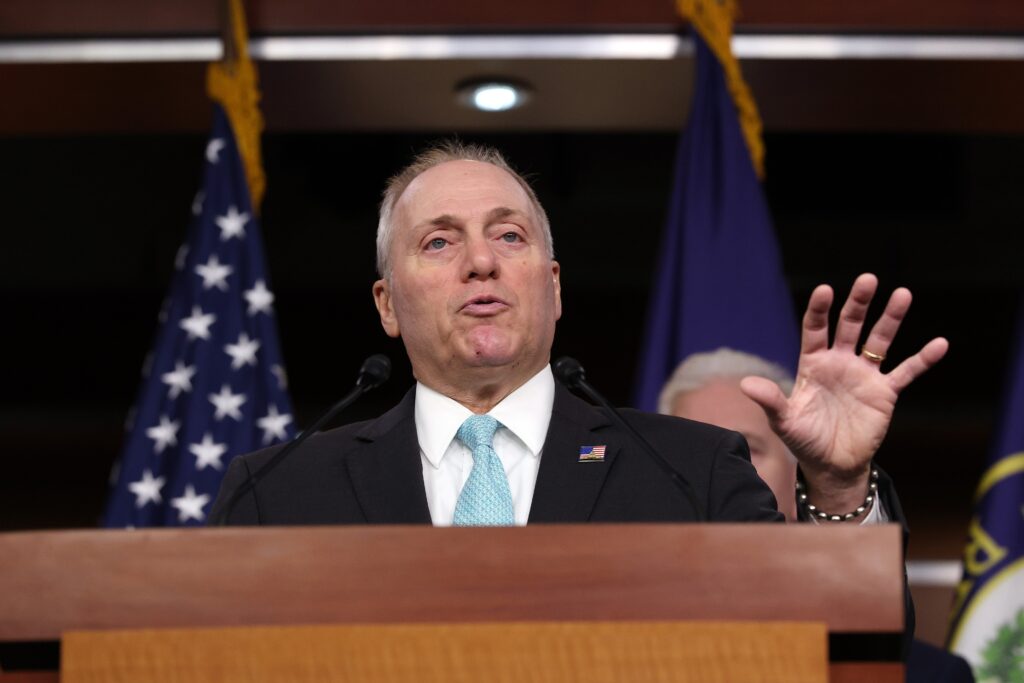
When asked whether GOP leadership has spoken to Kiley about his vote, House Majority Leader Steve Scalise (R-Louisiana) said that the leadership is “talking to a number of members” but that ultimately the House needs to “properly fund” the Department of Homeland Security, arguing that the department is facing several high-profile events — including the World Cup — and thus needs an appropriate level of funding.
Scalise would not say whether Republicans have enough votes to pass the measure Tuesday, given potential absences.
Tuesday is a primary-election day, and several members were out campaigning as recently as Monday night. “We always have to deal with absence, in a narrow majority, that’s life in the big city,” Scalise said. “But we’re going to get our work done.”
Some members were ambiguous about their support for the measure early Tuesday. Rep. Keith Self (R-Texas) said he wants reassurance from leaders that they will codify Trump’s immigration measures.
“We’re going to fund the people who will try to keep the bad guys out, but they haven’t codified the actions to prevent them to come back here in three years, so yeah, there’s a concern that we haven’t codified anything into law,” Self said.
Democrats, meanwhile, have said they will not support the ICE funding package, with House Democratic Whip Katherine Clark (Massachusetts) telling the House Rules Committee on Monday that Congress should not be appropriating more money for the agency.
“We have 60 percent of American families who are struggling to afford the basics and today, we are being asked to come back and say, ‘another $70 billion for ICE,’” Clark said.
ICE and CBP have been without normal appropriations since the end of January. Democrats have refused to support funding the agencies without new restrictions on operations after federal agents killed Renée Good and Alex Pretti during an immigration enforcement campaign in Minneapolis earlier that month.
While Congress funded the rest of the Department of Homeland Security through September, Republicans opted to use the budget reconciliation process to fund ICE and CBP through fiscal year 2029. The process allows Republicans to advance the measure with a simple majority in the Senate, avoiding the filibuster and forgoing Democratic support.
The legislation is particularly unusual because it is the first time reconciliation is being used to bypass the normal annual appropriations process and fund government agencies for multiple years in an effort to avoid future shutdowns.
Rep. Rosa DeLauro (Connecticut), the top Democrat on the Appropriations Committee, said Monday that using reconciliation to fund the agencies sets a “very dangerous precedent.”
Rep. Tom Cole (R-Oklahoma), chair of the Appropriations Committee, said that although he is “very reluctant” to use the reconciliation process to pass the immigration enforcement funding, he does not believe it will become normalized in the future.
“I blame the Senate Democrats in particular, and frankly, the Senate in general for letting the filibuster to be misused,” Cole said in an interview Tuesday. “But we’re not going to move to moving appropriations bills through reconciliation as a regular process. It’s not going to happen.”
The post House takes up measure to pass ICE funding after weeks of Republican delays appeared first on Washington Post.