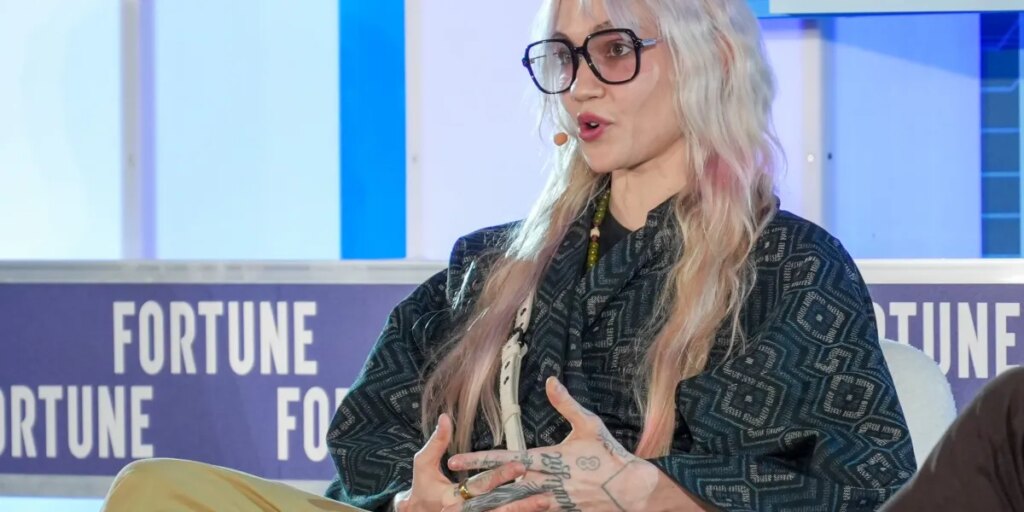
The singer-songwriter Grimes has embraced AI-generated music, but she insists that even as music formats change, humans must still play a central role.
Grimes appeared at the Fortune Brainstorm Tech conference in Aspen, Colorado on Monday alongside Robert Kyncl, chief executive of Warner Music Group. Debating the future for music artists in the age of AI, both championed the enduring value of human connection and storytelling in an increasingly digital world. Kyncl predicted that an abundance of AI-generated slop will trigger a reaction by audiences to intentionally look for human-only services. Grimes, meanwhile, urged artists to think of their work as philosophers, and poets.
“We’re lucky to be making art in an era where there’s such extreme change,” she said. “It’s like most artists don’t get to be tied into a great historical event that they can interpret.”
In 2023, Grimes began an AI software program called Elf.Tech, which has allowed people to use her vocal likeness as long as she receives a 50% split of the master recording royalties. She said she views the so-called democratization of her voice as a way to feel free in an era where voice cloning is already happening.
AI-generated music is surging. AI music generator Suno recently announced a new $400 million funding round at a $5.4 billion valuation. Suno and others have targeted use cases such as patients in hospice care using Suno to leave songs behind for loved ones, or therapists helping teens navigate mental health challenges through music creation.
More from Fortune’s 25th Brainstorm Tech:
Giant music groups have grappled with how to tackle AI and retaliated in recent years. Major record labels, which included Warner Music Group, sued Suno and startup Udio in 2024 for copyright infringement related to using copyrighted songs to train their models. Warner settled with Suno and Udio in late 2025.
In 2024, Tennessee lawmakers signed the Ensuring Likeness, Voice, and Image Security, or ELVIS Act, which classified an individual’s voice as a protected property right. The same year, Sony Music Group, which has represented Adele, Beyoncé, and other artists, warned hundreds of AI companies not to train models on its content without permission. Artists that include Billie Eilish, Nicki Minaj, and Stevie Wonder were among 200 musicians who signed an open letter in 2024 arguing that “this assault on human creativity must be stopped.”
Grimes and Kyncl both said on Monday that as AI expands, having mastery over the written word and the humanities will become more critical than ever. Being able to write something that is truly new is rare, Grimes said.
Kyncl shared advice for young creators to focus on the value of being a storyteller rather than specific technical preparation. Storytelling is a skill that will be beneficial regardless of how the future unfolds, he said.
“If you know how to tell stories, it’s it’s a skill that will be useful no matter what,” he said.
The post Grimes says AI can make music, but humans must still tell the story appeared first on Fortune.