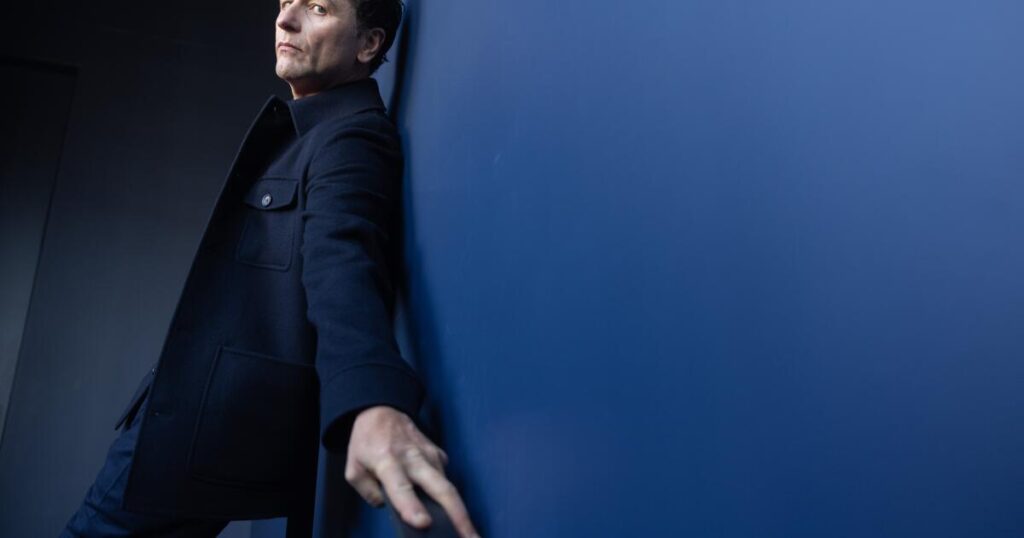
Matthew Rhys is no stranger to playing a man with the weight of the world on his shoulders. Six seasons juggling subterfuge and suburbia as deep-cover KGB agent Philip Jennings on “The Americans” (which earned him an Emmy in 2018) illustrated the Welsh actor’s skill at depicting a psyche fraying with every act of violence.
Now, Rhys embraces two wildly different roles he shot back-to-back, showcasing versatility against foreboding backdrops of murder and the supernatural. One character oozes confidence; the other struggles to gain any respect, even though he is in a position of power.
“It does amaze me when people go, ‘You are so disturbing.’ I don’t think I am. I think the part I played is disturbing,” Rhys says, speaking over Zoom from his Brooklyn home, having recently wrapped Season 2 of “Presumed Innocent.”
Rhys’ real estate scion Nile Jarvis is equally menacing and alluring opposite author Aggie Wiggs (Claire Danes) in Netflix’s cat-and-mouse thriller “The Beast in Me.” In Katie Dippold’s Apple TV horror-comedy “Widow’s Bay,” the actor gets a rare opportunity to flex his deft comedic timing as tightly wound Mayor Tom Loftis, who desperately wants to transform his cursed island town into “the next Martha’s Vineyard.” Both men keep secrets.
A frightening encounter with a fabled Sea Hag in the third episode turns dyed-in-the-wool skeptic Tom into a believer, allowing Rhys to exercise his pipes and impressive pitch. “I was concerned about the shriek,” Rhys says. “Because sometimes I would do it as a joke in rehearsal, and [director] Hiro [Murai] goes, ‘Try it, just try it, and we’ll do different versions. If it’s not ringing true, I’m not going to use it.’ We played around with it. It still makes me nervous.”
Rhys, also an executive producer on “Widow’s Bay,” refers to Dippold and Murai as a “match made in heaven,” and Murai’s grounded approach helped Rhys find his footing, while giving the actor room to experiment. One memorable laugh-out-loud scene directed by Murai later in the season is a master class in physical comedy. “I felt like Charlie Chaplin,” Rhys says. Another episode, directed by Andrew DeYoung, sees Tom accidentally ingest potent hallucinogenic mushrooms, with Rhys nailing absurdist humor and a haunting flashback.
Even when Tom isn’t on psychedelics, he alternates between wordless bewilderment and near-constant exasperation toward his co-workers, peppered with sharp outbursts — sometimes joy, sometimes fear. “He’s sitting on so much, everything with his son, his wife has passed away,” he says. “The town hates him. He’s like a pressure cooker, and it’s moments when it will erupt. That’s what I was playing around with.”
One adversary-turned-ally is Stephen Root’s cantankerous true believer, Wyck. Having gone toe-to-toe in 2020 with Root in “Perry Mason’s” first season, Rhys was thrilled Root was cast as Tom’s primary antagonist. “The first scene we did together was when he sings the sea shanty. The first rehearsal is just him going, ‘Aawoo,’” Rhys says, expertly capturing Root’s off-kilter delivery. “That stayed with us throughout the whole filming.”
But if you really want to scare Rhys, ask him to dance. Sea hags have nothing on the fear of performing Nile’s drunken dancing in “The Beast in Me.” The choice of “Psycho Killer” is purposefully on the nose, and nothing onscreen gives an inkling of awkwardness.
“Ten being the most terrifying, it’s like a 15. When I see any character dances, I’m like, ‘Ugh.’ I’ll do anything [not to dance]. I’d sing before I dance,” Rhys says. He covers his face when the line-dancing scenes on “The Americans” come up. “That still makes me shudder,” he says.
Despite the song’s title, though, Rhys didn’t know if Nile was guilty of murdering his wife when he signed on to “The Beast in Me.” Instead, Nile’s notoriety and status informed Rhys’ choices: “People treat you differently if they know you’re incredibly wealthy. If you have this social stigma of a missing wife, people treat you very differently.”
Rhys gave a kaleidoscope of options depicting the miniseries’ most unexpected act of violence, revealed in the fourth episode. “We did different versions,” Rhys says. “Whether it was a true moment of panic that he’s like, ‘Oh, my God, I f— killed someone,’ or whether it’s like, ‘I’m f— loving this.’”
He was mindful not to tip into villainous theatrics during layered interactions opposite Danes. “Those moments you’re trying not to twirl [the mustache],” Rhys says. “Ultimately, the audience has to believe that at a surface level it can be deemed a normal conversation. There’s many ways to skin it. You always hope it lands in a real way.”
Still, 51-year-old Rhys didn’t take Nile’s demons or Tom’s supernatural burden home. “I used to think that was the way back in your 20s, when you’re trying to be [Marlon] Brando or [Robert] De Niro and ‘Oh, my God, I’ve got to live it,’” he says. “Now, I’m just like, ‘You come in, you try to remember which kid has what sport or who you’re picking up.’ The switch is off the second they say cut.”
Speaking of family, Rhys’ face lights up at the mention of the recent Actor Awards, where partner Keri Russell won for “The Diplomat.” (Rhys was nominated for “The Beast in Me.”) Would the actor do “The Diplomat” if asked? “Oh, God, yeah. I think Deb[ora] Cahn’s writing is some of the best around at the moment,” he says. “She writes the same kind of beautiful humor that reminds me of Katie’s stuff; it’s so dry, acerbic, intelligent.”
It all goes back to the script. The appeal of playing characters like Tom and Nile stems from what lies beneath the surface. “There’s more layers to play,” Rhys says. “There’s more obstacles to get over. There’s more behind your eyes in the scenes. It’s always an added bonus to me.”
The post Matthew Rhys promises he’s not ‘disturbing.’ But his TV characters definitely are appeared first on Los Angeles Times.