BETZET, Israel — Rani Ben Dov, one of the few farmers still left in this northern border town, was exhausted.
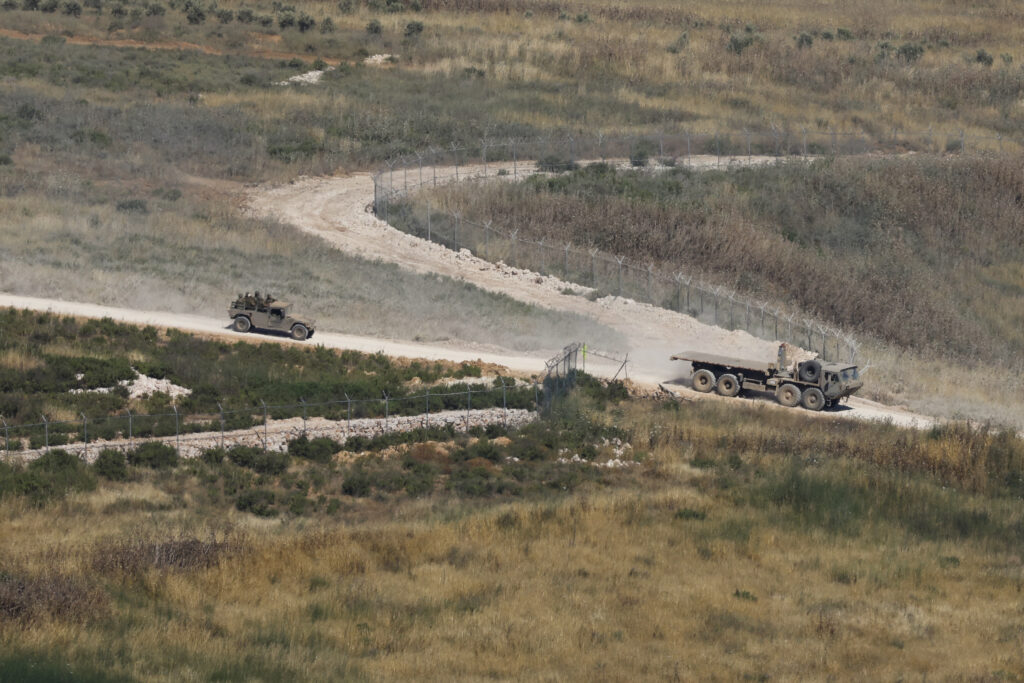
Israeli artillery could be heard pounding away in the distance. Drones were humming overhead hours earlier. Ben Dov, 77, was tired of seeking shelter from incoming Hezbollah fire, but even now the last thing he wanted was for Prime Minister Benjamin Netanyahu to pull the plug on the military offensive in Lebanon, just a mile away.
“We need to let the generals do what they need to do and eliminate Hezbollah,” Ben Dov said, as the sound of shelling punctured the hot summer air. “We can’t just leave.”
The sentiment is pervasive. In war-weary border villages, on prime time talk shows, within the political opposition and among Netanyahu’s supporters, Israelis are pushing their prime minister to fight — and stay — in Lebanon, which could undermine U.S. efforts to reopen the Strait of Hormuz and end the war against Iran.
For weeks, Iran has demanded an end to hostilities between Israel and Hezbollah, the Shiite militia it supports in Lebanon, as a condition of a comprehensive peace deal with President Donald Trump.
Trump has voiced frustration about Netanyahu “constantly fighting” in Lebanon, but Israeli military and political analysts say Netanyahu almost certainly will keep forces in Lebanon for several more months, if not years, for tactical reasons — and because of domestic political pressure ahead of a national election expected in September. On Sunday, Israel struck Beirut again despite warnings from Iran, which fired missiles at Israel for the first time since April and triggered a new cycle of escalation.
The exchanges grew more perilous on Monday with fresh waves of long-range missiles fired by Israel and Iran, putting the peace talks on the brink of collapse. Israel appeared to be defying Trump’s calls for restraint.
After Trump chastised Netanyahu about his ongoing offensive last week, leaders from across the Israeli political spectrum warned the prime minister not to buck under American pressure — a sign analysts said of the price Netanyahu might pay if he withdraws before the elections.
“For Hezbollah to agree to a ceasefire, it would insist that all the troops that invaded withdraw, but for the Israeli government, that might be perceived as a defeat,” said Giora Eiland, a former Israeli major general and ex-head of Israel’s National Security Council.
“We cannot accept that for good reasons, but also for political reasons,” Eiland said. “We are only a few months from an election.”
The situation, he added, was reminiscent of Israel’s 1982 invasion of Lebanon, which led to a draining 18-year occupation. Eiland said it was unlikely that Hezbollah would be diminished sufficiently to enable an Israeli withdrawal. “Is it going to happen in the next few months? Probably not,” he said. “Is it going to last 10 years or more? I don’t know.”
Since Trump opened negotiations with Iran in early April, Netanyahu has escalated operations in Lebanon — seeking to pressure Hezbollah into submission but also, analysts say, to undermine Trump’s talks with Tehran.
Netanyahu has unleashed massive airstrikes against Hezbollah targets in Beirut, displaced the civilian population from Israeli-designated “combat zones” that amount to one-fifth of Lebanon’s territory, and threatened to invade the Lebanese capital with troops.
The Israeli offensive has killed more than 3,000 people in Lebanon since March 2, according to its health ministry.
On Thursday, Israel and Lebanon announced a deal, brokered by Washington, calling for Israeli troops to pull back to about six miles from the Israeli border and to partly transfer security responsibility to the Lebanese army. But the deal did not require Israel to fully leave Lebanon, and did not limit Israel’s ability to bomb Hezbollah unless its fighters leave the country’s south.
Hezbollah balked and said it would not commit to any ceasefire unless Israel completely withdraws from Lebanon, raising the prospect of ongoing hostilities and uncertainty in the U.S.-Iran talks.
A poll by the Institute of National Security Studies in Tel Aviv in late May found that roughly 60 percent of Israelis and an overwhelming majority of the government’s supporters say Israel should intensify its fight against Hezbollah.
“There are fairly substantial portions of the Jewish population who are supportive of a security zone,” Dahlia Schneiderlin, an Israeli pollster said, referring to a strip of southern Lebanon that the Israeli military has evacuated and might occupy for an extended period. “Attitudes have only grown more hard-line,” Schneiderlin said. “The society has been told time and again that only military solutions work, and if it hasn’t worked, then we haven’t gone strong enough.”
Anger is particularly high among Israelis in the north, who were targeted and displaced by a barrage of missiles launched by Hezbollah beginning in October 2023, shortly after its partner, Hamas, launched the surprise attack on southern Israel.
During the last two years, northern Israeli residents have held protests demanding that Netanyahu eliminate the Hezbollah threat. Now, many are criticizing Trump, usually a popular figure in Israel, for trying to restrain Israel.
Residents feel “betrayed, frustrated, and helpless in the face of decisions being made overseas,” said Moshe Davidovich, head of the northern regional council that includes Betzet village.
Within Israel, Netanyahu has been buffeted by an array of other voices.
Political rivals, such as Avigdor Liberman, a former defense minister whose party will compete against Netanyahu’s in the upcoming election, argue that Israel’s security cannot be guaranteed if Hezbollah is not eliminated. In a radio interview last week, Lieberman proposed that Israel arm militias inside Lebanon, much like it did with Christian factions in the 1980s, to help the war effort.
Others, such as the far-right finance minister and settler leader Bezalel Smotrich, have cited messianic religious beliefs and argued for permanent Jewish settlements in southern Lebanon.
Today, the mood in Israel is a far cry from 2000, the last time Israeli troops withdrew from a lengthy occupation of Lebanon. At the time, mothers of Israeli soldiers killed in Lebanon regularly led protests demanding that Israel pull out. Crowds of Israelis celebrated as tanks finally rumbled home.
The Israeli film director Joseph Cedar received widespread acclaim after releasing a movie in 2007 about the toll suffered by Israeli soldiers defending Beaufort Castle, a highly symbolic fortification near the Lebanese town of Nabatieh.
But last week, the Israel Defense Forces reclaimed Beaufort and unfurled the Israeli flag over its stone ramparts. Israeli government ministers cheered on social media and in television appearances. Netanyahu delivered a speech proclaiming that Israel had “broken the barrier of fear” by returning to Lebanon “stronger than ever.” He then ticked off recent territorial gains.
“I have instructed the IDF to expand the incursion in Lebanon,” Netanyahu said. “Our forces have crossed the Litani River. They took dominant terrain. They captured the Beaufort ridge. And now my instruction is to deepen and expand our hold on places that were under Hezbollah’s control.”
Guy Laron, a historian at Hebrew University, called the recent events a “complete déjà vu” of Israel’s 1982 invasion. At the time, President Ronald Reagan warned Israeli Prime Minister Menachem Begin against entering Beirut. But Israel went in without an exit strategy and ended up being mired there, Laron said.
“There was this huge festival that we conquered Beaufort again, but have we forgotten what happened last time? It was a quagmire,” Laron said.
Netanyahu, he added, was motivated to keep fighting in Lebanon to undermine Trump’s talks with Iran, Israel’s paramount enemy in the region, because the war has yet to achieve Israel’s desired results.
“He’s using the warfare in Lebanon to make life harder for Trump to reach an understanding with the Iranians,” Laron said. “That’s why Trump is so livid.”
About 12 miles away from the Betzet farming community, Avi Ben Chitrit said he, too, worried about the threat of Hezbollah munitions raining down on his town, Shtula, like “drops of water.”
Hezbollah rockets over the last 30 months have destroyed homes and a community sports center in the village, which is nestled against the concrete barrier separating Israel and Lebanon. Drones target nearby Israeli troop positions on a near-daily basis.
Ben Chitrit said he and other community leaders in the north met last week with Netanyahu and that he was satisfied by the prime minister’s assurances.
“There is no ceasefire,” Ben Chitrit said. “He said we will continue to do everything to make sure the border will be secure. What are we supposed to do, stop all the activity in the north and let them kill us? We need to continue to defend ourselves until everything is quiet.”
The post Israelis push Netanyahu to resist U.S. pressure and keep fighting in Lebanon appeared first on Washington Post.