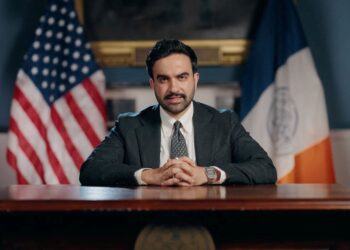
As Democratic heretics go, Representative Dan Goldman isn’t guilty of many crimes against his party. He initially won election to the House after prosecuting the first impeachment of President Trump (whom he now calls a “fascist”), and during two terms, he has voted overwhelmingly with Democratic leaders—even swinging to their left by backing Medicare for All and the abolition of ICE. Goldman isn’t tainted by scandal, nor is he on death’s doorstep; at 50, he’s pretty young for Congress.
Yet if the polls in New York’s Tenth Congressional District are anywhere near correct, Goldman will lose his bid for reelection in a primary later this month to another middle-aged Jewish guy aligned with progressive causes. Brad Lander, a former New York City comptroller and mayoral candidate, is challenging Goldman from the left, seeking to parlay an endorsement from the city’s new mayor, Zohran Mamdani, into a House seat.
Lander’s case against Goldman spans from the parochial to the global. Goldman refused to endorse Mamdani’s mayoral bid last year even after the former state legislator captured the Democratic nomination, and he was slow to turn against Israel’s war in Gaza, which Lander (like Mamdani) calls a genocide. “He’s fundamentally out of step with the core progressive values of the district,” Lander told me.
Goldman says Lander is exaggerating the gulf between them. “I am a progressive, I have a very progressive agenda, and I am very aligned with the district,” he told me. “I think 95 percent of the time we would vote the same way.” A few Goldman allies I interviewed seemed perplexed that the liberal wing of the party would want to defeat him. After all, he’s no Joe Manchin or Kyrsten Sinema, the centrist Democrats who stood in the way of some of former President Biden’s top priorities. Nor is he like John Fetterman, the Pennsylvania Democrat and onetime darling of the left who has become the party’s most ardent defender of Israel. “I don’t think he’s done anything wrong,” Mario Cilento, a New York State labor leader backing Goldman, told me. “Every Congress member gets one vote. If that individual votes the right way, I’m really not sure what else they can do.” To mock attacks on his record, Goldman is running a commercial designed as a scare ad that points out all the “radical progressives” who are supporting him, including Planned Parenthood, teachers’ unions, and public-housing advocates.
Goldman’s progressive critics acknowledge that he’s given them few bad votes to attack. But they have used the race to argue for raising the bar for a Democratic member of Congress, demanding more visibility—and more activism—rather than mere party loyalty. Lander’s backers are also challenging a system in which a safe House seat can easily become a sinecure, so long as the incumbent avoids either prison or an ideological betrayal. “Someone who’s gonna just take votes and follow the status quo of being a mainstream Democrat is not what this district deserves or needs,” Jasmine Gripper, a co-director of the New York Working Families Party, which is supporting Lander, told me.
New York City has been a staging ground for progressive primary challenges in recent years. Alexandria Ocasio-Cortez’s stunning 2018 defeat of Representative Joe Crowley, a Queens party boss and member of the Democratic House leadership, catapulted her to international fame. Two years later, another senior House Democrat, Representative Eliot Engel, lost in a primary to a left-wing challenger. This year, Mamdani is backing another like-minded democratic socialist, Darializa Avila Chevalier, who is running against Representative Adriano Espaillat, the chair of the Congressional Hispanic Caucus.
Those races all featured sharp divides—ideological, generational, racial—between the candidates. The dynamics of the Goldman-Lander matchup, by contrast, are more complicated.
New York’s Tenth District is split between Manhattan and Brooklyn, and it encompasses some of the city’s wealthiest and most recognizable neighborhoods, including Wall Street, Greenwich Village, SoHo, and the stately brownstones of Brooklyn Heights and Park Slope. By that metric, Goldman is a perfect fit for the district. He is one of the richest members of Congress and has contributed millions to his campaigns; earlier this spring he announced that he would match every additional donation with funds of his own. (Goldman’s middle name is Sachs, and he has up to a $50 million line of credit with Goldman Sachs, according to a 2022 financial disclosure, but his family money comes from the Levi Strauss fortune.)
Goldman’s wealth is a liability in the race—“He bought the seat” is a common refrain from the Lander side—but perhaps not as much in a city that thrice elected Mike Bloomberg mayor as it would be elsewhere. Goldman won his first primary in 2022 by just over 1,300 votes, aided by his considerable financial advantage, the fame he’d earned as an impeachment star and talking head on MSNBC, and—perhaps most consequentially—divisions within the district’s progressive base that split its votes among several other candidates. “The only reason he won—let’s be absolutely clear—is that the left was divided,” Gripper said. “Our side didn’t get their act together.”
[Read: California Democrats avoided a worst-case scenario]
Since taking office, Goldman has focused his attention less on his district’s ritzier, progressive neighborhoods than on the working-class, immigrant-populated enclaves that he says local politicians have neglected. On a recent Tuesday I found him stumping in Manhattan’s Chinatown, where he spoke to about 100 constituents inside a small shopping mall that had seen better days. Goldman campaign signs covered up makeshift wooden walls, and wiring hung down from a partially intact ceiling. Residents told me that the mall had once been full of stalls leased by local merchants but that it had emptied out during the pandemic and, unlike many other areas of New York, struggled to recover. Few in the audience were conversing in English, and they listened quietly as they waited for Goldman’s remarks to be translated.
He explained that he’d opened a satellite office in the neighborhood that has served more than 1,000 people, and he touted his work fighting against cuts to SNAP, anti-Asian hate crimes, and the Trump administration’s immigration crackdown. Toward the end of his speech, Goldman finally got to the rub: “One of the reasons why Chinatown is often underserved and overlooked,” he said, “is because voter turnout is pretty low, and what happens is many elected officials, including my opponent, only focus on the areas that have high voter turnout.
“I didn’t do that,” Goldman continued, “because I knew that you all needed more help than you were getting.” “But,” he said: “now I need your help.”
Goldman’s direct appeal was at once the kind of ask that urban politicians have been making of their constituents for generations—and a telling indication of why he’s in so much electoral trouble. While Goldman is hunting for votes in places that don’t ordinarily turn out in large numbers, Lander seems to have the advantage in the neighborhoods that do. He represented Park Slope and its surroundings on the city council for 12 years. Lander’s ads depict him as a Mister Rogers–like figure who will “make every day a beautiful day in our neighborhood” (one ad mentions a “fascist president” and “rogue ICE agents” as animated birds tweet by). Polls have shown that he has better name recognition in the district than Goldman, the incumbent. The disparity has forced Goldman into the awkward position of defending a seat he’s held for two terms by running, at least in part, as the outsider. “He has a much longer history in the district,” Goldman told me of Lander. “And I bring a new and different energy to this job.”
Goldman’s problem, his critics say, is that he has avoided the district’s more liberal neighborhoods and refused to engage with its influential activist community. Those tensions were magnified after Hamas’s attack on Israel on October 7, 2023, when progressives in New York began demonstrating against Israel’s retaliatory war in Gaza. Robert Carroll, a Democrat who represents Park Slope in the state assembly, endorsed Goldman during his first race but told me he soon realized he had made a mistake. He accused Goldman of displaying an “arrogance” toward activists that Carroll found off-putting. “New York 10 is a progressive bastion,” Carroll said. “There are not many in the United States, and the idea that we have a representative who refuses to meaningfully interact with, represent, and work with the progressive voters and residents of his district is disqualifying.”
I sat down with Goldman for an interview in a diner in Chinatown he’d picked, not far from where he had held his event the week before. He expressed few regrets, other than wishing that more people knew about the record he had built in Congress. “If I were to do something different, it would have been to more aggressively publicize a lot of the work that I have done,” Goldman said.
From the moment he narrowly won his primary in 2022, progressives seemed to have marked Goldman for future defeat. But if there was a threat, he appears not to have picked up on it. I asked Goldman whether, knowing that he had captured just over a quarter of the party vote in that first election, he had developed a plan for beating back the kind of challenge that had toppled much more established New York City Democrats in recent years. “I didn’t really think about it that much,” Goldman replied. “I mostly really focused on doing the work.”
Goldman’s path to reelection might have been smoother had Lander gotten either of the municipal posts he sought last year. He finished third in the Democratic primary for mayor after locking arms with Mamdani in a cross-endorsement facilitated by the city’s ranked-choice voting system. After Mamdani captured the nomination last summer, Lander was reportedly angling to become first deputy mayor—in essence, chief lieutenant—in the new administration. But Mamdani picked someone else and instead gave Lander his enthusiastic endorsement to challenge Goldman. “He needed a job,” Goldman told me, “and I think the mayor wanted to give him an off-ramp to save face a little bit.”
For his part, the 56-year-old Lander told me that some of his supporters began urging him to run for Congress as soon as he lost the mayoral primary. “I’m grateful for his support,” Lander said of Mamdani. “A seat in Congress is no one’s consolation prize, especially at a moment when your democracy is on the line.” (A Mamdani spokesperson did not respond to a request for comment.)
[Read: Where Mamdani has refused to moderate]
The mayor’s endorsement of Lander has set up something of a proxy battle with other Democratic power brokers, such as New York Governor Kathy Hochul and House Minority Leader Hakeem Jeffries, who are backing Goldman. But Mamdani is clearly the most popular of the three in the district, and Lander mentions him nearly as often as a Trump-backed Republican name-drops the president in MAGA territory. “We don’t agree on every single thing, but I want the mayor to have an ally in Washington instead of an adversary in his own backyard,” Lander said during a local radio forum last month.
Goldman was far from the only prominent Democrat to withhold support from Mamdani during his general-election campaign. Jeffries didn’t endorse Mamdani until late October, and Senator Chuck Schumer (a constituent of Goldman’s in Park Slope) never backed him at all. But Goldman appears to be the first to pay a price for his neutrality. In my interviews with voters, Goldman’s refusal to get behind Mamdani was one of two main complaints they had about his record.
The other was Goldman’s support for Israel, which has come to dominate the race, crowding out discussions about Trump, immigration, and affordability. (The issue took up the first quarter of an hourlong debate he and Lander held earlier this week.) Lander has assailed Goldman for accepting AIPAC’s endorsement and for voting to send military aid to Israel, which Lander has vowed to oppose. Lander has also criticized Goldman for voting alongside Republicans to censure Representative Rashida Tlaib, a Democrat and the only Palestinian American serving in Congress, over her use of the phrase from the river to the sea in the immediate aftermath of October 7. Goldman recently suggested that he regretted the vote, citing the emotions of the moment—he and his family were in Israel when the attack occurred—but at the time he said Tlaib had used “a hurtful antisemitic trope.”
Goldman has loudly opposed Trump’s war in Iran; he begins one TV ad with the words “No more wars,” a line he delivers morosely and directly to the camera. He told me that “the devastation in Gaza is horrific, unnecessary, and excessive.” But Lander has gone much further in his denunciations of Israel, particularly in the past year. During his mayoral campaign, he did not use the word genocide to describe Israel’s war in Gaza. By the fall, however, he had begun accusing Israel of genocide—a shift that coincided with his preparations to challenge Goldman. Lander told me that he’d changed his mind after conversations with his daughter, a 23-year-old University of Chicago graduate who talked to him about her studies of Raphael Lemkin, a Jewish lawyer from Poland who is credited with coining the term genocide after the Holocaust.
Goldman has tried to minimize his and Lander’s differences on Israel, noting that in a district in which nearly a quarter of the electorate is Jewish, both Democratic candidates identify as “liberal Zionists,” have condemned Israel’s tactics in Gaza, and support the creation of a Palestinian state. Lander and Goldman each opposed a vote by the Park Slope Food Co-op to boycott Israeli products.
Goldman’s critics and, privately, a few of his allies, believe he did not appreciate the shakiness of his standing within his district, or the threat that even a few political missteps might pose to his future. He may not have broken with his party—or even his district’s progressive base—all that much, but his margin of error was thin to begin with. “Dan Goldman has been doing his best to fight Donald Trump, which is all we can expect from him,” a Lander supporter, Steve Flack, told me. But to Flack and, it seems, many of Goldman’s constituents, that is not sufficient to win another term. Goldman, he said, “really just thought he could slide as an incumbent.”
If Goldman once thought the seat he won in 2022 was securely his own, he knows now that is not the case. He’s spent months reintroducing himself to voters, touting his record, and trying to rebut Lander’s claim that he’s too closely aligned with the corporate establishment. But in the coming weeks, Goldman may discover that in this district, at this fraught moment, Democratic voters just want more.
*Illustration sources: The New York Historical / Getty; Tom Williams / CQ-Roll Call, Inc / Getty; Michael Nagle / Bloomberg / Getty.
The post When Fighting Trump Isn’t Enough to Win Another Term appeared first on The Atlantic.