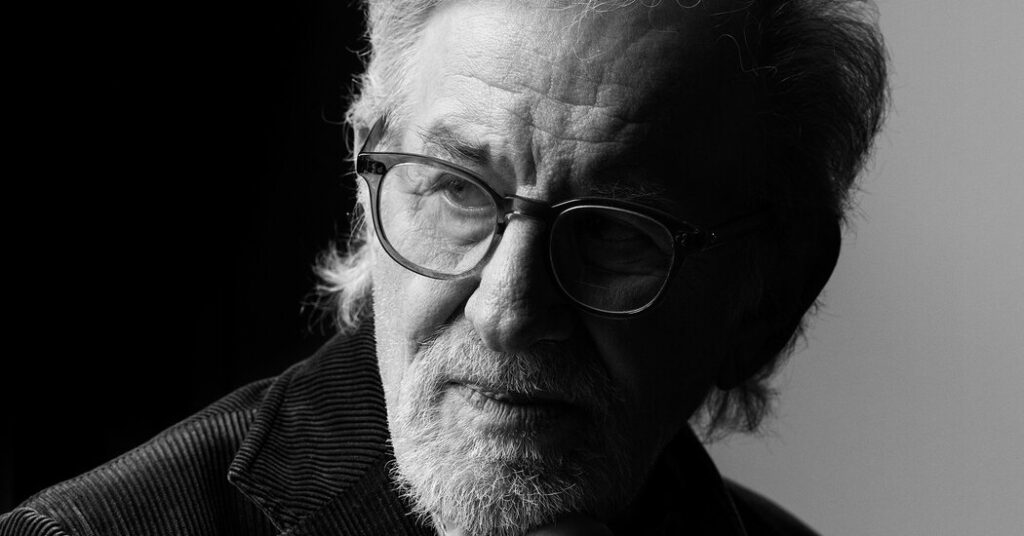
On Jan. 1, something amazing happened. Steven Spielberg, a longtime Angeleno and most people’s dictionary definition of “Hollywood director,” became a New York City resident. On the one hand, this is a significant event. What classic Spielberg location requires a 212 or 718 or 646 to phone home? On the other hand, he has made five of his last six movies in New York State, including his exuberant, ominous reconsideration of “West Side Story.” Plus, for decades, Spielberg has kept a place on the Upper West Side. Five of his seven children live here, and all six of his grandchildren. So yeah: no big whoop. It was simply time. But to a New Yorker, this is a meaningful move: as if Magic Johnson had spent the rest of his career playing at the Garden.
And Spielberg is still playing. He turns 80 in December. The signs of wear and tear of a half-century of moviemaking are discreet. He uses a barely-there hearing aid, and his gait is a tad slower than maybe he’d like. He has become an insole guy. (“I’m on my feet as a director my whole life. My feet have gotten as flat as a pancake.”) The mellower pace of Los Angeles suits his temperament. He’s voluble, yet reserved. In a five-way conversation, he’ll do as much listening as speaking. He wants to hear what’s going on with everybody around him.
But here, in Spielberg’s New York era, his zest for everything has kicked up a notch. Invite him out, he’ll show up — for dinners and openings, for one of the farewell episodes of “The Late Show With Stephen Colbert.” Until Colbert, he hadn’t done late-night television since the end of the 1970s. At one point, he brought the house down. “I made a couple of jokes,” he marveled the next day, smiling with the sort of bashfulness that obscures most of his teeth. He has more true friends now than he used to. He would even schlep his Lakers-loving self to a Knicks game, but only “if Spike Lee takes me.”
“Suggestible” might be too mild for where Spielberg is right now. “Open,” “ready” — those seem closer. “Adaptable.” Willing to adjust a plan in order to experience someone else’s preference. One evening at dinner, he was all set to order the salmon when I told him I was having a calf’s liver. His eyes widened behind his glasses. “Fuck the salmon!” He enjoys some funk when he eats. “I kind of like food that reminds me of what I just ate,” he said, with not a little bit of delight. “I want food that reminds me, five minutes later, before I contaminate the taste with something else.” He then ventriloquized the food: “I hope you enjoyed me, because I’m going to linger!”
Later that night, he and I were sitting at the Lyceum Theater, waiting for Maya Rudolph to make her Broadway debut in “Oh, Mary!” when he turned to me and said: “I really want to do theater. I really do.” He said this the way a kid might announce how bad he needs to pee. “I want to direct something. I don’t know what it is yet, but I’ve had this yearning.” Afterward, at a cozy, wholehearted welcome party for Rudolph, Spielberg grew wistful over the outpouring of support, the hooting and the adulation. “This never happens in film — only in theater,” he said above all the cheering. He didn’t mean for him (rooms ovate Spielberg all the time). He was moved by the utter earnestness of theater-community camaraderie, of people eagerly gathered to celebrate what they’d just made. His eyes were wide again. “This is infectious,” he kept saying.
Lest anybody worry, Spielberg’s appetite for filmmaking remains hardy. His 35th movie, an aliens-are-among-us action-thriller called “Disclosure Day,” opens June 12. And that thirst for connection runs beneath the movie. He has made a propulsive, lean-mean conspiracy machine that’s funny, intriguing and suspenseful — but it also concerns our alienation from something Spielberg is certain we desperately need more than ever: collective catharsis, the sort you come by at the movies.
Lately, the idea of a Steven Spielberg has felt endangered. For more than 50 years, his imagery has epitomized American movies, maybe even epitomized America. He has been at the center of an industry that, if it’s not dying, is certainly diminished. The sort of original movies that made Spielberg Spielberg are virtually nonexistent, even though the two major flavors that now define the industry — global box-office smash and best picture nominee — are, with Spielberg, indistinguishable (start with “Jaws,” “Raiders of the Lost Ark,” “E.T. the Extra-Terrestrial”). More than once, he inhabited both modes within one calendar year: “Jurassic Park” in the summer of 1993, for instance, then “Schindler’s List” at the end of Hanukkah, perhaps the most triumphant single-year change-up any Hollywood director has had. (He’s still the most commercially successful director ever, and he’s tied, at 13, with William Wyler for directing the most best picture Oscar nominees.)
Popular art has always bonded us to one another, no matter what might have been cleaving us apart, no matter how different our lives or how our responses to that art diverged. And Spielberg’s films have been a premium adhesive. Not only the ones he directed but the dozens of swooshing, indelibly kooky hits unleashed by Amblin Entertainment, his production company: “Poltergeist,” “Gremlins,” “The Goonies,” the “Back to the Future” trilogy, “Who Framed Roger Rabbit,” “Arachnophobia.”
Spielberg’s stardom arose from the collision of capitalism, audacity and creative vision. His movies emerged alongside the arrival of cable television and proliferating advances in personal computing and home entertainment. I watched “E.T.” at the movies, devoured it on cable, played it on my Atari and let Michael Jackson sing me a lullaby the movie inspired him to write. (Spielberg: so titanic that the other king of pop worshiped his thrillers.)
But a kind of cultural malnourishment has set in. While you once needed a pair of hands to count the major studios, we’re on the verge of barely needing one. And the best, most lucrative ideas entail microwaved nostalgia that we all know by its legal nickname: I.P. The takeovers and reheating, the obscure metrics that ensure we never quite know exactly how popular anything is, it’s dispiriting: Pac-Man eating ghosts, algorithms keeping secrets.
When movies play in only a handful of theaters to qualify for awards, and increasingly millions of us watch them on our phones, “that is not my definition of a motion-picture experience,” Spielberg told me. For that, he said, you need “an audience to be the accelerant of that experience, to be the contagion of making the experience even more profound for the individual in that crowded theater — or what we hope is a crowded theater.” Obviously, streaming changes that experience, denying us the companionship of hundreds of strangers either confirming or causing us to question our humor, our tastes, our responses.
This is to say that what Steven Spielberg symbolizes, what he built in Hollywood and in our hearts, could be reaching its twilight. He is touched by our appreciation for all that he has come to mean to us. At that “Oh, Mary!” cast party, a stocky, ebullient woman approached and asked if she could show Spielberg the “Jaws” tattoo beautifying her calf. Of course she could. And even though Spielberg estimates that he has seen 30 of these since “Jaws” came out in 1975 (plus dozens of other tattoos inspired by his movies), he listened and marveled as though hers was his very first. Earlier, on the corner of 45th Street and Eighth Avenue, a young, fit guy with a blond ponytail sitting on a construction barrier looked up and said, with biblical concision, “Thank you.”
It was a “thank you” that contained so much. As I interpreted it, thank you for your vision, your imagination, your ingenuity, acuity, spirit and nerve. Thank you for “All my life I had to fight” and “You’re gonna need a bigger boat,” for every single caftan you let wear Meryl Streep in “The Post.” Thank you for more than 50 years of unflagging energy and unshakable belief that we human beings are worth the trouble. But the gratitude was tinged with sorrow. “Thank you” for daring and caring and trying to show us the light, to keep the lights on, as the artistic system you worshiped and symbolized and helped redefine renounces itself.
But he’s not thinking of his career or his meaning that way. He’s going to keep on keeping on. As you read this, he’s getting ready to make his first western.
Spielberg has always known how to reach us, how to reach into us. The first time he reached inside me, I was 6.
My mother took my sister and me to see “E.T.,” and I was besotted. This space alien that had been taken in and cared for by Elliott, Gertie and Mike, whose capacity for love glowed like lava in his chest, who just wants to return home. I got it all. When E.T. goes missing and Mike goes looking for him on his bike and discovers the poor thing passed out in a ravine, I understood, for the first time, the porous border between the screen and the rest of the world. I wasn’t in a movie theater anymore. I was at a funeral. I went, in escalating stages, from sobbing to weeping to bawling. The theater was packed. The bawling was probably a real disturbance. My mother leaned over and asked if I wanted to go home, and I have a clear memory of saying, with a sharpness that she later described as “appalled”: No.
I was having my first art attack. And Steven Spielberg induced it.
I’ve done my share of blubbering at other people’s movies. But crying at my first Spielberg was primal. By the end, as Elliott and E.T. are aloft on a bike, framed by the moon, soaring as much on John Williams’s score as on air, the waterworks had revved up anew. But now I was crying tears of joy. I was experiencing what I can only describe as the Spielberg rinse: a full-cycle emotional power wash.
A rinse can occur when you least expect it. Take “West Side Story.” The minute Ariana DeBose begins her assault on the asphalt of 68th and Broadway in the “America” number, I lost it. I was sure this was the most exhilarating musical sequence I’d ever seen. For the whole number, DeBose is a firework that whirs and whirs and never seems to extinguish: limbs and shoulders and hips, but also the yolk-yellow of her skirt and its scarlet underskirt. So how did Spielberg rinse me here? Let’s start with the controlled rush of imagery. The camera and editing are savoring every shot, but they’re also doing their own dance. The movie came out when we were still pandemic-skittish. I hadn’t been out dancing with strangers in a long time. And all that vigorously precise motion, presented from head to toe, summoned the desperation I’d been feeling for dancing I could not do.
I cried because here was incontrovertible proof that Spielberg, who was in his mid-70s when the movie came out, still had gusto to go for, gusto to burn. And then there was this: I was horny. One turns to Spielberg for many things, but the erogenous hadn’t been one of them. And yet he’d managed to serve us a number that, visually, is nothing but sex.
A Spielberg works in other modes, too. Take wonder. He has a shot for that. Often our heroine or hero gets a load of something — no, no, they witness it, they behold it. And what they’re seeing they can’t believe. The camera will often swing around to capture this moment of awe. Richard Dreyfuss awaiting rapture at the end of “Close Encounters of the Third Kind.” Whoopi Goldberg’s Celie agog as her long-lost family returns to her in “The Color Purple.” Laura Dern, dumbfounded at the sight of a dinosaur in “Jurassic Park,” rising from her Jeep so automatically that she’s all but levitating. These are just a few of the protagonists; agape bit players could stock their own hourlong montage.
Crucially, this is a career spent harnessing that wonder to peer into childhood’s recesses. Light happens to be a major Spielberg motif — flashlights and spotlights and searchlights and floodlights and headlights; the sun, the moon. Projector stand-ins, perhaps. But also evidence that something is being detected, ferreted out, sometimes found. His movies understand that anything could happen to a kid, so almost everything does — divorce, dinosaurs, dinosaurs during a divorce, assault, abandonment, adulthood. I’ve always thought about that moment in “Close Encounters” when a son sits at the dinner table and weeps as he watches his father tearfully play with his food; the upside-downness of what he’s witnessing embarrasses him, but it’s also breaking his heart. Spielberg has always known that his movies are attempts to understand his boyhood and his parents, to try to heal them through fiction and illuminate parts of himself.
“For years, I was working out my mom and dad’s divorce through my stories,” he told me. The split happened when Spielberg was about 15, but the marriage had begun to fade years before. The family dissolved, too. He went off to live with his father, Arnold, a computer engineer, in Los Angeles, while his three sisters remained in Phoenix with their mother, Leah, a classical pianist who used to operate a kosher deli. But it seems that living under the same roof didn’t significantly change how remote Arnold could feel to his son.
Over dinner one night, Spielberg told me about working on “Indiana Jones and the Last Crusade” with George Lucas. The movie reunites Harrison Ford’s Indiana with his father, a Holy Grail expert played by Sean Connery. “My contribution was: ‘OK, but I want to meet Indy’s dad, and I want them to have had years of estrangement and father neglecting son because the father was a workaholic. And this story will bring them back together again.’” When Spielberg said this, he still sounded wishful and a touch sad. Watched through the lens of his childhood, his movies can seem newly forlorn, someone blowing on a birthday cake gated with stubborn candles.
For centuries, we’ve lived with a myth that genius — male genius — expresses itself as wild eccentricity or madness, that the personality warrants a cult or a harem. Spielberg disorients in that regard. I, at least, needed a moment to absorb how familiar he felt, how familial. The man who made “E.T.” was eerily reminiscent of the woman who took me to see “E.T.” Both of them have in common a special intuition to anticipate needs we don’t know we have. My mother did it for a household. For more than half a century, Spielberg has been doing the same for a planet.
Yet as a man, he maintains a small scale. He’s as modestly sized as his movies tend to be gargantuan. Maybe the movies wouldn’t work without this modesty. If he were any other way, you’d lose sight of the people. Their lives often start simply enough, in houses with, say, shag carpets and cluttered bedrooms. But then they are ripped from home and spend the movies on a quest to find it again, or to fight to keep it, recreate it, ensure it stays intact.
Spielberg hasn’t been to see a therapist since he was in college. Instead, the movies are the arena in which he has worked on some of the mysteries he couldn’t solve on his own. What we experience as sorcery is, for him, a process of exorcism. “I can’t express enough how therapeutic and healthy it is for me to keep doing this job over and over and over again,” he said deliberatively, almost as if he was feeling this out. “I work so much out through this process. So much out. I get to bleed off some of the darkness instead of letting it fester inside me. You get to let it fester inside you.”
It seems that his marriage has been therapeutic too — a chance, perhaps, to better grasp his father by being a husband. He has been with Kate Capshaw since they met making “Indiana Jones and the Temple of Doom” more than 40 years ago; she played Indy’s chanteuse sidekick, Willie Scott. Capshaw told me that when she went in to read for the part, Spielberg sat across from her with a pair of aviators on, and she summoned the gumption to ask him to take them off.
“Oh, that’s so much better,” she remembered saying. “Now I can see you.” He was in his mid-30s. He’d already made “Jaws” and “Close Encounters,” “Raiders of the Lost Ark” and “E.T.,” and maybe he had been enjoying the performance of “Hollywood movie director,” the costume of it. Capshaw, who was in her late 20s, wanted to peel away the defenses. “All the jobs that are required in order to make a movie, he could do all of them, and he could do all of them almost better than anyone else,” she said. But when she came into his life, “It was like: Yes, you’re a director, but that’s what you do. I’m interested in who you are. Like, who’s the man?”
Spielberg tried to resist how he felt. “I like to be very professional on a movie,” he says. He was still involved with the actress Amy Irving, whom he eventually married. But Capshaw disarmed him. She asked to get a look at him, a professional look, and gradually, he made himself vulnerable to his feelings — for her. “Changed my whole life,” he said.
Capshaw, who is now in her 70s and seems part solar and part floral, talked about her husband with ardor. They raised seven kids together, often on location, with him on film sets and her directing at home. Yet somehow her love sounds as if she pulled it out of the dirt yesterday. Her appeals to her husband to remove the sunglasses, so to speak, continue. “Kate always sees where I don’t want to go,” Spielberg told me when we walked through Times Square. “And she doesn’t let. It. Go.” He wasn’t registering a complaint. It seemed like a source of healing, a conjugal deep-tissue massage. “The second I get quiet, she knows she hit a nerve. And I’m like: How do I get out of this? Somebody pull the fire alarm!”
But he’s open to being pushed. He’s the rare director who prefers his screenwriter present during shoots — a custom that David Koepp, who wrote the screenplay for “Disclosure Day” and whom Spielberg has been working with, off and on, since “Jurassic Park,” typically deems “painful.” The actors “sometimes think you’re there to be a word cop,” Koepp told me. It’s different with Spielberg. “Steven is eager to actively involve the writer in problem-solving, which makes the day much more interesting and makes one feel useful, rather than just an observer,” Koepp said.
Tony Kushner is another trusted collaborator and one of Spielberg’s beloved sounding boards, even though, as Kushner himself explained, he’s pushy and possibly more than that. “I’m a kvetch and a worrier and unbelievably unpleasant,” he told me, and Spielberg “puts up with it.”
The Kushner collaboration is another of Spielberg’s committed marriages and maybe his toughest to fathom. Kushner is a vertiginously erudite, nervous, opinionated, gay, dyed-in-the-wool socialist. Spielberg frequently carries an unlit cigar with him and sits in a director’s chair printed with the word “Dad.” But the fruit of their partnership is cherries all the way across: “Munich” and “Lincoln,” plus “West Side Story” and “The Fablemans.” Their partnership works because maybe it shouldn’t: the author of “Angels in America” and the man who brought us “Raiders of the Lost Ark,” a masterful avant-garde polemicist and perhaps our greatest Hollywood director. Somehow, their respective geniuses dovetail. But they have their moments.
“West Side Story” was a particularly grueling shoot, Kushner says. At some point, he was so upset about how much Spielberg’s idea for an ending was diverging from what was in the script that Kushner says he left the set. When he returned the next day, Spielberg was eager to share what he filmed in his absence: a mournful long shot in which the Jets carry Tony’s body away as a bereft Maria trails behind them and the police arrive to arrest Tony’s killer, Chino. The camera tracks upward, observing the entire event through the bars of the fire escape. “I was blown away by it,” Kushner said.
“The thing that really just floored me is that he scans up through the fire escape, which is the icon of ‘West Side Story’ romanticism. It’s the balcony scene. And he turns it into the bars of a prison.” Kushner was chagrined that he hadn’t thought of that. “I don’t think he even knew necessarily consciously what he was doing, but that’s the thrill of him. He’s guided by something really deep.”
I had caught Kushner in the grip of a Charles Dickens phase. In Dickens’s day, Kushner offered, there were reading clubs devoted to his writing in which literate people read to illiterate ones. Dickens was a hit with the working class; his novels are complex aesthetic achievements that nonetheless were accessible. “There’s no condescension,” Kushner says. “There’s no dumbing down.” Such is the case with Spielberg, too. “There’s a profound sense of human community in his work, and of profound belief that the world, although it’s not perfectible, is infinitely improvable if human beings recognize their interconnection with one another, and their shared apprehensions, and misapprehensions, and work on them collectively.”
As we were getting ready to head over to “Oh, Mary!” Spielberg told me a story about the time his mother’s brother, Bernard, took him and his cousin, Paul, to visit the Lincoln Memorial. It was 1952 or ’53. He would’ve been 6. The three of them climbed the steps. “Suddenly I was standing at the foot of a scary giant,” he recalled. “I remember glancing up and being so terrified I could only look at the hands.” He fixated on how they “were overhanging the armrests” and felt the urge to flee. But something held him back. “When I turned around, I looked up at his face. At this statue. Of Lincoln. A calm washed over me. An instant connection washed over me.” His fear ceased. What arrived in its place was unabated curiosity. He began to read all about Lincoln and started making silhouette cutouts of him, an obsession you can see re-enacted in the opening scene of “Minority Report,” when a child makes a paper mask of Lincoln.
By all means, allow this memory to serve as an origin story for Spielberg’s movie, “Lincoln,” about the 16th president’s stewardship of the passage of the 13th Amendment officially abolishing slavery. But what if it’s the origin of everything else, too? Spielberg experiences fear — over a sort of monster at first, then a giant, then someone majestic — and wills it to become awe.
Kushner’s husband, the critic and author Mark Harris, who has had a front-row seat to Kushner and Spielberg’s partnership since it began, said to me about Spielberg: “I believe he is a searcher. He won’t make a movie unless he knows why he wants to make it. And I think he also won’t make a movie unless he knows what scares him about that particular movie. I do think he likes being scared a little bit.”
Capshaw agrees. “Almost every movie, we wake up in the morning — we get up at the same time, whether it’s 5 a.m. or whatever,” she said, “and it’s like, OK, we’re off to work. And I’ll say, ‘How you feeling?’ And he’ll go, ‘Terrified.’ I go: ‘Excellent. A great day.’ Or he’ll say, ‘I don’t know what the hell I’m doing.’ I say, ’You couldn’t be in a better spot.’”
The search — all those flashed lights — is a wish to sublimate that creative fear into astonishment.
Would Spielberg’s awe explain the correspondent wonder that has been such a major visual signpost in his work for more than 50 years? When Jaws finally rises up from the ocean, is that mouth a rictus of astonishment? Look what I can do! Is that why we’ve given ourselves so many tattoos of that one shot, of the movie’s iconic poster — fear not being conquered, per se, but awe being eternalized? Anytime one of Spielberg’s many awe-struck characters takes their wonder to the skies, what should we have called that glance? I once called it heavenward, but what if, maybe, it’s truly just Lincolnville up there, an infinite expanse of liberation, rationality and eloquence? I considered the possibility that I’d gone overboard here, until I remembered who I’d been talking to.
When I said to Spielberg that Lincoln had become bigger than life to little Steven, his response almost leaped out of his chest. “Childhood is bigger than life!”
That feels as true as ever in “Disclosure Day.” Its two protagonists, a TV weathergirl (Emily Blunt) and a cybersecurity expert who works for a government subcontractor (Josh O’Connor), strangers to each other, experienced something profound as children that neither wants to face. Whatever it was that happened has put them on the same path, barreling toward the event of the movie’s title. Blunt discovers, suddenly, that she can quite literally speak other people’s languages — Chinese, Russian — and experience what they’re feeling, like, what’s in their hearts. He, meanwhile, has his own special power, an uncanny knack for numbers.
The two strangers might be Leah and Arnold Spielberg, the artistic feeler and the digital pioneer. But they’re also two parts of their son, the empathizer and the gadget nut. They’re both running from a Defense Department outfit called Wardex and toward a mysterious figure named Hugo (Colman Domingo). Hugo knows about their childhoods, their gifts, and that they’re destined to play a major role in the fate of the universe. We see him call the shots from a kind of soundstage where a crew is, mysteriously, constructing some kind of elaborate set, where all will be revealed. He’s the visionary, the director.
Hugo’s vision entails the planet coming to a halt for the movie’s climax, an event that blows coverage of an impending nuclear war off the nation’s screens to show us heartbreaking footage of the aliens — essentially, a Spielberg movie. The whole world watches it at the same time. The film is a cry for a monoculture that’s pure Spielberg.
We still have reasons to look up in Hollywood. For more than a year, studios have been serving us original movies that we’ve turned into hits. As I write this, a handful of the top 10 movies at the box office are based on original screenplays — “Obsession,” “Passenger,” “I Love Boosters.” Throw in a pop biography like “Michael” and a purposeful sequel like “The Devil Wears Prada 2,” and it all feels like a healthy complement to the umpteenth “Star Wars” product squatting at No. 1. The moment seems ripe for Spielberg to entreat us to show up for “Disclosure Day” and lead us back to ourselves.
For most of the film, Blunt’s character has no idea why or how she can reach into people and so profoundly relate to them. She’s a regular person but itinerant, avoidant. Now she has been called by a power she doesn’t even want to understand, a power to communicate with strangers to manipulate them for goodness’ sake, because they need to hear her short-order therapy. This gift is beyond her control, and she accepts this, that she’s an instrument for a higher purpose, to bring us together with a message of hope. She has a job to do. And despite the repressive forces trying to stop her, she does it.
Paolo Pellegrin is an award-winning Magnum photographer. He has documented a wide array of subjects, including war, the effects of climate change and the lives of cultural figures.
The post What Steven Spielberg Taught Me About Fear, Catharsis, and Being Human appeared first on New York Times.