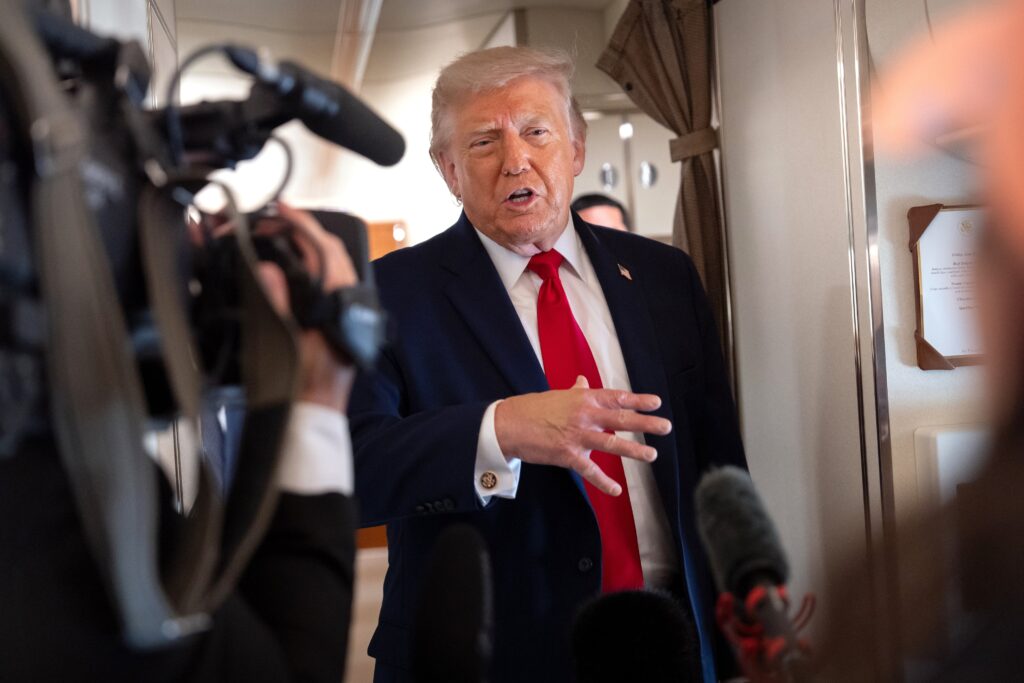
President Donald Trump said the United States would not lift sanctions on Iran or unfreeze its assets up front as part of any peace deal with Tehran and would consider doing so only if other conditions are met, he said on NBC’s “Meet the Press.”
“If they behave, if they do a good job, we start talking,” Trump told NBC’s Kristen Welker in an interview aired Sunday.
The question of economic relief for Iran has emerged as a major sticking point as the two sides pursue an agreement to end the war on Iran, which began Feb. 28, and reopen the Strait of Hormuz. In recent weeks, both sides have signaled they are “close” on a deal, but one has yet to emerge.
“I think we’re very close. We have a couple of points. They don’t even seem like big points,” Trump said in the interview, which was taped in Wisconsin on Friday.
Mohsen Rezaei, a military adviser to Iran’s supreme leader, Mojtaba Khamenei, told CNN on Friday that “if [Trump] wants to reach an agreement with Iran, this $24 billion is a test of trust.”
An Iranian official, who spoke with The Washington Post late last month, said an agreed-upon memorandum of understanding that would open the Strait of Hormuz includes a first phase that would unlock $12 billion in frozen Iranian assets and lift the U.S. naval blockade of Iran’s ports. CNN and others have reported that Tehran wants an additional $12 billion to be unfrozen in a subsequent phase.
At the time, a diplomat familiar with the talks said that Iran’s frozen assets would not be released until it begins giving up its highly enriched uranium, a key U.S. demand.
Asked by Welker why Iran hasn’t agreed to the U.S. ceasefire terms, which include the removal of its highly enriched uranium, Trump said: “Because they’re strong. They’re proud.”
“There are things they never thought they’d be doing that they’re going to have to do. They’ve got no choice,” he added. “And it takes a little while.”
The Trump administration has made limiting Iran’s capacity to build a nuclear weapon a top goal, and Tehran’s openness to turning over its enriched uranium is another significant point of contention in the talks.
If a deal is reached, Trump said, the United States will work with Iran, using U.S. equipment, to remove and destroy its highly enriched uranium. “If we make a deal that now we’re friendly, we’ll all go together,” he said.
“Now, if we don’t make a deal, then we’re going to take them out militarily, very harshly. And we’ll wait until we do that before we go, in which case we’ll have safety either way,” he said.
As he’s done in the past, the president said that the United States has “totally destroyed” Iran’s military. He added that “maybe 21, 22 percent of their missiles” remain. The Post reported last month that U.S. intelligence assesses Iran retains significant ballistic missile capabilities.
Trump said he has not spoken directly to Mojtaba Khamenei, the regime insider who succeed his father as Iran’s supreme leader, but said he would be open to if invited. He described the leader as “younger. I think more rational. Injured. He’s pretty badly injured. So there’s a certain bravery there.”
Asked about the whereabouts of Khamenei, who has been reportedly living in secrecy, Trump said “I don’t want to say whether or not I know where he is. But there’s a good probability that I do,” he said.
On Lebanon, which is also in shaky negotiations to end the war between Hezbollah and Israel, Trump said, the United States is “not demanding” but thinks Lebanese leaders would “like to see” Lebanon be part of a short-term deal.
The United States, Israel and Lebanon announced a ceasefire deal last week, contingent on Hezbollah ending its attacks. But Hezbollah militants called it a “farce,” and both sides continued attacks.
Israel on Sunday struck Beirut’s southern suburbs, days after the ceasefire deal was announced. Defense Minister Israel Katz said last week that the Israel Defense Forces refrained from powerful strikes in the capital, “except for targeted assassinations,” following a U.S. request. He warned then that Israel would strike Dahiyeh, a southern Beirut suburb where the militant group Hezbollah holds sway, if Israel’s northern communities are targeted.
Iranian lawmaker Ebrahim Rezaei on Sunday wroteon X that Iran will deliver a “painful and decisive” response to Israel’s attack on Dahiyeh. “Look at the sky over the occupied lands tonight,” he wrote.
When pressed by Welker to account for how his campaign pledge of “no new wars” squares with the U.S. joining Israel to launch the Iran war, Trump claimed he made no such promise and that this is “not an endless war.”
“I’m doing you and everybody else a big favor,” he said.
He said he put out the “horrible threat” of Iran having nuclear weapons for “many years” and now is going to put it out “permanently.”
“I’m going to do it either through negotiation, where we’re very close to a deal, or I’m going to blow the hell out of them, to be honest with you,” he said, calling the latter “actually the easier path.”
The post Trump says U.S. open to unfreezing Iranian funds, easing sanctions ‘if they behave’ appeared first on Washington Post.