What does it mean when two fashion-forward actresses and luxury brand ambassadors ditch their contractual attire to wear dresses made from discarded scraps of fabric by a little-known designer in Brooklyn?
Last month, Ayo Edebiri, a Chanel ambassador, wore a red-and-white polka-dot, gingham and strawberry-seed print dress by Giovanna Flores to the Drama League Awards. The dress was made from a bag of mismatched pre-cut fabric pieces, including a sleeve and half of a top that Flores found at an upstate New York thrift store.
“It seemed like someone gave up on their project, then donated the fabric,” Flores said. “I filled in the blanks.” A red carpet fashion aggregate on Yahoo described the dress as a “laundry apron.”
Two weeks later, Greta Lee, a Dior ambassador, posted to Instagram a photo of herself wearing a Flores mustard-gold velvet dress during her London press tour for “Toy Story 5.” For more than a year, Flores had been sitting on 10 boxes of velvet panels that had been stretched in the wrong direction.
“I opened the boxes and was like, ‘Oh, this is why they were discarded,’” Flores said.
She decided to splice them vertically with sweatpants, shirts and the dress Lee wore.
The dresses worn by Edebiri and Lee had the low-fi, naïve human touch that defines Flores’s aesthetic, from her fashion collection introduced in 2015 to Flores Paper, a small run of stationery she started with her sister Janelle late last year.
The sisters sell sculptural, spiral notepads made using deadstock from their dad’s print and paper shop in Los Angeles. In just a few months, the items are on track to become an if-you-know-you-know desk accessory, already appearing on the Instagram feeds of members of the indie print elite, including the illustrator Carly Kuhn and Alexandra Gordienko of Marfa Journal.
Flores, 33, offers a look and an ethos that are everything corporate luxury is not: undermarketed, underdistributed and underproduced. Flores’s collection — a delightful surprise from outside the mainstream that hasn’t been sanded down by committee or commercial ambitions — is the fashion equivalent of what made Edebiri and Lee distinctive stars. As valuable as those Chanel and Dior contracts are, it’s just as important to be perceived as someone tapped into the deep cuts. “We’ve still got it!” the looks, chosen by their stylist Danielle Goldberg, seemed to say.
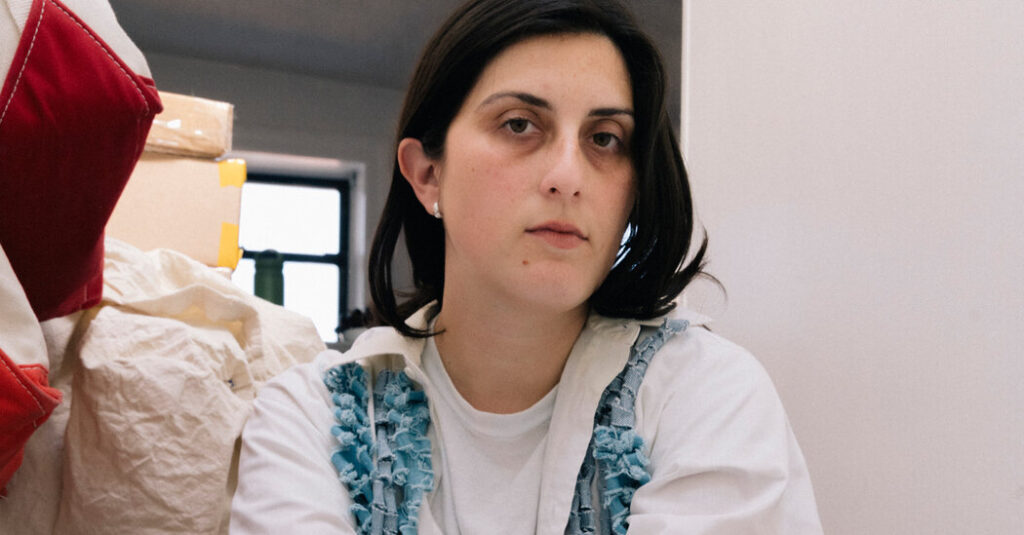
Flores works on her fashion collection alone, sewing and draping every piece by hand from a tiny room in her walk-up apartment across from the Brooklyn Navy Yard. A few weeks before Edebiri wore the strawberry print dress, it was in a messy pile in Flores’s studio. The room was stuffed with cardboard boxes overflowing with what looked like fabric scraps, a shelf of colorful spools of thread, a dress form and a sewing machine.
Flores, who grew up the eldest of three daughters in a Mexican family in Los Angeles, started sewing when she was 12. Her mom put her in a class to quell her anxiety. “Sewing is very therapeutic,” she said. The first project was a pillowcase, but she had her sights on the dress forms in the back.
Flores does not work with patterns. There is no production run. Everything she designs is one of one, much of it made from materials collected over the years from $20-a-bag rag houses and fabric donation sites. She sells her clothes on her website and at Twos, a vintage store in London, because the owner is a friend. She has had talks with more traditional retailers along the way — Opening Ceremony (before it closed), Ssense. Sometimes she holds sales in her apartment or by appointment. If you want a Giovanna Flores piece, you have to know how to find it.
Chloë Sevigny is someone who knows. As captivating for her personal style as for her onscreen career, Sevigny has been onto Flores after receiving one of her vintage polos reshaped with darts as a gift. “I had always been interested in people that upcycled,” Sevigny said. “There was a Holly Hobbie/hippie/preppy kind of overriding thing that really appealed to me.”
In early May, Sevingy wore one of Flores’s reconstructed polo-sweater hybrids on “The Good Buy,” a Harper’s Bazaar podcast. The next week, she was photographed in a loose, patchworked floral dress and matching capri tights by Flores to the Pioneer Works Village Fête, a benefit gala, in Brooklyn.
“Everybody stopped me,” Sevigny said. “People haven’t seen something like it.” A few days later, Goldberg — Edebiri and Lee’s stylist — started following Flores on Instagram. “Two minutes later,” Flores said, “I got an email being like, “Can we pull these dresses?’”
After her sewing classes, Flores was eager to work. “I already had a résumé at 14,” she said. She got a job at Fred Segal Couture in Santa Monica, Calif., selling Pucci, Blumarine, Anna Molinari, Calvin Klein and Missoni. A surfer who sold her own tie-dye designs at the store taught her how to dye. Flores studied fashion design at Pratt Institute in New York and had internships spanning all levels of the fashion ecosystem: Marc Jacobs, Moschino, Narciso Rodriguez. One of her most influential teachers was the designer Susan Cianciolo, who straddled the line between art and fashion with her performances, one-of-a-kind garments and D.I.Y. dress kits.
The stylist Mel Ottenberg pulled a Flores piece, from her graduate thesis collection, for Rihanna to wear on “Saturday Night Live” in 2015. Chris Peters and Shane Gabier, who designed for their label Creatures of the Wind at the time, hired her after seeing her graduate collection. “It reminded me of everything I loved about New York in the mid- to late ’90s,” Gabier said. “It was weirdly stunning.”
Flores has always been attracted to the common castoffs right in front of her. She remembers digging through the recycling bin at her dad’s print shop and bringing home a haul of colorful paper scraps and sheets of stickers to play with.
“They weren’t like fun kids’ stickers,” she said. “I would take the whole page, cut shapes out of it and make my own stickers.” Her father, Javier Flores, has been in the business of printing business cards, We Buy Junk fliers and menus for places like Roscoe’s Chicken & Waffles since the 1980s. The spiral notepads he gives his clients with a candy cane as holiday gifts caught her eye.
“I was like, ‘Wouldn’t these be really cool if they were this tall and white?’” she said. She recast the notepads as swirls that looked like small windswept desktop sculptures, some of them tipped in colors and stripes. Flores and her sister hand-wrap every pad in brown paper and colorful twine, continuing the thread of childlike simplicity and sophistication that runs through her fashion collections.
“It’s just really pretty to me,” she said.
For very niche collections, her range is improbably broad. Just after the Covid pandemic, Peters, who is now senior design director of runway at Tory Burch, was working on his own small upcycled collection, CDLM.
“I had a 1940s polka-dot silk dress from France that was shredded and all this 18th-century metal bullion from the basement of this church in England,” he said. ‘I was like, ‘Gio, you want to make something out of this?’ She came back with this very sexy dress.”
The post The Niche Designer Dressing the A-List appeared first on New York Times.