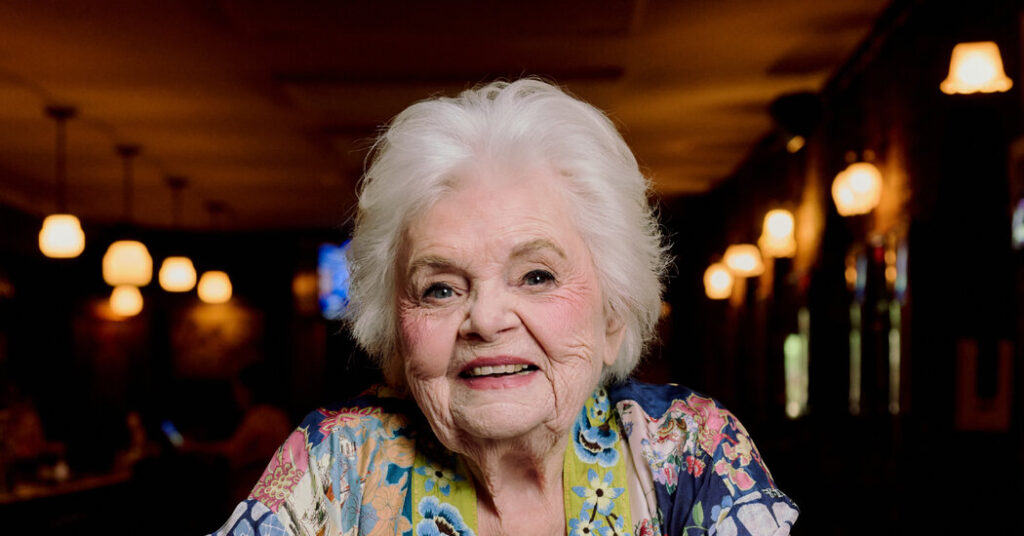
As a striving actress trying to make it in New York starting in the 1950s, June Squibb had learned to sing, weather rejections and scrap around for cash by modeling for romance magazines and hostessing at car shows.
At 38, she was thrilled to have landed her biggest Broadway role yet. So you can forgive her for being a little bit irritated when her mother, after seeing the show, asked whether it was finally time for her daughter to return to her hometown in rural Illinois (population 5,000).
“‘Well, are you going to come back home now?’” Squibb recalled her mother saying after seeing her perform in “The Happy Time,” a musical by John Kander and Fred Ebb, in 1968.
She certainly would not be.
Over a stage career of more than 75 years, Squibb has never viewed acting as a phase of her life — something from which to eventually retire or move on from. At 96, she has received her first Tony nomination, for her featured role in “Marjorie Prime.” The play, about aging and grief, proved to be one of the most demanding roles of her life.
“I don’t think I ever thought of it as something you stop,” said Squibb, sipping a martini a couple of a days ago at Joe Allen, the theater district haunt that she started frequenting not long after it opened in 1965. “But when I read a script, I think, physically, can I do it?”
Had she ever had to turn anything down?
“Well, nothing that I wanted to do,” Squibb said. She agreed that age can sometimes make a convenient excuse.
Squibb is one of the oldest acting nominees in Tonys history; she is likely the oldest, though representatives for the awards have not been able to say so definitively. It’s an honor that Squibb seemed to appreciate — though perhaps not as much as she appreciated when the waitress came by with martini No. 2.
“I really spend very little time thinking about my age,” she said.
But there were still perks: “For me, it’s like, I can sit down. Nobody’s going to question it when I sit down, you know?”
Over a bowl of vegetable stew, Squibb traced through a stage career filled with both bit parts and features; musicals and straight plays; successes and some flops. (The macabre cabaret show “Gorey Stories,” in which she played a “spinster” never made it past its Broadway opening in 1978, because the producers ran into money troubles.)
It started when she was 19, after she had escaped her hometown, Vandalia, Ill., where her father sold insurance to farmers and her mother taught piano lessons. After five years at Cleveland Play House, she moved to New York, where she soon became recognizable by casting directors for her blond pixie cut, comic panache and plucky spirit.
At 30, Squibb landed her first Broadway role by pretending to be experienced in “strip movement” during an audition to join the first production of “Gypsy,” starring Ethel Merman. It was in those early years in New York that a friend explained what others in the theater world were saying about her.
“They’re calling you the foulest mouth on Broadway,” the friend told her.
Squibb said she is much more restrained in her language now than she used to be. Her hair stylist, John Francis, who joined for dessert, agreed: “Occasionally she might drop an F-bomb here or there,” he said. (She only used it twice at dinner, once in reference to the state of American politics.)
Kelly Sweeney, her longtime assistant, broke in with another classic “Junie” anecdote.
“What about the one where you push the girl off the stage?” Sweeney asked.
Squibb nodded: It was true. While performing in an Off Broadway revival of a musical comedy called “The Boy Friend” in the late 1950s, she asked another performer to give her some space onstage, but the young woman continued to crowd her. One night, when the dancer was close to the edge of the stage, Squibb decided to nudge her right off.
“She got back up onstage, she started dancing again, and she never said a word to anyone,” Squibb said.
As for her life offstage, she said both her first husband and second, with whom she had a son, were supportive of her career, though the first one balked when she wanted to take a job at a burlesque house in New Jersey.
There were plenty of other opportunities outside of New York: a U.S.O. tour in East Asia during the Vietnam War, stints at regional theaters in Baltimore and Philadelphia and sporadic onscreen roles in Los Angeles. She ultimately settled there after the death of her second husband — of nearly 40 years — in 1999.
By then, her film career was picking up. She received an Academy Award nomination for the 2013 film “Nebraska,” but it wasn’t until her 90s that she debuted in her first leading Hollywood roles, in “Thelma” (2024) and “Eleanor the Great” (2025).
“I think that there’s an interest in our whole world, our whole country, about aging, because we’re becoming an aging population,” Squibb said. “I just feel that people are really more interested in the aging process. I think they want to know about retirement homes. I think they want know what you can still do and what you can’t do.”
The films gave Squibb a new level of public exposure — and plenty of opportunity to share her catalog of feisty anecdotes to an eager circuit of talk-show hosts and podcasters. A team making a documentary about her life has been visiting her on and off for months.
Last year, when Squibb was invited to make a return to Broadway — her first since a stint in the musical “Waitress” in 2018 — some of her friends told her she would be out of her mind to take the role. With eight performances a week, it was likely to be much more taxing than film work.
But Jordan Harrison’s script for “Marjorie Prime,” she said, was just too good. Set in the future, the play follows her character, Marjorie, as her son-in-law (Danny Burstein, a Tony nominee for the role) experiments with an A.I. replica of her deceased husband as a way to help ease her mental decline. But this is to the discomfort of Marjorie’s daughter (Cynthia Nixon).
During the production, Squibb was accompanied to New York by Sweeney, her assistant and fierce advocate. Sweeney insisted, for example, on the perfect armchair for Squibb to sit in on the set.
“I’m very strict,” Sweeney said. “I suss it out, I push it: ‘It’s too soft, it’s too low. It needs a pillow, not that kind of pillow.’ And they’ll do it.”
Over the course of the play’s three-month run, Squibb said she only missed one performance. It wasn’t because of illness or exhaustion, but rather a blizzard that prevented her from taking a car to the theater.
At Joe Allen, over a slice of banana cream pie, Squibb described her recent project and the ones still to come. She just finished filming the final season of “Yellowjackets” in British Columbia. And later this year, she’ll film the second season of “Killer Grannies,” a true-crime series about elderly criminals that Squibb hosts.
After that, she said, “I have about five films that I’ve been asked to do.”
Julia Jacobs is an arts and culture reporter who often covers legal issues for The Times.
The post The ‘Foulest Mouth on Broadway’ Is Up for a Tony appeared first on New York Times.