“Who here knows what the ‘F’ in N.F.L. stands for?”
The question, posed by a teacher at Daegwang Elementary School in Seoul on a recent Friday, sent befuddled murmurs rippling through the 86 third graders seated in the school’s auditorium. Finally, a boy cheerfully piped up: “France?” Exasperation darkened the teacher’s face.
Misunderstandings like these would be corrected by the day’s event, a read-along arranged by the Los Angeles Rams. After the children had been given copies of a colorful picture book — a primer on football culture featuring landmarks like the Santa Monica Pier — an upbeat emcee named Jennifer took the stage as Rampage, the team’s mascot, jumped out and began striking poses. The children cheered.
The event was part of the National Football League’s latest effort to globalize. It has been selling out its games in cities like London, and last year, Roger Goodell, the N.F.L.’s commissioner, declared that Asia was next in its sights. The league’s 32 teams are now in 22 countries marketing their brands and courting new football fans. In addition to South Korea, the Rams hold marketing rights in China, Japan and four other countries.
“In Korea, our primary focus is the youth,” said Stephanie Cheng, the Rams’ head of international projects.
The N.F.L. is also getting a push from the Trump administration, which sees the export of football as a way of strengthening American influence abroad. In February, the State Department hosted Super Bowl watch parties for “high-value audiences” in 60 countries.
The N.F.L. has made flag football, a no-contact version of the sport, a centerpiece of its globalizing strategy, successfully lobbying for the game to be included in the 2028 Olympic Games in Los Angeles. The Rams, for their part, hope that South Korea’s ties to its large diaspora in Los Angeles will get South Koreans excited about their brand, as well as the sport itself.
But many South Koreans still confuse football for rugby. And how would parents feel about their children playing a sport that is controversial for its injury risk?
“They probably wouldn’t like it,” said Shin Youn-hie, Daegwang Elementary’s vice principal. “We participated in this program because of the English reading element. But who knows? Maybe one of these children will grow up to be interested.”
The history of American football in South Korea is surprisingly long: The first college clubs were founded in the 1940s and ’50s, some using equipment discarded by U.S. soldiers at military bases that were established in Seoul after World War II. But since then, as soccer and baseball ascended, football has hobbled along at the fringes.
Kim Sung Il played quarterback, left tackle and linebacker for the Yonsei University Eagles in the 1980s. “We never had enough players so everyone had to play multiple positions,” he said.
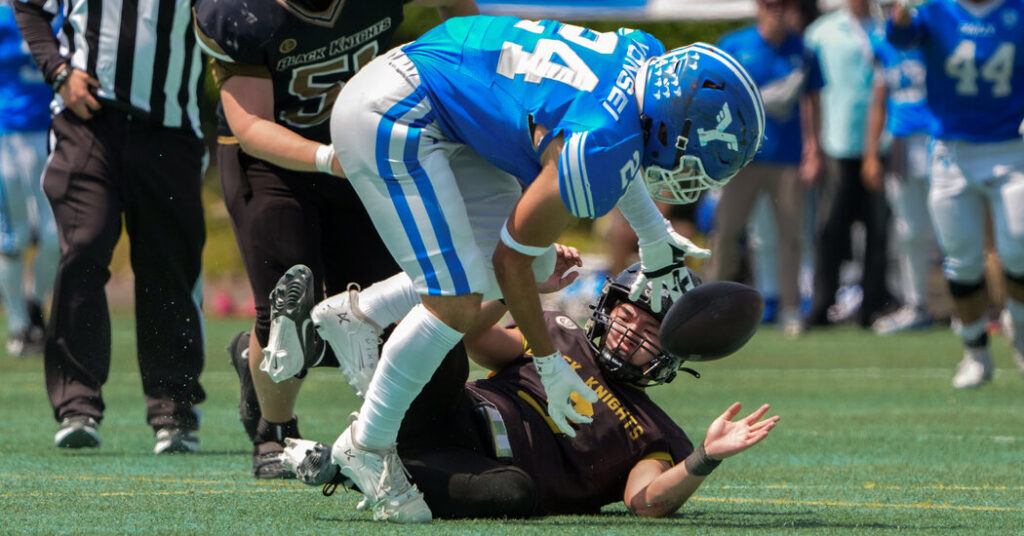
A retired diplomat, Mr. Kim, 65, is now the general manager of the Eagles. On a recent Saturday, the team faced off against the Black Knights of the Hankuk University of Foreign Studies, in the college league’s spring tournament.
The game was held on a rented soccer field in Seoul, where a group of players hoisted up jury-rigged football goal posts, wedging them securely into the soccer nets. Crooked yard lines were drawn with turf chalk.
The size of South Korea’s football fandom is a mystery, even to the N.F.L. A common estimate is 150,000, the number of subscribers to a popular South Korean football YouTuber’s channel.
The Eagles-Knights game drew a single fan: Song Ji-na, 26, a game developer who stood on the sidelines in the baking sun, watching through thick-rimmed shades. Like many young South Koreans, her introduction to the sport was the Japanese manga series “Eyeshield 21,” in which a boy’s experience running from bullies helps him excel in football. She was soon joined by a friend she had invited, also a manga convert.
“I like it because it’s a little more violent than other sports,” Ms. Song said, as the Eagles pummeled their way to a 47-27 win. She said she had been to around 30 college games, “but I haven’t ever run into another fan.”
Flag football’s newfound Olympics legitimacy could bring in more fans, said Hong Dong Hyuck, the managing director of the Korea American Football Association and an agricultural technology professor at Kyungpook National University.
“P.E. teachers are into it because it’s exciting and new,” he said. “They’re tired of teaching soccer or volleyball again and again.”
The association recently secured about $600,000 in annual funding from the South Korean government, which it has used to hold flag football clinics at schools and organize tournaments. Last year, the Rams held their own flag football clinic. There are currently around 40 youth clubs in the country. Mr. Hong aims to add at least 100 more this year.
Can flag football endure in South Korea? Niche sports like archery or speedskating have survived here because they regularly bring home medals, which sustains funding. But flag football is dominated by the United States, where the N.F.L. is already developing a professional league for both men and women. Some wonder whether South Korea can be competitive enough at the next Olympics to generate similar interest.
“It will be virtually impossible to qualify for the Olympics with just the local talent we have now,” said Park Jae-sik, the general manager of the South Korean national flag football team.
He plans to hold tryouts in the United States and recruit N.F.L. players with Korean heritage, like the Minnesota Vikings quarterback Kyler Murray, who has publicly expressed interest. The league’s owners recently voted to allow its players to join Olympics rosters.
Mr. Hong, who wants to hire an American coach for the Korean national team, said that football would need a local spin if it is to thrive here.
“American football is all about the spectacle,” he said, musing whether cheerleading culture and K-pop might be fused in some way. “I’m thinking about that a lot these days.”
Chang W. Lee has been a photographer for The Times for 30 years, covering events throughout the world. He is currently based in Seoul. Follow him on Instagram @nytchangster.
The post Can the N.F.L. Win Fans in South Korea With Flag Football? appeared first on New York Times.