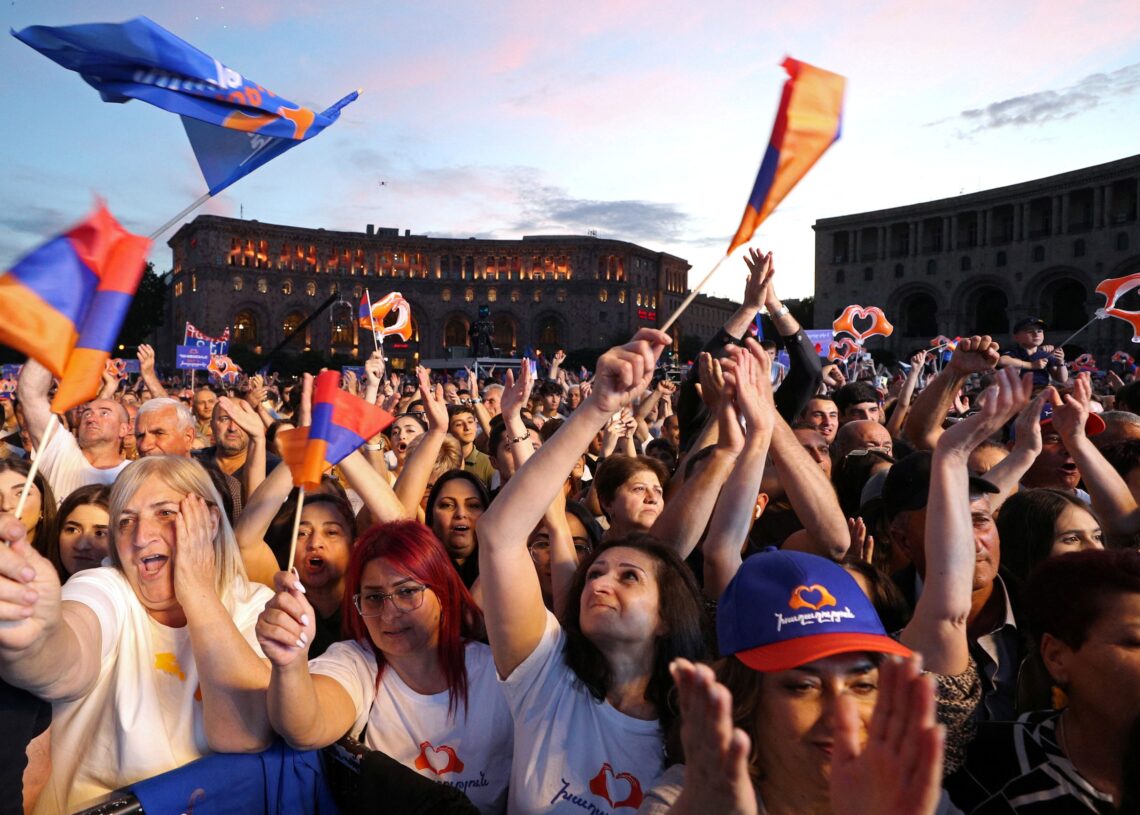
In a Great Game-style tug of war between Russia and the West for influence in the strategic South Caucasus, tiny Armenia is reaching toward the European Union and the United States, drawing punishing economic penalties from Moscow and even an oblique threat from President Vladimir Putin that the country could face the same terrible fate as Ukraine.
Ahead of a national election on Sunday, Armenian Prime Minister Nikol Pashinyan has been talking up his hope of joining the E.U. and he has expressed gratitude for President Donald Trump’s “COMPLETE and TOTAL endorsement.”
Trump has also boasted of his efforts to broker peace between Armenia and neighboring Azerbaijan, and has literally put his name on the region, with a plan for the Trump Route for International Peace and Prosperity — a joint venture that would transform a derelict stretch of Soviet-era railway into a 26-mile trade link.
But for Putin, who has been losing sway over the broader region since Russia invaded Ukraine in 2022, an even greater offense was Pashinyan’s appearance with Ukrainian President Volodymyr Zelensky at an event in Yerevan, the Armenian capital, last month, where they shook hands and exchanged remarks in English rather than Russian.
At the event, a gathering of the European Political Community, Zelensky told the leaders of more than 50 nations that this summer is “the moment when Putin has to decide what to do next: expand his war or follow a diplomatic path” and threatened more Ukrainian drones hitting Russian cities.
“Two mindless Russophobes who speak excellent Russian spoke in poor English due to their inferiority complexes,” former Russian president Dmitry Medvedev posted on social media.
French President Emmanuel Macron also used the Yerevan event to accuse Russia of treachery for not coming to Armenia’s aid during its war with Azerbaijan over the disputed territory of Nagorno-Karabakh. “Russia was not there for Armenia — no more than it was for Venezuela, Syria or Iran,” Macron said.
Moscow, which still maintains a large military base on Armenian soil, has responded to Yerevan’s westward drift with mounting pressure. Just days before the election, Russia reached for a familiar tool of coercion, banning imports of Armenian flowers, fruit, vegetables, alcohol and mineral water.
Putin has insisted that Armenia cannot simultaneously belong to the Eurasian Economic Union — a trade bloc with Kazakhstan, Belarus and Kyrgyzstan — and the European Union, and he has warned ominously about the consequences, including a potential loss of 14 percent of GDP without Russian investment.
At a recent summit of the Eurasian Economic Union in Kazakhstan, which Pashinyan skipped, Putin said: “The crisis in Ukraine began with attempts to join the E.U.” The Russian leader asked Armenia to hold a referendum on E.U. membership as soon as possible.
Analysts said the remark was designed to stoke divisions in Armenia and boost the chances of pro-Russian candidates ahead of Sunday’s vote.
While Trump and Putin each seem to envision a return to a world in which great powers divide up spheres of influence, Trump has shown little deference to Russia’s historic role in the South Caucasus.
Pashinyan, for his part, seems less interested in taking sides than in diversifying alliances, reducing Armenia’s economic and security dependence on Russia, and ending its enmity with Azerbaijan and Turkey after more than 30 years of war over Nagorno-Karabakh.
Armenia’s pivot is part of the broader realignment rippling through the region since Russia’s full-scale invasion of Ukraine, which drained Moscow’s resources and sent many former satellite states adrift and in search of new friends. Many recent elections in the post-Soviet space have been defined by fears of suffering Ukraine’s fate.
The rapport Yerevan has built with Washington is also an extension of Trump’s unorthodox geopolitical ways. Armenia’s rapprochement with the United States began under President Joe Biden’s administration, and it was far from clear that Trump would take a similar interest in a remote and complicated region.
But Armenia, which Trump once mistakenly called Albania when praising his success in reconciling it with Azerbaijan (which he called “Aber-baijan”) — became yet another entry on the list of wars the president claims to have settled.
In fact, Azerbaijan won the war by force, with a lightning offensive in September 2023, retaking territory that was long recognized internationally as belonging to Azerbaijan but that was populated largely by ethnic Armenians and occupied by Armenia since the early 1990s.
For Trump, the stars largely aligned in allowing him to help forge the postwar relationship between the historical enemies.
“President Trump said that he’s really very interested in supporting peacemaking in the world, and Armenia was actually the most ready country at that time to go with a peace agenda,” said Narek Mkrtchyan, Armenia’s ambassador to the United States.
At the core of Trump’s plan is the Trump Route for International Peace and Prosperity (TRIPP), the proposed trade that will run through Armenia, connecting Azerbaijan to its Nakhchivan exclave and to Turkey while bypassing Russia and Iran.
In late May, Secretary of State Marco Rubio and his Armenian counterparts signed three deals during a brief airport visit, including a framework agreement on TRIPP.
To win Trump’s attention, Armenia also positioned itself as a country rich in critical minerals that is willing to give the U.S. a share of its resources. It has also tapped into the artificial intelligence rush by striking a deal to build an AI supercomputing facility — which, if successful, would be the first large-scale AI data center in the South Caucasus.
Pashinyan has been recalibrating Armenian foreign and domestic policy around what he calls “Real Armenia” — an ideology that envisions moving on from the painful losses in Nagorno-Karabakh and parts of eastern Turkey where large numbers of Armenians once lived.
“By this, he means the idea that Armenians should concern themselves primarily with events inside Armenia’s recognized national borders, rather than the wider ‘historical Armenia,’” said Joshua Kucera, an expert on the region at International Crisis Group, the Brussels-based policy institute.
Pashinyan and his allies look set to win on Sunday.
Polls show his Civil Contract party with a commanding lead and on track to secure a parliamentary majority, but how much leverage he gains to advance his agenda, especially normalizing relations with Azerbaijan, will depend on the precise outcome.
As a condition for signing a final peace deal, Azerbaijan has demanded that Armenia amend its constitution and remove language that could be interpreted as laying claim to Nagorno-Karabakh and parts of Azerbaijani territory.
To push that through, Pashinyan will need a two-thirds majority to trigger a referendum. Without that legislative muscle, the peace process could stall.
The U.S. plan to set up a railroad in what Moscow considers its own backyard has set off angry grumbling in the Kremlin.
Deputy Prime Minister Alexey Overchuk, who is responsible for Eurasian integration, warned that “the arrival of outsiders in the South Caucasus region will disrupt the established security balance.”
The TRIPP project has also faced backlash from pro-Russian political forces inside Armenia.
Former president Robert Kocharyan, who is backed by Russia and has made opposing Pashinyan’s Western tilt his central political mission, recently accused the prime minister of abandoning the country’s traditional alliances and accommodating longtime adversaries instead.
Kocharyan dismissed TRIPP as a PR project “blown up to a planetary scale” and criticized it for stoking tensions with Iran and Russia.
TRIPP promises Armenia a role as a regional transit hub, but the economics only work if Turkey agrees to reopen its land border, which Turkey has said will depend on the final Armenia-Azerbaijan peace deal that has yet to be signed.
In the meantime, Turkey and Azerbaijan are building their own railway bypassing Armenia, which could weaken Yerevan’s leverage.
Complicating things further, Russia has operated Armenia’s entire rail network under a 30-year concession since 2008, meaning the very track TRIPP requires is controlled by Russian Railways.
A clean break with Russia would be difficult, if not impossible, for Pashinyan. Hemmed in by closed borders with Turkey and Azerbaijan, which have long constrained its development, Armenia has relied on Russia as the destination for more than one-third of its exports.
Pashinyan recently has taken strides to signal he is willing to maintain flexible relations with Russia. But with few strategic options left after losing Nagorno-Karabakh, he appears to have concluded that his country’s best prospects lie with the West.
E.U. accession, he has argued, would benefit the country regardless of the outcome — aligning with European standards would modernize institutions and open up new markets.
“Our foreign policy doctrine is about balance,” Mkrtchyan, the ambassador, said. “Armenia is a landlocked country with nearly 80 percent of its borders closed — we have always needed this kind of diversification.”
The post Armenia, caught in Trump-Putin power contest, eyes E.U. and feels Russia’s ire appeared first on Washington Post.