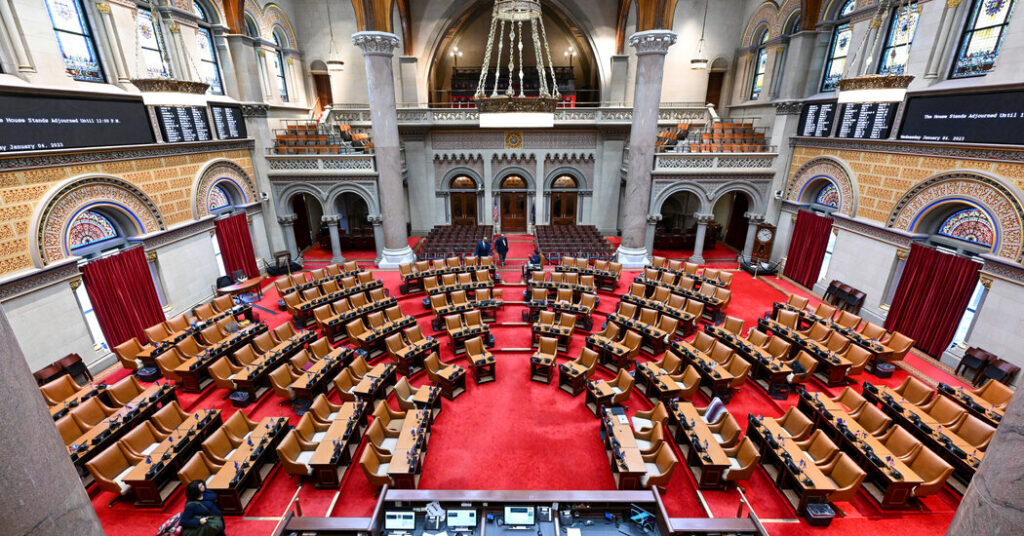
New York State lawmakers gaveled out on Friday, ending a session with its share of triumphs and disappointments.
They passed two major pieces of legislation related to the use of data. One bill restricts the use of consumer data in price setting; another bill imposes a one-year moratorium on mammoth data centers used to power generative A.I.
Democratic lawmakers also took the first step in a two-year process to allow the Legislature to aggressively gerrymander electoral maps, in response to Republican efforts in Texas and other states. If approved by voters, those changes would give New York Democrats broad latitude over when and how maps are redrawn — in part by removing the statutory prohibition on drawing lines to harm a specific candidate or party.
Even so, there seemed to be a gnawing sense that the Legislature could have done more, with some lawmakers frustrated that they would be returning to their home districts with a slightly shorter list of accomplishments than in years past.
Negotiations over the state budget, the latest in almost two decades, took up nearly all of the legislative session. This left the Legislature with a single week to advance its own agenda — a particularly cruel blow, given that this is an election year.
The result was a session that achieved just about all of the goals of Gov. Kathy Hochul, a Democrat seeking re-election this year.
“The governor’s power grows as her control of the legislative session grows,” said Blair Horner, a senior policy adviser at the New York Public Interest Research Group, a nonpartisan consumer group, and a longtime observer of the dynamics of Albany. The truncated legislative session had another unusual effect, he noted: It empowered Republicans.
“If the minority is willing to debate a bill, it’s much more likely to get killed,” Mr. Horner said. “Therefore, issues of consequence fall off the table.”
This year there were many consequential issues: The 450,000 people kicked off a subsidized state health plan as a result of the Trump administration’s actions. An effort to expedite the process for connecting renewable energy to the grid. An ambitious push to address the proliferation of plastics spreading into the soil, water and people’s bodies.
The Senate majority leader, Andrea Stewart-Cousins, acknowledged the difficulty of the drawn-out budget process. Even so, she said, she believed her conference had delivered.
“I’m leaving here feeling that we’ve accomplished the important things that we needed to accomplish,” she told reporters on Thursday. “I always tell my members, we live to fight another day.”
One of the most meaningful initiatives for consumers is a bill backed by the attorney general, Letitia James, that ban companies from using consumer data to set personalized prices online based on what they believe the buyer will pay, also known as surveillance pricing.
“Personal data is being shared on us, like our ZIP code, or when we’re getting a paycheck, when we’re more able to pay more or less for a good, if we’re closer to a store,” said Emérita Torres, a Democrat who sponsored the One Fair Price Act in the Assembly.
The result, she said, was that “two people get different prices for the same products or services — and that’s inherently unfair.”
That legislation was vigorously opposed by companies like Uber and Instacart, which targeted users with messages opposing the bills. A companion measure that would have banned digital price tags passed the Senate but died in the Assembly.
The measure to pause the construction of so-called “hyper-scale” data centers affects facilities over 20 megawatts, which power the largest data needs, including generative A.I. There are 28 of these centers currently in the pipeline, according to Senator Kristen Gonzalez. If constructed, she said they would expand the entire state’s energy use by roughly a third.
That could cause serious upheaval, given the state’s existing energy needs, not to mention its goals of shifting to renewable and zero emission energy sources over the coming decades.
The bill advanced by the Legislature requires companies to help cover the cost of connecting to the grid and any improvements necessary to ensure that costs are not passed along to New Yorkers. It also creates a requirement that even smaller data centers use increasing amounts of renewable energy to power their operations — from roughly one third by 2035 to 90 percent by 2040.
Lawmakers believe this could help spark investment in renewables more broadly.
“I hope that this increases investment in building out renewable energy,” said Ms. Gonzalez, a Democrat who represents parts of Brooklyn, Manhattan and Queens. She added: “I hope it gives a lot of people and also a lot of states, hope that we can take on these tech Goliaths, and we can win the government.”
Republicans and some within the business community worry both measures — the moratorium and pricing restrictions — will harm New York’s economy at a time when job growth is already slowing.
Keith Brown, a Republican representing central Long Island, said during the Assembly debate that the moratorium would “send a message that this state is closed for business.”
“I fear we are going to turn New York into another Rust Belt state,” he added.
All of the legislation passed will require the signature of Ms. Hochul to become law.
For years, the Legislature vied with the governor to set the agenda for the state. Former Gov. Andrew M. Cuomo was known to be a shrewd and at times abrasive negotiator. And although he was considered a more moderate Democrat, Mr. Cuomo nonetheless signed into law a spate of progressive priorities from bail reform and new tenant protections to the nation’s most ambitious climate law.
When Ms. Hochul inherited the office after Mr. Cuomo’s resignation, she promised a new era of collaboration with the Legislature. Five years later, however, Ms. Hochul has settled into a negotiation style that is more coercive than collaborative.
The governor has increasingly used her leverage over the state budget to force the Legislature to accept her policy priorities — some of which run counter to theirs. She has repeatedly demanded the Legislature weaken or rollback signature reforms like changes to the criminal justice system.
The coup de grâce came this year, when Ms. Hochul was facing pushback from the Trump administration over renewable energy development and convinced the Legislature to water down the 2019 climate law. A mandate to convert school buses to electric was also delayed.
Many lawmakers hoped that they could use that loss as leverage to pass the Packaging Reduction and Recycling Infrastructure Act, which would have required the companies producing goods to reduce single-use plastic in packaging by 10 percent over three years and 30 percent over 12 years. The bill has been a key priority for many environmentalists, who cite the proliferation of micro and nano-plastics in the soil, water and human body and mounting evidence of their links to cancer and infertility.
But aggressive lobbying from an army of chemical and food companies, who warned it could drive up consumer prices, helped to kill the bill in the final days of session.
Grace Ashford covers New York government and politics for The Times.
The post N.Y. Lawmakers Move to Pause Data Centers and Curb Surveillance Pricing appeared first on New York Times.