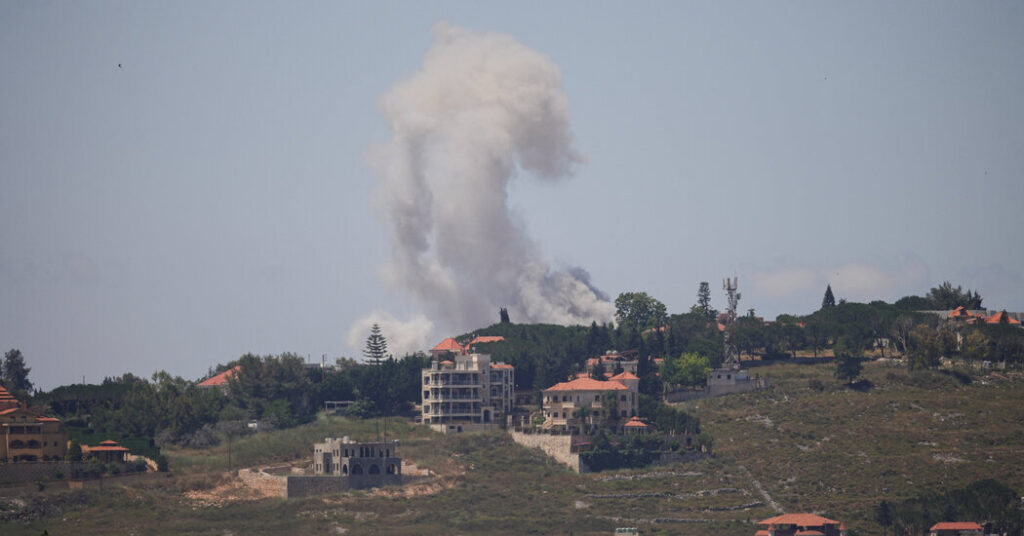
An Israeli strike in southern Lebanon on Saturday killed three Lebanese soldiers, including a brigadier general, the Lebanese military said, piling further pressure on a fragile U.S.-brokered cease-fire between the countries.
The general was the most senior Lebanese officer killed since violence erupted in early March between Israel and Hezbollah, an Iran-backed militia that dominates parts of southern Lebanon. Hezbollah is not controlled by the Lebanese government and was not involved in the talks between Lebanon and Israel.
The deadly strike targeted a military vehicle near the southern city of Nabatieh, the Lebanese military said, as it denounced what it called “continued, deliberate and repeated” Israeli attacks inside the country.
The Lebanese army is not party to the conflict between Israel and Hezbollah, and it is outnumbered by the group in much of the country. But Lebanese soldiers have sometimes been sucked into the violence since Israel invaded Lebanon in March and occupied parts of it after Hezbollah began firing rockets into northern Israel in response to the U.S.-Israeli attack on Iran.
The Israeli military acknowledged the strike in a statement and said that the vehicle had been moving “suspiciously” toward Israeli troops in southern Lebanon. It said that Israel had received “concrete indications” that Hezbollah would fire on Israeli soldiers in that area, leading the soldiers to view the vehicle as a threat, and that the incident was under review.
The strike occurred days after Israel and Lebanon announced the latest in a series of U.S.-brokered cease-fire agreements, none of which have stopped the fighting between Israel and Hezbollah.
The new agreement was intended to halt an escalating Israeli offensive targeting the group that began last week. But Israeli strikes have continued across Lebanon, and Hezbollah has kept up its attacks on Israeli troops in the country’s south. Naim Qassem, the group’s leader, rejected the Israeli-Lebanese agreement as tantamount to “surrender,” as it required it to unilaterally cease its attacks without any immediate concessions from Israel.
Both the Israeli military and Lebanese military are backed and funded by the United States. The latest killings may prove politically sensitive there because Israeli officials have repeatedly said that their war was only with Hezbollah, not the Lebanese state. Lebanese and Israeli military officials have also been taking part in the direct talks in Washington, but the attack threatens to undermine the Trump administration’s efforts to stop the fighting.
President Joseph Aoun of Lebanon condemned the deadly strike as a “flagrant violation” of international law. Mr. Aoun, a former army general who previously commanded the military, urged the international community to “put an end to these repeated attacks.”
Roughly three dozen members of Lebanon’s security forces have been killed in the war, according to Armed Conflict Location and Event Data, or A.C.L.E.D., an independent nonprofit organization funded by the United Nations that tracks global conflict.
Before the latest strike, the Israeli military had hit Lebanese security forces at least 21 times since the start of the conflict, killing 30 personnel and wounding 17 others, said Bassel Doueik, an A.C.L.E.D. researcher.
Those attacks, he added, were “inconsistent” with Israel’s assertions that it is only targeting Hezbollah, and make the Lebanese government’s tenuous push to disarm the Iran-backed group more difficult.
“These incidents not only erode the operational capacity and morale of the institutions tasked with extending state authority, but also complicate the government’s broader effort to consolidate control,” he said.
For decades, the Lebanese state has struggled to assert control over much of southern Lebanon, where Hezbollah has long exercised de facto authority. Israel has cited the group’s military buildup along the border to justify repeated invasions.
Dayana Iwaza contributed reporting.
Euan Ward is a Times reporter covering Lebanon and Syria. He is based in Beirut.
The post Israeli Strike Kills 3 Lebanese Soldiers, Days After Truce Was Signed appeared first on New York Times.