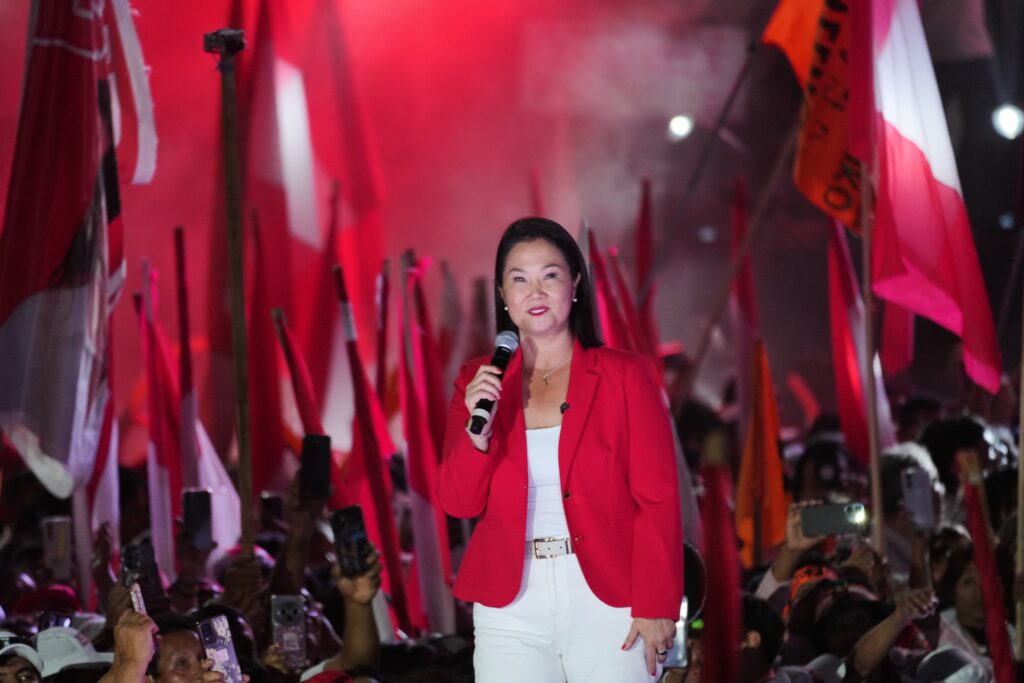
LIMA, Peru — Her father saved Peru from hyperinflation and a blood-spattered Maoist insurgency but ended his presidency in disgrace, accused of vote-rigging, kleptocracy and murder. She herself has been jailed on charges of money laundering.
Few politicians carry quite as much baggage as Keiko Fujimori. Yet polls give the right-wing former congresswoman and party boss a strong chance, on her fourth attempt, of winning the presidency of this South American nation in its runoff election Sunday.
Voter surveys indicate a tight race between Keiko, as she is known universally here, and Roberto Sánchez, her left-wing opponent, a polarizing choice that has left Peruvians despairing for the future of their democracy.
Fujimori, promising to restore authority in a society racked by political turmoil, endemic corruption and surging violent crime, has walked a delicate line between evoking the successes of her late father Alberto Fujimori’s 1990-2000 presidency and ignoring the dark side of his legacy.
“Order or chaos. These are the two options that our country faces today,” she said Sunday during a televised debate with Sánchez. “Order is … knowing that you will go out to work, and then return safe and sound to your home.”
Alberto Fujimori was initially revered for his supposed technocratic efficiency — thanks, in part, to racist notions about his Japanese ancestry. He became known for his no-nonsense style, his helicopter visits to marginalized Andean and Amazonian communities previously ignored by Lima politicians and presiding over the defeat of the Shining Path guerrilla insurgency.
But his presidency also saw Congress shuttered, journalists bribed to smear opponents and the forced sterilization of poor and Indigenous women. Suspected terrorists were targeted by a clandestine death squad; among the Colina Group’s dozens of victims were an 8-year-old boy and other innocents
Fujimori was convicted of multiple human rights abuses, including kidnapping and murder. He was sentenced to 25 years in prison; he died in 2024.
Keiko Fujimori, 51, has said her father committed “errors.” In a rare interview this week, with CNN Español, she went further: “Those horrendous crimes committed by the Colina Group will in no way be permitted or happen in a Keiko Fujimori government.”
She has pledged to cut red tape to boost investment, build new maximum-security prisons and deploy the armed forces to combat violent crime.
But her surname isn’t her only challenge. Arguably Peru’s most powerful politician of the last decade, she is widely blamed, as founder and leader of the party that dominates Congress, for the nation’s recent instability.
Her party, Popular Force, has repeatedly played kingmaker, forcing out multiple presidents but propping up Dina Boluarte as she faced a string of graft investigations and presided over the massacre of anti-government protesters.
Meanwhile, the party has been instrumental in passing legislation undermining basic freedoms and favoring organized crime. The measures have included blocking nonprofits from suing the government over human rights violations, limiting the use of plea deals in complex criminal investigations and passing amnesties for military and police officers accused of extrajudicial executions.
In recent months, the congressionally appointed panel that hires and fires judges and prosecutors has ousted respected chief prosecutor Delia Espinoza, on what critics called arbitrary grounds and begun removing magistrates who have defied the party.
Fujimori spent 16 months in pretrial detention in two stints from 2018 to 2020 for allegedly laundering illegal campaign donations, including from Odebrecht, the Brazilian construction giant at the center of a sprawling international corruption scandal. She called it political persecution. The constitutional court eventually annulled the case on procedural grounds.
“Keiko doesn’t represent order. She represents impunity and criminality,” said Gloria Cano, a human rights lawyer in Lima. “She has governed from the shadows and destabilized governments, captured institutions and attacked the rule of law.”
That Fujimori, the runner-up in 2011, 2016 and 2021, could finally win is an indication of how deeply unpopular her opponent is, too. Sánchez, 57, a member of the outgoing scandal-plagued Congress, is an ally of Pedro Castillo, the populist president whose government collapsed in 2022 amid accusations of ineptitude, graft and, finally, a self-coup.
Castillo, the political outsider who defeated Fujimori in 2021 as the candidate of a Marxist-Leninist party, attempted to avoid impeachment the following year by dissolving Congress and ruling by decree. He was convicted last year of fomenting a rebellion and is serving an 11-year prison term.
Sánchez has been campaigning in the straw sombrero favored by Castillo. His original manifesto promised to nationalize swaths of the economy, halt a range of imports and impose controls on the media.
Sánchez has been accompanied on the campaign trail by Antauro Humala, the radical brother of another jailed former president, Ollanta Humala. Antauro was recently released after serving a lengthy prison sentence for leading a 2005 military uprising against an elected government. He has called repeatedly for the execution of corrupt politicians — starting with his own sibling.
Since finishing second to Fujimori in the first-round vote, Sánchez has been distancing himself from Antauro while promising to revoke recent Fujimorista legislation. In doing so, he has won qualified endorsements from several moderate opponents defeated in the first round.
“Uncontrolled criminality has intensified further because one parliamentary group, to launder its misdeeds, rulings and sentences, has subverted the justice system and generated pro-crime laws,” Sánchez said during the debate.
Political scientist Gonzalo Banda believes Fujimori could finally win the presidency — and fears what it might mean for Peru.
She has benefited, he said, from demographic change. With an average age of 34, fewer Peruvians have any personal recollection of her father’s abuses.
“It’s generational,” Banda says. “Anti-Fujimorismo has run out of road. When you see videos on social media against her, it’s people who are 35, 40 or over.
“I thought Alberto Fuijimori would have been buried in shame, in private, with just his family. But he actually got a state funeral.”
It’s Keiko Fujimori’s fourth trip to the second round, but the first time that she has won the first round. Pollsters warn than that an unusually high number of voters, around 1 in 4, have yet to decide how they will cast their ballots.
The runoff may once again boil down to which of the two candidates is least loathed — or, as Peruvians wearily express it, “the lesser evil.”
The post Fourth time could be the charm for Keiko Fujimori, Peru’s most polarizing politician appeared first on Washington Post.