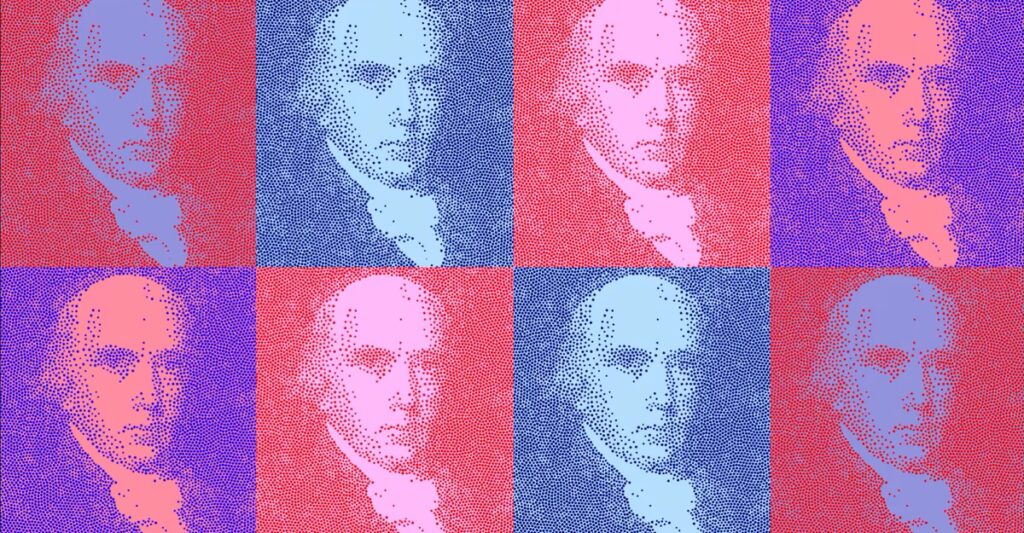
In 1787, as the Founders gathered in Philadelphia to draft the Constitution, Alexander Hamilton wrote in “Federalist No. 1” that there was more at stake than the future of a single country. The American experiment would “decide the important question, whether societies of men are really capable or not of establishing good government from reflection and choice, or whether they are forever destined to depend for their political constitutions on accident and force.”
The Founders were hopeful, in part because the information environment of the late 18th century was favorable to “reflection and choice.” A flourishing newspaper industry kept Americans informed and fostered vigorous debate. But the number of publications was limited—about 100 total in the 13 states—and the authority of editors and writers meant that a free press didn’t turn into a free-for-all. And at a time when nothing traveled faster than a horse or ship, the sheer size of the new country meant that news spread slowly, an obstacle to impulsive public decisions. Given time for deliberation, passions would cool, and elected representatives could focus on the country’s long-term good rather than short-term gratification.
Today, those advantages have disappeared, thanks to a technological revolution the Founders could never have imagined. The internet has turned everyone into a potential publisher, able to instantly spread facts or falsehoods to millions. Most people get information about politics and current events not from newspapers but from social media, which discourages engagement with human beings of different political persuasions. Now the rise of AI is discouraging engagement with any human beings at all; instead, more and more people are forming their views in conversation with a machine that lacks moral sense. As America approaches its 250th anniversary, the biggest question for our democracy is whether a system designed for the communications technologies of the 18th century can survive those of the 21st.
The Founders’ commitment to democracy was based on a radical philosophical idea. When Thomas Jefferson wrote, “We hold these truths to be self-evident,” he was invoking a central premise of the Enlightenment: that ordinary human beings are capable of recognizing truth on their own. In the middle ages, truth was imposed from on high by divine authority, backed by coercion and violence if necessary. But the modern view held that truth could be discovered by free individuals making up their own mind. This idea raised a central question for the American founding: How do citizens in a democracy decide what to believe?
[From the November 2025 issue: What the founders would say now]
One of Madison’s main goals in drafting the Constitution and the Bill of Rights was to protect “liberty of conscience”—that is, the ability of individuals to form their own understanding of political, religious, and factual truth. The defining moment of his early political career was his battle against Patrick Henry’s Bill Establishing a Provision for Teachers of the Christian Religion, which would have used a property tax to fund Christian ministers in Virginia. Madison insisted that religious beliefs cannot be imposed by the state, quoting Virginia’s Declaration of Rights, “Religion or the duty which we owe to our Creator and the manner of discharging it, can be directed only by reason and conviction, not by force or violence.’”
Madison believed that it’s not just wrong for governments to tell people what to believe—it’s impossible. The English philosopher John Locke had written in A Letter Concerning Toleration that opinions can be formed only by “inward persuasion of the mind,” not by “outward force.” As Madison put it, opinions about religion and politics are “unalienable,” meaning we can’t grant the government the power to make up our mind for us, even if we wanted to. “The opinions of men, depending only on the evidence contemplated by their own minds cannot follow the dictates of other men,” he wrote.
Given this responsibility to think for ourselves, Madison argued that citizens must take the time to examine arguments and evidence. Drawing on Enlightenment thinkers such as David Hume, he insisted that listening to a variety of arguments, even wrong ones, can help us discover the truth. “Give me the liberty to know, to utter, and to argue freely according to conscience, above all liberties,” the poet John Milton had written in Areopagitica, his great pamphlet denouncing Parliament’s scheme to control the publication of books. Milton insisted that religious and political truth could emerge only through reasoned debate with a multiplicity of opinions: “Who ever knew Truth put to the worse, in a free and open encounter?”
When Madison drafted the First Amendment, which protects the freedom of speech and the free exercise of religion, he was embracing this belief that truth would ultimately triumph in the marketplace of ideas. Jefferson agreed: “Here we are not afraid to follow truth wherever it may lead, nor to tolerate any error so long as reason is left free to combat it.”
The Founders recognized that free thought is not just a right but a difficult responsibility. Hume wrote that it is “on opinion only that government is founded,” but opinions are not motivated by reason alone; they can also be based on emotion, custom, self-interest, and prejudice. What if it’s too much to expect individuals to evaluate truth based on reason and evidence? What if instead they end up basing their opinions on partisanship, convention, or fear?
[George Thomas: The other fear of the founders]
In The Federalist Papers, Madison worried that these irrational motives could lead to the rise of “factions,” which he defined as any group animated by passion rather than reason and devoted to self-interest rather than the public good. Madison believed that the tendency to form factions is “sown in the nature of man.” “A zeal for different opinions concerning religion” and politics was a common source of factions, he wrote in “Federalist No. 10,” and often led to the oppression and persecution of minorities. Because factions could not be extinguished without the abolition of liberty—a remedy “worse than the disease”—Madison instead sought to create a suitable “means of controlling” their effects.
One “cure” for “the mischiefs of faction,” he argued, was America’s sheer size. Because the United States was so large, it would be hard for impetuous mobs to organize and make impulsive decisions. The other key institution Madison counted on was a free press. In the hands of an enlightened class of writers and thinkers he called “the literati,” Madison hoped that newspapers would spread ideas and help facts triumph over falsehoods. The literati, he wrote, “are the cultivators of the human mind—the manufacturers of useful knowledge—the agents of the commerce of ideas—the censors of public manners—the teachers of the arts of life and the means of happiness.”
Madison placed his faith in newspapers because he saw America’s rich and diverse newspaper culture at work. Newspapers were the public’s primary source of information about the Constitutional Convention’s debates; The Federalist Papers were distributed on broadsides. “Were it left to me to decide whether we should have a government without newspapers or newspapers without a government, I should not hesitate a moment to prefer the latter,” Jefferson wrote in 1787. “But I should mean that every man should receive those papers & be capable of reading them.”
The system that the Founders created was remarkably resilient, even if American politics never fully lived up to Madison’s ideal of thoughtful deliberation. Right from the start, for example, it was clear that the newspapers would not be run by wise literati but by rabid partisans such as Philip Freneau, editor of the National Gazette, the house organ of Jefferson and Madison’s newly formed Democratic-Republican Party. Far from moderating political passions, Freneau stoked hatred of his political rivals, the Federalists, and their leader, Alexander Hamilton, even publishing an anti-Semitic poem comparing Hamilton’s work at the Treasury Department to that of Jewish moneylenders. In the 1820s, opponents of Andrew Jackson argued that he was using the press for demagogic purposes by making direct appeals to the public in partisan Democratic newspapers. Jefferson himself considered Jackson “a dangerous man” who was “unfit” for the presidency, saying in 1825 that Jackson’s popularity “has caused me to doubt more than anything that has occurred since our Revolution.”
In 1844, Samuel Morse’s demonstration of the telegraph—his first message, sent from the U.S. Supreme Court chambers in Washington to Baltimore, was, “What hath God wrought?”—sparked what the historian Daniel Walker Howe called the “communications revolution” of the 19th century. As America’s territory grew larger, the telegraph in effect made the country smaller, counteracting the slow communications the Founders had counted on. “Time and space has been completely annihilated,” a correspondent wrote after Morse’s telegraph demonstration. Instant communication made it possible for people to learn the results of political conventions and wars in real time—and to form and share opinions just as hastily.
The telegraph was only the first in a series of new technologies that political theorists saw as threats to democracy. In the 20th century, the journalist Walter Lippmann wrote that movies would encourage viewers to substitute the “pictures in their heads” for empirical truth. The political theorist Hannah Arendt noted that technology made it possible to distort historical evidence, as when Stalin airbrushed his rival Trotsky out of photographs of the Russian Revolution.
Arendt and Lippmann proposed creating spaces where judges and journalists could evaluate evidence dispassionately and reach reliable conclusions about truth. But in the 20th century as in the 18th, democracy turned out to be more durable than the literati feared. Their guardianship wasn’t just unnecessary; at times it could be actively harmful. Jefferson himself had promoted scientific racism. In the Progressive era, many scientists and ministers were enthusiastic supporters of eugenics, or “the science of human improvement through better breeding.” The Supreme Court upheld laws mandating the sterilization of the so-called feeble-minded; Justice Oliver Wendell Holmes Jr., one of America’s greatest jurists, wrote that “three generations of imbeciles are enough.”
In the 20th century, new mass media such as radio and television offered politicians a way to address the American public directly, without the mediation of the literati. The result, many critics complained at the time, was a dumbing down of public debate. As before, democracy was still able to function, in part because mass media had their own built-in limitations. America had just three major broadcast-TV networks, and their news anchors saw their role as nonpartisan, allowing journalists such as Walter Cronkite to earn the trust of the entire nation.
Democracy has been resilient for a long time, but that doesn’t mean it can’t reach a breaking point. Social media is an unprecedented challenge: In every way, it represents the Founders’ nightmare. Madison wanted to slow down communication to allow for thoughtful decision making; social media encourages instant responses and emotional, ad hominem arguments. Madison worried about factionalism; social media encourages it. More than any previous communications technology, social media has the effect of herding users into likeminded communities where they never have to hear an opposing point of view. In a 2020 article in Science, 15 psychologists and political scientists wrote that America’s political divisions were being amplified by “popularity-based algorithms that tailor content to maximize user engagement.” If the Founders had been able to spend an hour on X, they would have been a lot less optimistic about human beings’ capacity to govern themselves by reason rather than passion.
[Jeffrey Rosen: The founders would’ve opposed ‘nationalizing’ elections]
The arrival of artificial intelligence promises to create equally difficult problems for democracy. AI makes statements based on probabilistic judgments and language patterns, but it delivers them with seemingly total confidence, presenting people with a single version of truth that claims to be authoritative.
Also significant is that the new tech platforms are controlled by a small group of oligarchs such as Elon Musk, giving them far more control over public discourse than any newspaper owner ever dreamed of. In the founding generation, the most prescient critic of oligarchy was John Adams, who warned that the rich could use their influence to corrupt the democratic process: “Every flattery and menace, every passion and prejudice of every voter will be applied to; every trick and bribe that can be bestowed, and will be accepted, will be used.” After reading Adam Smith on the human “passion for distinction,” Adams also accurately predicted that the rich would be just as interested in celebrity as in wielding political power.
He hoped that the power of the wealthy would be constrained by confining them to the Senate. The popularly elected House of Representatives would represent the whole people against the elites, and the president would put the public interest above his own financial interests. But Adams’s expectations were disappointed, no less than Madison’s hopes for the literati. He would have seen the election of multimillionaires to the White House and Congress as a clear sign of democratic decline.
In many ways, the United States is a more democratic country today than the Founders envisioned. For one thing, they never imagined that the Americans engaging in political “reflection and choice” would include women and people of color. But if American democracy has been able to survive and deepen for more than 200 years, much of the credit goes to the Founders’ faith that ordinary people can form opinions “depending only on the evidence contemplated by their own minds.” The Founders also believed that the whole world had a stake in the success of America’s democratic experiment. If 21st-century technology overwhelms our 18th-century institutions—if social media and AI destroy our capacity to think independently, evaluate facts, and recognize truth—Americans aren’t the only ones who will pay the price.
The post American Democracy Wasn’t Designed for This appeared first on The Atlantic.