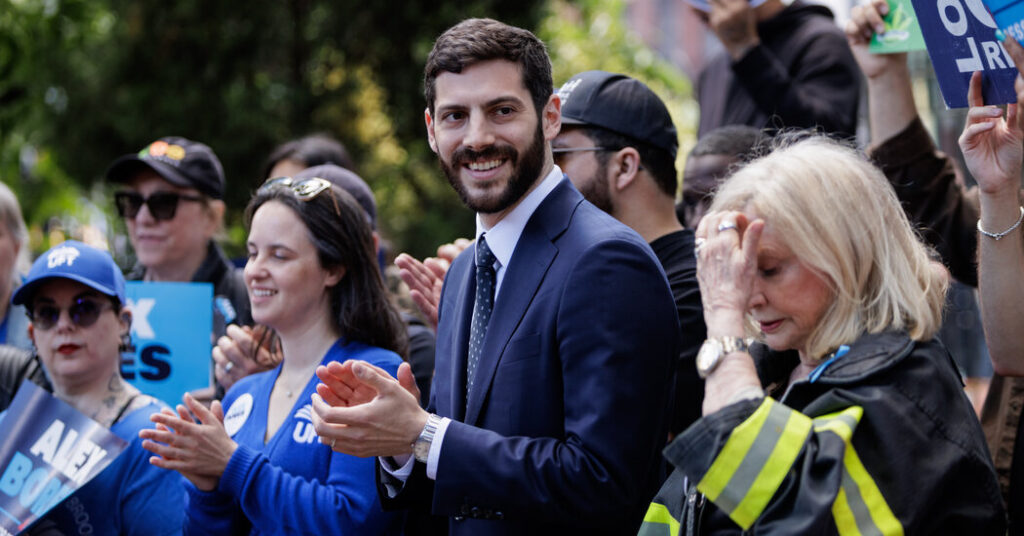
In the crowded Democratic primary race to succeed Representative Jerrold Nadler of New York, there are candidates who stand out for their names, or perhaps for their visibility on television.
Assemblyman Alex Bores does not match either description. Yet he has arguably become the race’s biggest and most polarizing figure, with a total of more than $12 million spent by outside groups for and against him.
The reason?
Last year, Mr. Bores sponsored a bill in Albany seeking to regulate advanced artificial intelligence models. An expensive pitched battle ensued, giving him an outsize role at the center of an urgent global debate.
And once Mr. Bores entered the House race in Manhattan, he became an immediate target for some of the industry’s largest companies.
“Alex Bores. Wrong on A.I. Wrong for Congress,” one attack ad said.
“Hypocrite,” read another. “Liar,” said one more.
For months, district voters have received a steady barrage of mail, texts and television spots trained at Mr. Bores, who first joined the State Assembly in 2023 and whose district on the East Side lies inside the congressional district. These messages are part of a multimillion-dollar assault on his candidacy from a super PAC, Leading the Future.
Close to $75 million has flowed to the group from Silicon Valley heavyweights like Joe Lonsdale, a co-founder of Palantir, and Greg Brockman, a co-founder of OpenAI. So far, $6.2 million has been spent against Mr. Bores, according to federal filings.
OpenAI’s largest competitor, Anthropic, has argued for more government oversight and a more cautious approach to the development of new A.I. tools. It has backed Mr. Bores from the start, with employees donating at least $186,000 to his campaign.
Far more has flowed to outside groups supporting him. Four super PACs — all with ties to Anthropic or its ideological allies — have spent about $6.5 million defending Mr. Bores or attacking his opponents, according to federal filings.
Chris Larsen, a billionaire crypto investor, spent $3.5 million to help Mr. Bores “when he learned that OpenAI was deliberately targeting” Mr. Bores’s campaign, according to Alex Tourk, a spokesman for Mr. Larsen.
All that money and attention to Mr. Bores has cast a shadow over the race to represent the 12th District, which includes some of New York’s wealthiest neighborhoods: the Upper East Side, the Upper West Side and Midtown Manhattan. Many of his rivals are struggling to compete for attention amid the battle of tech behemoths that has Mr. Bores in the middle.
“I had never heard of him until I saw the ads attacking him,” said Michael Paluszek, a 40-year resident of Stuyvesant Town.
Mr. Paluszek shifted his support from another candidate once he learned more about Mr. Bores, and he plans to volunteer and “own the corner of East 14th Street and Avenue A,” at the district’s southernmost reaches.
“That’s going to be my corner,” he said. “I’m going to compete.”
Mr. Bores said that his interest in A.I. stemmed from his experience working at these companies and his understanding of how they work. He said he had already heard from members of Congress who were excited to work on the issue if he is elected, and he had a stock reply for them: Don’t wait for him.
“I’m not going to be there for eight months,” he said. “Take it. I have no pride of ownership.”
His expertise on the subject will be an asset for Democrats, he said. Despite the assertions of his opponents, he said, his focus as a legislator has never been on giving one company an advantage over another. Sometimes he reads the inflammatory texts the PACs have sent and wonders how they could possibly be ascribed to him.
“A lot of people that come to this from the A.I. safety angle or A.I. regulatory angle, we were the first people to say: ‘Hey, this is really powerful and that’s why we think there needs to be regulation, but it can also be used for good,’” he said.
Mr. Bores did not set out to be an A.I. expert. As a student at Cornell University, Mr. Bores wanted to become a lawyer focused on international trade and labor rights. That remained his goal as he excelled at debate, protested Nike’s use of sweatshops and won an elected seat on the university’s board of trustees. Friends described Mr. Bores as an intensely focused striver.
Kate Bronfenbrenner, a university professor and an early mentor of Mr. Bores, said he was not doing “crazy things,” as many other campus activists were.
“He was the one saying, ‘OK, let’s figure out where they’re vulnerable,’” she said. “He was always strategic.”
For financial and other reasons, Mr. Bores decided against going to law school. He earned a master’s degree in computer science and worked at tech companies for years.
After a year in consulting, Mr. Bores in 2014 joined Palantir, then a budding start-up focused on analyzing reams of data for government agencies. Even then, the company was already being criticized for helping expand government surveillance capabilities.
In his roughly four years at Palantir, Mr. Bores worked with the Justice Department to investigate pharmacies that were overprescribing opioids and helped hospitals operated by the Department of Veterans Affairs be better supplied, among other things.
Leading the Future and other candidates in the race have attacked Mr. Bores’s work for Palantir, tying it to the company’s contracts with U.S. Immigration and Customs Enforcement. Palantir has become a flashpoint in many Democratic primaries across the country, as the company continues to support President Trump’s immigration agenda.
Mr. Bores said that he did not work with ICE while at Palantir, and that the company’s ties to the agency contributed to his departure in 2019 — a decision that meant leaving “generational wealth on the table,” he said in an interview this year.
In recent months, Mr. Bores divested his small holdings in the company, which were based on index fund investments, and donated the proceeds. He sold between $900,000 and $1.3 million in Palantir stock, according to financial disclosures filed with the state in 2021 and 2022. By leaving when he did, Mr. Bores said, he forfeited another $2 million in shares based on the stock’s value in September 2021.
Ms. Bronfenbrenner applauded Mr. Bores’s stand against the industry figures attacking him and said that his tech work informs how he legislates. Still, she believes he could have left Palantir sooner.
“There are many, including many of his close friends, who believed he waited too long,” Ms. Bronfenbrenner said.
After working at several smaller tech start-ups, Mr. Bores arrived in Albany and made technology regulation one of his priorities.
Influenced by his industry experience, Mr. Bores said he believed that with the proper guardrails, there was an enormous opportunity for these technologies to have an immense and positive impact on society.
“There is such a concentration of power in so few hands in terms of the ability to get things done,” he said.
“We are in this dangerous race condition where there are incentives to put safety to the side.”
When Mr. Bores began crafting rules for the safe development of the most advanced A.I. models for his bill, which became known as the RAISE Act, he knew there would be significant pushback because so much money was at stake. As a result, he sought the input of Google, OpenAI, Anthropic and others.
“If he thinks it will help inform a bill that will do some good and pass, he takes the meeting,” said Jon Weinberg, a college friend and later his legislative counsel.
After the RAISE Act passed, an army of lobbyists and company representatives worked to neuter its key components or kill it outright. They ultimately convinced Gov. Kathy Hochul that certain provisions of the legislation would stymie growth and innovation.
She agreed to sign the bill but extracted key concessions that watered down some of its enforcement mechanisms. Despite Mr. Bores’s frustrations with her demands, he accepted them and declared victory.
The companies opposing Mr. Bores did, as well. Think Big, a super PAC affiliated with Leading the Future, supported the final version of the RAISE Act because it “protects start-ups by focusing on large frontier labs and setting standards for transparency and risk management.”
Still, as the bill’s fate hung in the balance, the group targeted Mr. Bores, blasting his “ideological and politically motivated legislation.”
The political allegiances of the donors to Think Big offered a coherence to Mr. Bores’s campaign. In such a thoroughly Democratic district, all the candidates were searching for ways to present themselves as a capable bulwark against Mr. Trump. (One candidate, George T. Conway III, has based his entire campaign on his history of opposing the president.)
Mr. Bores was being targeted by some of Mr. Trump’s largest donors, Mr. Brockman and Mr. Lonsdale.
“The A.I. oligarchs who are rigging our economy are scared of me,” Mr. Bores said at a televised candidates’ debate on Thursday. “They named me their No. 1 enemy and said they would spend at least $10 million to defeat me.”
Benjamin Oreskes is a reporter covering New York State politics and government for The Times.
The post A.I. Companies Don’t Know What to Do With Alex Bores appeared first on New York Times.