Clap your hands. Tap a foot. Whistle. It doesn’t even have to be a tune.
It’s all musical, and it all comes from the human body. The body, in turn, has inspired the shape of instruments for as long as they’ve existed, an observation that made the curator Bradley Strauchen-Scherer curious.
“So many instruments specifically reference the human body in their form or in their decoration, across cultures, from folk culture to pop culture to classical culture,” said Strauchen-Scherer, who works in the Metropolitan Museum of Art’s department of musical instruments. “What’s going on here?”
That simple question eventually led to the exhibition “Musical Bodies,” which opens at the Met on Friday. The show contains objects from several thousands of years of history: paintings and prints, fashion and sculptures, and, of course, instruments. Connecting them all, Strauchen-Scherer said, is an exploration of “the human condition through the lens of music.”
“Often we think about music as a very specialist thing,” she said. “Sometimes it gets branded as being elitist. But when we look at why people make music across time, it’s in our DNA. It’s absolutely fundamental to human survival.”
Much of the exhibition makes that point through music that visitors can hear for themselves. Below are five examples.
The Voice
The human voice has more timbral color and possibility than any traditional instrument. Far more than a medium for song, it has shadings and percussive sounds that are still being developed and applied to music; just listen to anything by Meredith Monk.
When visitors enter the galleries of “Musical Bodies,” they quickly encounter videos of beatboxing. “I thought this is something that catches people off guard,” Strauchen-Scherer said. They will hear the voice without lyrics, through percussive and plosive sounds. It will, she hopes, get people “to stop and think, ‘Ah, this isn’t the voice as I know it.’”
Beatboxing is an art form born in New York, from hip-hop musicians who couldn’t afford drum machines and instead learned to vocally provide their own beats and effects like D.J. scratching. In a full-circle moment, beatboxing returned to instruments, with the human voice simulated on Oberheim synthesizers.
Making Music
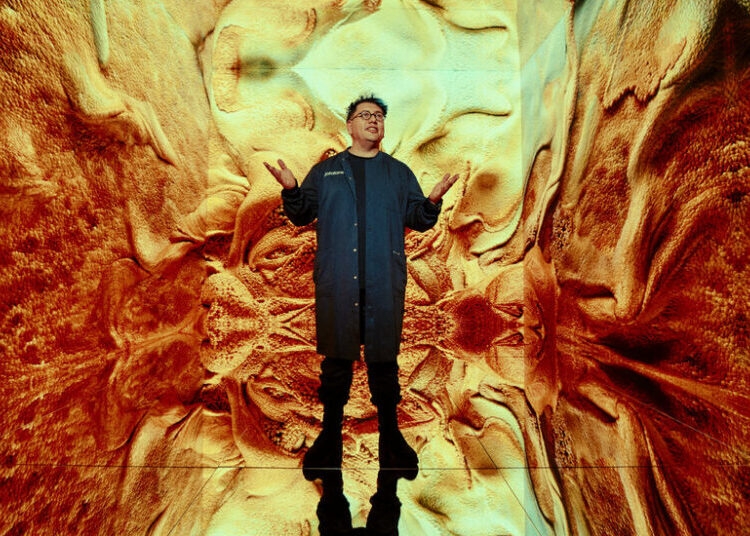
“Musical Bodies” also invites visitors to make music of their own. After they pass through galleries of objects that blur the boundaries between bodies and instruments, they encounter a hallway whose floor, decorated with shapes that resemble long pills lined up side by side, responds to touch with harmonious sound. You could dash or dance across it, alone or in a group.
It’s an opportunity, Strauchen-Scherer said, for people to riff on the themes of the show. The Met’s audience engagement department developed the instrument with the technologist Jeff Crouse, and it was composed, in a sense, by David Van Tieghem, who contributed sounds built around a pentatonic scale so that no matter how many people were on the floor, the result would be pleasantly concordant rather than cacophonous.
Circle of Gongs
One idea that recurs throughout the show is that while music has changed over time, people haven’t. Strauchen-Scherer makes connections across eras and cultures, such as the juxtaposition of a traditional Thai gong circle and the PianoArc, a circular keyboard used by Brockett Parsons in Lady Gaga concerts.
“We have iconographic evidence of these gong circles being used in Thailand back at least to the early 1500s,” Strauchen-Scherer said. “And then you see a form like the PianoArc. There’s nothing new under the sun, it’s just that our ability to realize these things changes.”
The circle, she added, is an ergonomic form. And in the case of the gong circle, a musician can be inside the instrument, and that positioning changes how sounds are made. If gongs are lined up, as in a gamelan, they typically require multiple players; a circle allows a single person to achieve the same range of expression.
Cello Body
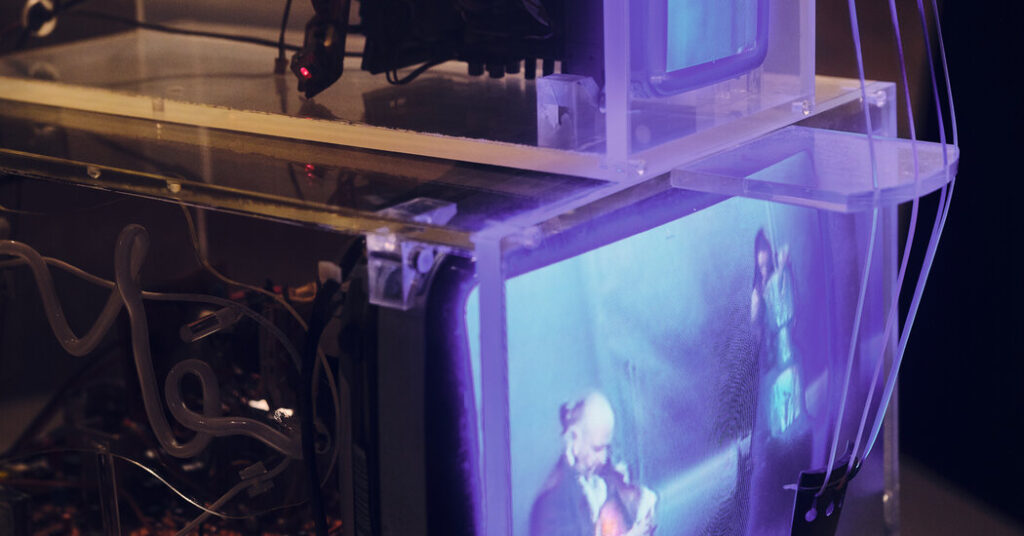
Nam June Paik’s “TV Cello” blurs not only body and instrument, but also their relationship to other art forms. A cello is like a fun-house mirror reflection of the human shape, and in this mixed-media piece, the instrument is made of monitors in plexiglass cubes that are stacked and topped with a traditional neck, scroll and strings.
“TV Cello” was historically performed by Charlotte Moorman. At the Met, it is an installation, with the monitors showing footage that includes her playing the instrument. Her image on the cello isn’t so different from a Renaissance instrument decorated with a painted or carved feminine figure, as Strauchen-Scherer observes in the exhibition’s catalog.
“It’s very powerful because of this recursion,” she said in the interview. “It invites visitors to think about playing bodies, playing instruments, everything just looping back on itself: Is it an instrument, is it a sculpture?”
Hunting Calls
If you look closely, you’ll see that Strauchen-Scherer appears in the exhibition. There is a horn from the 19th century, compact like an intestine and meltingly curved, called a cornet-trompe in D attributed to Alphonse Sax (brother of Adolphe, inventor of the saxophone). It is perched near a monitor with a video of the instrument in action, and she is onscreen, performing a hunting call written for the top of the day.
“That’s a wild instrument,” Strauchen-Scherer said. “I’ve had visitors say to me, ‘Oh, did Salvador Dalí make that?’ So I always love to say that if Salvador Dalí made a horn, it probably would look something like this.”
The truth of its creation, she added, is “much more mundane.” It was made for hunting calls and is designed to be more portable than traditional horns. But its production, which involved bending about 14 feet of tubing into its elegant shape, was “incredibly labor intensive, and not something that lends itself to expedient production.”
It never really caught on, but it has an expansive range of sound because of the length of its tubing, allowing for “a whole repertoire of hunting tunes and entertainment,” she said.
This horn is an artful step up from the whistles that humans once used to hunt. But the connection between how both sounds were used, Strauchen-Scherer said, is a reminder that music “is not an extracurricular, it’s front and center and embedded in who we are.”
Joshua Barone is an editor for The Times covering classical music and dance. He also writes criticism about classical music and opera.
The post Why People Sound Like Instruments, and Instruments Look Like People appeared first on New York Times.