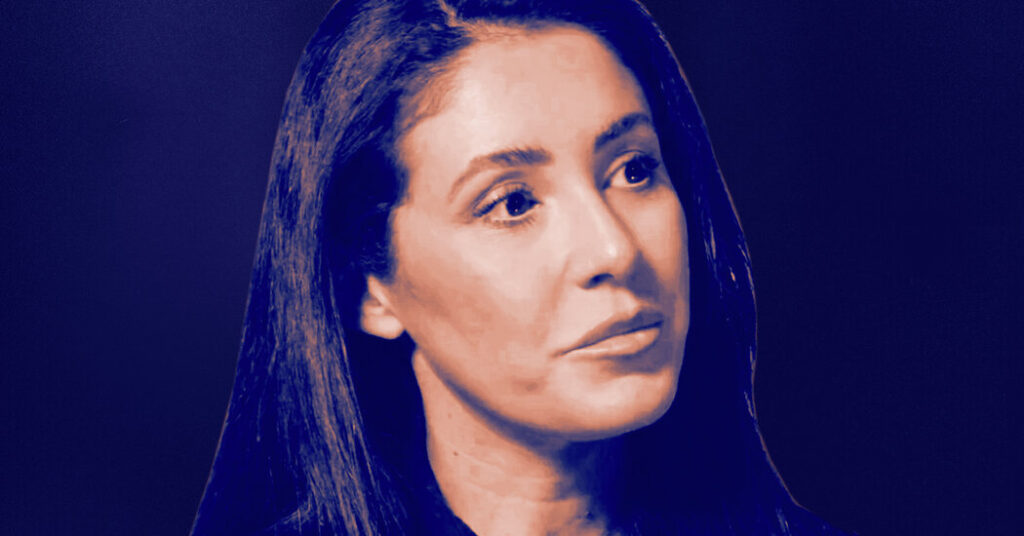
In an era defined by deep institutional distrust, a new trend within populist conservatism has emerged. It’s a sense that the federal government is keeping secrets and protecting the powerful at our expense. My guest this week is Representative Anna Paulina Luna, a conservative Republican from Florida who has quickly established herself as a political troublemaker. She’s challenging fellow lawmakers — Republicans and Democrats — on issues like sexual harassment and ethics, but she doesn’t see her campaign to clean up Congress as in tension with her allegiance to President Trump. Luna has focused her first years in Congress on exposing what she views as coverups, from the Epstein files to the assassination of John F. Kennedy and longstanding government secrecy around U.F.O.s.
Below is an edited transcript of an episode of “Interesting Times.” We recommend listening to it in its original form for the full effect. You can do so using the player above or on the NYTimes app, Apple, Spotify, Amazon Music, YouTube, iHeartRadio or wherever you get your podcasts.
Ross Douthat: Representative Anna Paulina Luna, welcome to “Interesting Times.”
Anna Paulina Luna: Thanks for having me on.
Douthat: I’m excited to talk to you, first of all, because I think you’re a unique kind of political troublemaker. You are a conservative Republican who’s been in the House of Representatives for less than four years. And in that time, in a very polarized environment, you’ve managed to make plenty of trouble for your own leadership and your own party, as well as for the Democrats.
And then second, I think that you embody a really important tendency in American conservatism right now, which is the sense that American institutions — institutions of government, especially — are keeping important things secret.
Sometimes those secrets have to do with the misbehavior of powerful people, and sometimes they have to do with the ancient American mythologies, like the J.F.K. assassination or government secrecy around U.F.O.s — where I should say I personally am convinced that something is being kept secret. I’m just damned if I can figure out what it is.
So you’re going to help me figure that out. But first, how would you describe your own politics right now as a Republican congresswoman in 2026?
Luna: I’d have to say that I am, and I think a lot of people have said, “You’re conservative, yes, but you have a strong populist streak.”
I also think I’m someone who wants to reform the Republican Party. So a lot of what I’ve been focusing on is: How do you actually change the institution so that it better works for the American people?
And I’ve been on a lot of sides of many issues that I think are wildly popular among not just the base but the American people — 80/20 issues, banning insider trading, voter ID.
So I found myself strange bedfellows in Congress working with people to try to get this done.
Douthat: So you said “conservative with a streak of populism” — or maybe more than a streak.
Luna: Yeah. I guess. [Laughs.]
Douthat: Since we’re still in the Trump era, would you define yourself as MAGA?
Luna: Yeah, so I’ll give you a little bit on my background. I got elected to Congress the second time I ran, and President Trump had endorsed me both times. And MAGA’s really where I got my start in politics. Prior to that, I was in the military. I actually never had even anticipated running for office. So, again, that kind of political outsider coming in.
You wouldn’t be surprised to know that many people spend a lot of time gearing up to try to make it to Congress. Sometimes it’s a family business, sometimes people will run for local election, then state, and then they get to federal. And for me, I wanted to bring change quickly, so I realized the way to do that would be to come to Washington, D.C., to do it. So, yes, I’m MAGA, but I’m also trying to lead on certain issues that I feel that the Republican Party is missing, especially with younger people.
One thing I think that’s different about me versus some of my colleagues is that I’m not going to be there forever. This aspect of people looking at it like a full-time career is something that kind of horrifies me, because if you go up there, it doesn’t matter how good you are. It eventually will beat you down — the system, the institution, the power.
D.C. basically operates on two levers: pressure and pain. When you’re pulling those two levers, eventually, you get burned out. I don’t want to be that person, so I will eventually pass the torch.
But there’s a lot of things that need to happen before I go, and I’m kind of helping to do that now.
Douthat: Give me a couple of examples from the run of normal political issues, let’s say, of things that you are most focused on, that you would say define you and make you distinctive among Republicans.
Luna: I’d have to say I’m willing to keep my party going true north on issues that I know are — so when I think about things, if I see a problem, I’m not just thinking about an immediate fix to that. I’m thinking about what caused that problem and where the stem of the issue is.
And so, for example, the one thing that I’ve been so frustrated about — and I had sponsored legislation even before MAHA, this Make America Healthy Again movement, was a thing, looking at food additives — what was happening with the special interest lobbying coming into Washington.
But what you realize is the whole idea of what it means to be an elected representative has become corrupted and perverse in the sense that you do have a lot of people that are just basically answering to lobbyists’ special interests, and they won’t even tell their party no when they know something’s wrong.
For example, that’s why I’ve been so big on banning insider trading, to answer your question. When you have members of Congress that are given access to certain information, they’re making a lot of money.
And this is not just like a Republican or a Democrat thing. It’s happening on both sides, and you can see that. Then you’re seeing how the special interests are donating to their campaigns, which they turn around and invest their personal money in, so they’re becoming rich. They’re essentially betting against the American people.
Why is that so wrong? You could take, for example, an issue like capping prescription prices for pharmaceuticals. You could take an issue like what happened recently with the glyphosate and liability protection, which would essentially shield these corporations from being able to be sued if you found out, for example, that it caused your kid cancer and you wanted to seek financial restitution for that. That shouldn’t be the case.
And we can get into the specifics of what I’ve observed. When I first got elected, you go out there and you think that they’re going to teach you how to do the parliamentary procedure or how to write the bills, and they don’t. They tell you two things: Don’t vote against your party, and don’t take down the rule. And within the first couple of weeks of being in office, I did both. So I was automatically put on the naughty list.
Once that happens, then you realize: OK, so I still want to be an effective member of Congress. I still want to be able to advocate for my constituents. How do I do that?
So I actually read the rule manual twice. That’s actually what caused me to get into the massive fight with my party on the vote by proxy for new moms.
That’s basically where you still cast a vote, but you don’t have to physically be present.
If you are recovering in the hospital, let’s say there’s a war vote, you can’t vote. We don’t have a lot of women my age who are in office, and yet you’re being told that you can’t do that. I think that that’s a problem.
When I went to advocate for this issue, I figured out in the rule manual how to actually physically go and collect signatures. It’s called a discharge petition. I introduced something, and my party told me: It’s a tool of the minority. You’re not supposed to be doing that.
Well, I would argue that it’s not. We all voted for it to be in the rule manual. So that’s just the attempt to control someone from being able to actually do their job, which is representing their constituency. If I can’t vote for them, what is that saying to all my people back home, the over 700,000 people that I’m supposed to represent?
Separately, the irony in all of that is that a lot of people that were vocally against it had voted by proxy. So there’s that.
Douthat: I think that’s given a good sense of the range of things that you’re interested in.
Luna: [Laughs.] Yeah.
Douthat: It seems like it’s a really interesting mixture of issues that people might think of as conventional conservative issues — you mentioned voter ID as one — and issues that are connected to how Congress actually works, and then issues that maybe come out of your own distinctive background.
So talk about your background. Where did you grow up?
Luna: [Laughs.] That’s a lot.
Douthat: In four minutes or less, take us from childhood to Congress.
Luna: I grew up in Southern California. My parents were never married. My father, who passed away the year that I got elected — that was absolutely brutal — he was an interesting character, but he unfortunately struggled with substance abuse. In and out of jail. A lot of my childhood, as a result of that, was somewhat chaotic.
My mom, when I was in ninth grade, secretly studied to take the LSAT so that she could apply to law school. She was in a not-so-good relationship and applied to law school and got in. I remember she was studying for that, and I had to watch my brother and sister because my stepdad at the time was actually not allowing her to apply.
Ultimately, by the time I had graduated from high school, I had gone to over six high schools, one of which was Venice High School, in the early part of the 2000s. I’m sure you know Venice Beach now is gentrified, but it was not always that way. And I got jumped at that high school.
I had wanted to go to college. I just didn’t have a way of paying for it. I didn’t even really know about the application process and how to do it. And I had overheard a conversation about how the military would pay for your school.
So, to date myself, if anyone remembers this — MapQuest. [Laughs.]
Douthat: I remember MapQuest.
Luna: I MapQuested directions.
Douthat: It’s a hot new technology.
Luna: Yeah, before Waze, there was MapQuest. So I MapQuested directions to a recruiter’s office, and I enlisted. I didn’t tell my family what I was doing. I let them know, once I’d already signed paperwork, that I’d be leaving. And I joined the Air Force, and it was the best decision I could have made.
I met my husband in the Air Force. In 2014 he was shot in Afghanistan. That was also absolutely brutal. Literally, I tell my husband now that looking back then, I had no idea that that would bring me to where I’m at today because, as a result of him getting shot, it was my first time going up to D.C. I actually stayed at Walter Reed with him.
Ultimately, I got in contact with a group that was doing advocacy — counter child trafficking at the border — and it was kind of paired with that. It was at that point in time that I really got political.
Douthat: And had you been a conservative or a Republican before you were sort of pulled into the child trafficking debate?
Luna: I would have to say that being where I grew up, my mom was not necessarily … well, she was definitely not conservative, let’s put it that way. But I don’t think that it was necessarily a huge normal discussion for me to engage in politics. The environment that I was in was not really focused on that.
When I joined the military, obviously, it’s a different lens and perspective. But even so, at the time that I joined, you really didn’t talk politics. Everyone showed up in the uniform, and that was it — you left your politics outside of it.
Toward the later part of my military career, that’s when you started to see it evolve. I had actually rejoined the service as a National Guardsman, and that’s when you start seeing the more political conversations happening a little bit. Even then, I would have to say that I got really involved within the gun community, doing spokesperson stuff, gun manufacturing.
I think at that point, maybe around 2016 onward, is when I really started getting political. But up until then, it wasn’t really a thing for me.
Douthat: And then you worked for Turning Point USA, right?
Luna: I did, I did. So I was actually in the military. I was at the Portland Guard unit, and I was working with these nonprofits. And I was posting online on my social media account, on Instagram, and I remember Charlie Kirk actually D.M.’d me. He was like: You should really come to the Young Women’s Leadership Summit.
So I actually went down to Dallas — this was in 2018 — and what I didn’t realize at that time is that he had been kind of looking at my social media and scouting me.
Douthat: So this was not just accidental, right?
Luna: Correct.
Douthat: It wasn’t like you wrote a few posts and Charlie Kirk called you up.
Luna: Yeah. Correct. I had a following.
Douthat: You had some sense that you were creating yourself as an influencer, right? Did you think of it that way? What is the conscious aspect of that transition?
Luna: I guess I didn’t think about it like that because that’s not really what my goal was.
I guess that’s kind of what I was doing. I was one of the original people. Also, people forget that when I was in the military, part of how I amassed my social media following — this is early stages of Instagram — was that I had done Maxim’s “Hometown Hottie.” I had been featured in Sports Illustrated.
So I was really kind of cultivating this online following. But it was also largely based on military firearms ——
Douthat: So on the gun stuff, I’m just curious. How does it fit together? You’re modeling, appearing with guns. Anyway ——
Luna: So I have a picture of when I was 5 years old with my dad at the shooting range. OK.
Douthat: So that part goes way back.
Luna: Yeah, it goes way back. And then, obviously, being in the military. And I had a break-in story that happened when I was stationed in Missouri that absolutely horrified me. I told people that story because I think, especially with women, if you’ve ever gone through something like that, it’s horrifying. But also the trauma that goes along with that, and not having that sense of security. And I remember when I first ran for office, I had this really nasty article come out from The Washington Post where they just tried to discredit and undermine everything, and I actually had to find that police report.
I had text messages from my colleagues at the time, who were in service with me, debunking that. But yeah, that had always been there.
Douthat: And this has been a recurring anti-Luna critique.
Luna: Yeah.
Douthat: That you have curated your narrative, you’ve curated your biography and so on.
Luna: Yeah, that seems to be what people try to say. It’s always been there.
If people don’t like you, they’re going to try to pull anything. But it’s funny because, as a result of these critiques happening, you saw that big blowup with The Washington Post, Time magazine actually did a deep dive into my background, realized I was telling the truth and named me as Time’s “100 Next” in 2023 as a result of that. And I was like, “Well, that’s a silver lining vindication.” So thank you, Time magazine.
Douthat: So by then you were in Congress.
Luna: By then I was in Congress.
Douthat: So you worked for Turning Point. You were a spokesman and organizer?
Luna: I was hired by Charlie as the national Hispanic outreach director. So I did grass-roots activism nationally, but really, I think a majority of my job was traveling across the country, doing the college campus debates with him, Brandon Tatum and Candace Owens.
And I don’t care what side of the aisle that you’re on; I think everyone who’s over the age of 30 will realize that when you’re in your 20s, when you’re in your late teens, you think you know everything. And when you debate college kids that really haven’t been outside of the institution into the real world, they can get pretty interesting.
But it was some of the best times in the early start to my political career, because I always say that it was a kind of trial by fire.
Douthat: So you ran for Congress from Florida once. You lost. That was 2020?
Luna: Yeah, 2020.
Douthat: And then you ran and won in 2022. And then you ran again, and this is your second term, right?
Luna: And I’m up for a third.
Douthat: But in Congress one of your big focuses, and something that has attracted a lot of attention in recent months, has been issues around sexual harassment and ethics inside Congress.
So can you just describe the work you’ve been doing or the arguments that you’ve been making around those issues?
Luna: Yeah, this is something that kind of boiled up to the surface that I’d been really frustrated about. And it wasn’t just me; it was other members of Congress. But there seems to be this consensus within the chamber — and it’s on both sides, and this is why I called both sides out about it — that you have to let the process play out.
And I’m all for letting the process play out, but when you have someone ——
Douthat: Meaning that if someone is accused of sexual misconduct ——
Luna: Correct. Yes.
Douthat: You don’t do anything until what?
Luna: Well, what they try to say is that you let the process play out, and if someone brings forward an accusation — because anyone can accuse anyone of anything — obviously, you want there to be evidence. And then ultimately it’s up to, or it should be, the responsibility of the ethics committee to make the recommendation on expulsion or resignation or referrals, if there’s criminal action involved.
But what’s happened is the ethics committee has become so partisan and about protecting the party that they’re not doing their jobs.
Ultimately, what happened was the first individual that this had really come up about was Representative Tony Gonzales, who’s a Republican from Texas, and I didn’t have any personal issues with him. However, I remember seeing the headline that his staffer had committed suicide by lighting herself on fire.
I saw that and I said, “That’s horrible.” And also, what would cause a young mom to do that?
She has a son — she had a son — that is a little bit older than my son, and just the head space someone has to be in. I saw that and made a mental note, and I remember sending it to one of my female staff. I said, “Have you heard anything about this?”
And then a couple of months later, we started hearing rumors that he had had this inappropriate relationship with her, and then those rumors with evidence started turning out to be true. Text messages started coming out.
It was to the point where you knew for a fact that he was violating our House rules. You can’t have a relationship with your staff, period. But he was still wanting to seek re-election.
And ultimately, I had obtained text messages that were not publicly released that were so horrible.
Douthat: How had you obtained those text messages?
Luna: I followed up on it directly with the husband of the deceased staffer and his legal team.
And I went to leadership and I said, “What’s going on with this?” And they said, “There’s a process, there’s a process.”
But ethics, I later learned, had had these text messages for over a month and was making no recommendation. At that point in time, I was like, “This guy’s got to go.”
Then another woman came forward and said that she was on the campaign side of things, and said that there was some inappropriate stuff.
At that point, I kind of made a mental note that I was going to do the motion for expulsion, because there was enough evidence there. I didn’t need to wait for the ethics committee to make a recommendation. It was there, cut and dried — it had happened. He admitted it. And he was still seeking election at that time.
Then on Friday, Representative Swalwell, who’s a Democrat from California ——
Douthat: This is Eric Swalwell.
Luna: Yeah, Eric Swalwell. That’s when stuff started blowing up on him. And I said, “This makes everyone in general just look bad.”
So I was willing to file a motion to expel both of them. Then we found out that you could only do one at a time, and I was contacted by a representative from New Mexico. She’s a Democrat, and she said, “I’ll support yours to expel Swalwell. Will you support mine to expel Tony?” And I said, “Absolutely.”
We actually never even had to call up those votes because they both ended up resigning. And it wasn’t just them — it was Cherfilus-McCormick and other members as well.
But the point is: Why did it take me having to do that?
Douthat: And did it only work because there was a Republican and a Democrat at the same time? Because, as you just suggested, under highly polarized, highly partisan conditions ——
Luna: They protect party.
Douthat: Well, Republicans have a very narrow majority. Neither side wants to have a sudden special election or have to deal with any kind of fallout.
Luna: Correct. I think it was so bad that people did not want to be associated. So in this instance, if push came to shove and I called it up, they would have voted for it.
But I will say, it’s been very frustrating. There have been other instances. For example, the congressional slush fund for sexual harassment or misconduct.
Douthat: What are those funds?
Luna: Those are funds that are paid for out of the House of Representatives. And for example, if I’m working for you and you do something you shouldn’t, I can then bring a lawsuit against your office, and then your office will pay out. And usually there’s an NDA.
Douthat: And that is paid for by?
Luna: That’s taxpayer funds.
Douthat: I see.
Luna: First of all, that shouldn’t be the case. So you can just see that the institution will protect itself.
It’s very hard for people, I think, to be confrontational with people that they are serving with, because there’s this sense of, are they your colleagues or your friends? You can be friends with people, but you don’t have to cover up for their misconduct.
The point is that when we go up there to serve, if you tolerate this behavior, it’s a poor reflection on everyone. And then also, too, how could you then expect people to trust the institution, trust you, have faith in the federal government?
This gets into the whole aspect of why I’m so big on disclosure, declassification, and, really, this open source model of doing government. It’s because trust in the institution, trust in government, is at near an all-time low with the American people — and I think rightfully so, because of stuff like this.
Douthat: Yeah. We’ll get to the larger disclosure push in a minute. Just to stay on this issue, how much of this is about government secret keeping, versus how much is it a #MeToo-style story about male misbehavior in particular being protected? And do you see yourself, Congresswoman Mace and others as doing a kind of #MeToo push against entrenched male bad behavior?
Luna: So I think that’s two parts to this question.
Douthat: Take them both.
Luna: In general, I think that the aspect of what I’m trying to do is follow through on the transparency aspect that I think the federal government desperately needs. That’s why I head up the task force that I do, which is the declassification of federal secrets.
By the way, a lot of people thought it was some kooky task force, and now you’re seeing that the task force has actually done some wildly cool stuff. And we’ll get to that in a minute, whether it’s J.F.K. or U.A.P. [Laughs.]
Douthat: I never thought it was kooky.
Luna: But that’s what they try to discredit. They see me as young. People will automatically sometimes assume or try to discredit me because of, I think, my background and my age.
But it’s crazy what happens when you read books. You can learn a lot in regards to how the whole entire institution functions, and I’m one of the few members that actually knows how that works. So I can operate in a different way, and I’m effective in that way.
As far as what we’re doing, no. There’s females that do this as well. It’s not as prevalent because there’s smaller ratios of females to men in this institution, but in general, I’d have to say that I just don’t think that this should be hidden from the American people because there’s this aspect of transparency.
If you are serving in Congress, or if you’re asking for someone to vote for you, there’s a different threshold and standard at which you’re supposed to conduct and maintain yourself. I’ve been pretty good on this issue, even as far as disclosing, for example, congressional stock trading.
I stood up with Governor DeSantis in the state of Florida, and he actually changed the qualifying candidate forms to disclose if you’re going to trade stocks while you’re in Congress. This is great, because at the federal level, we’re supposed to actually have a vote on banning insider trading, which, by the way, happened because myself and Representative Burchett and a few others actually came together and said that this is so wrong on both sides, and we are working against our own parties to actually get this to the floor.
This is, I think, in line with my push for transparency on these things.
Douthat: Right. OK. I’m curious about listening to your critique of how Congress works and stock trading and people covering up sexual harassment, and all of these things. It seems like versions of that critique could apply to the president himself, and the White House and his administration, in ways that range from the history of allegations of sexual harassment and assault against the president to the various ways in which the Trump family seems to be enriching itself in this administration.
Isn’t there some kind of tension between saying, “I’m here to clean up Congress, but meanwhile, I am in an alliance with a president who seems to be manifesting the same kind of vices”?
Luna: Going back to when you have evidence, it’s one thing, but when you have accusations, it’s totally separate — what’s been interesting is that I was leading the charge, when no one else wanted to touch it, on the Jeffrey Epstein declassification of files.
And when we brought all the victims in with their attorney, it was both Democrats and Republicans and Mike Johnson. And the first question that a Democrat asked was, I think, along the lines of: Was President Trump involved? Do you have any information that implicates the president in any of this?
And the victims said no. Later on, when I took the deposition for Bill and Hillary Clinton, which is so wild, I was in the room sitting across from President Clinton, and he actually exonerated President Trump.
Regardless of where you’re at, to answer your question ——
Douthat: I wasn’t suggesting that there was strong evidence that President Trump was involved there. I think there is ample evidence that people close to the president have enriched themselves substantially in this presidency. The president himself has made a number of stock trades that have increased his net worth.
I’m just saying there’s a range of things outside of the Epstein case where he and people close to him seem to fall into the same category of people you’re criticizing in Congress.
Luna: So I’ve looked extensively into this, and if Congress had the same laws in place that the administration has specifically with stock trading, you would not see the insider trading that you see now.
I actually even suggested, well, instead of doing a stand-alone, why don’t we try to essentially reflect it with the executive branch? And they still didn’t want to do it. In fact, I had a bipartisan, very tough bill on insider trading, and Hakeem Jeffries told Democrats to not support it.
So I have. I’m a hawk on this. I’ve looked extensively into this. But I do think the aspect of ——
Douthat: But do you think the president’s stock trades above are fine?
Luna: Above the board? I haven’t seen what his stock trades are, but I don’t have reason to believe that what he is doing is on the level of what Congress is doing. Because I know that the disclosures for the executive branch are way more strict and harsh than the disclosures for this branch.
And of course, too, then we get into the same aspect of, I was also on the Hunter Biden and Joe Biden, basically a task force that Congress had set up — I don’t want to call it a “task force,” but we investigated that extensively.
Then the critique, then one could say, well, why aren’t we then talking about Joe Biden and Hunter Biden, that were getting all this money from Ukraine and China?
Douthat: Because he’s not president.
Luna: But at the time, though, the thing is that the media’s not — with the arguments, if we’re going to talk about Trump and this, well, we have known reports from Treasury. Do you see what I’m saying?
Douthat: I think it’s perfectly reasonable to say that there was inadequate coverage of something associated with Joe Biden. I just also think that Donald Trump is president right now, and you’re on an anti-corruption crusade, and so ——
Luna: I don’t think ——
Douthat: How about this? Why do you think that the president was so reluctant to release the Epstein files?
Luna: Well, I talked with him extensively on this, and I was actually ——
Douthat: And what did he say?
Luna: So I was on this, to put it in a timeline for people that aren’t tracking, in November of the year prior. I wanted the flight logs, and I remember Marsha Blackburn had made a motion to release those flight logs in the Senate, and it was a Democrat senator that blocked them.
And then, come time to President Trump taking the administration over, with the new attorney general, in January I got the Task Force on the Declassification of Federal Secrets, and so the purview of the task force was U.A.P., J.F.K., M.L.K., R.F.K., Epstein and 9/11. That was the initial start of it. And I remember writing the D.O.J. and just not hearing a response from them, so I was vocally calling for the release of the files from Bondi, and then the rest of it kind of transpired.
But I actually remember calling over and saying, “Hey, I think you guys should just release these. Give the files to oversight.” And they said OK. The problem is that the timeline and the second order of documents came out of a judge from New York.
So you had the D.O.J. that allocated, I think it was 500 attorneys at once, trying to go through and redact victim information. That in itself wasn’t ideal. However, why did it take so long?
Douthat: But also, during this time, the president was out giving public comments, saying this is now “a Democrat hoax,” and so on.
It wasn’t simply a matter of that there was a slow process to release the files. It was also clear that he himself had some objections to the kind of release that you were pushing for.
Luna: I think when he said “Democrat hoax,” and I think that Karoline Leavitt clarified this, in that when you have someone that’s accusing you of trafficking people and saying that you are a rapist, that you are going to get upset and you’re going to call it — like, if I was being accused of that, I would probably say the same thing.
However, I want to be clear that my conversations with him were not personal and nasty, and I was the biggest proponent of releasing these things.
At a certain point in February, I had a whistle-blower that came forward. I actually wrote a bill, I talked to media on it. And I said, “Hey, I think that we’re only dealing with a partial deck here” — in that we had someone that said that there was destruction of files and evidence specifically pertaining to Jeffrey Epstein.
And then you have this other aspect of: Was Jeffrey Epstein a member of the intelligence community? I think so. We had the attorney that represented the victims ——
Douthat: So you think basically that the harder-core Epstein conspiracy theories are still likely to be true?
Luna: Well, there’s a lot of them, so which ones?
Douthat: Not the hardest, but ——
Luna: Well, tell me what they are. [Laughs.]
Douthat: So I looked at the material that was released, and I’m not going to tell you that I read every single document.
Luna: That’s almost impossible.
Douthat: But I was very interested in the Epstein story for a long time, and I thought that there were clearly things there that were hidden or mysterious, and I wanted to know what was going on.
And to me, the upshot of the huge data dump was that there was maybe less than I thought. It seemed like maybe he had connections to Israeli intelligence or some foreign intelligence, but was not actually working for them, in the sense that I didn’t see evidence that he had carried out any kind of blackmail. Maybe that was a possibility, but there wasn’t evidence there.
The exposure reduced my sense that there was a truly profound and dark secret here, and made me more likely to think the guy was a sexual predator who had a lot of rich and powerful friends, and they helped cover up for him. It’s still an interesting story, but it’s not the most interesting story.
Luna: So I discovered a document in going through some of the records unredacted over at the D.O.J., and he did have an alias. It was a passport, and his address was located, I think, in Saudi Arabia. I believe it was an Austrian passport. And that was in his safe that he had with a bunch of other cash, diamonds, et cetera.
Most people don’t have a completely fake name in a safe with that type of information. That was my first kind of, all right, he definitely had intel connections. I think the guy dealt in intelligence and exchange of information.
The thing that will always be a question for me, and I don’t think that we’re ever going to get the answer on this, is: What happened with the alleged evidence that was destroyed? And also, this type of operation could not have existed without the intelligence agencies knowing about it, so what exactly was he doing?
Douthat: What kind of … ?
Luna: Well, moving the amount of money that he was, interacting with the people that he was aware of, the alias passport, the travel, all of that — that doesn’t just happen unless you have friends that are helping you.
So the verdict out on that is that, yes, obviously, he was known to be a sexual predator. But the other thing that I don’t think that the media fully focused on, and this was something that I read in an unredacted F.B.I. report on co-conspirators, is that the only co-conspirator sitting in jail right now is Ghislaine Maxwell.
There were other women that were listed as co-conspirators, and they were able to walk. Those women could have easily given names. Were they helping to assist in the purchase and transaction for minors?
And this goes to show that this just doesn’t go back to this administration. This goes all the way back to, I think, Bush 2.0. And why is it that it stayed hidden for so long?
The really responsible reporting would be: Yeah, both sides messed up. They should have handled this early on. This entire thing was a complete botch of the entire judicial process. And then, in addition to that, what you have is people — victims — that have their entire lives destroyed because there was no due process for them.
Douthat: So, last question on Epstein. One of the striking things is that we have had all of this information, all of these things released, all of this public debate and controversy, and the only person who has seemingly been taken down is Prince Andrew — potentially, allegedly. He was not tried and convicted.
Luna: You’ll have the BBC calling you here in a minute. [Laughs.]
Douthat: But do you think that before this story is done, we will actually get the names of other powerful guys who were part of his, essentially, trafficking work?
Luna: To answer your question, I’ll just have to follow up with: We asked specifically the victims for names of people. And I remember the attorney saying: Since we’ve been up here, I’ve been getting phone calls from people that are basically, from what we gathered, involved in a lawsuit.
And I think part of, unfortunately, the thing surrounding Jeffrey Epstein is that the victims, if they do sue civilly, they then sign NDAs, and then it goes away. And then they’re not going to talk, and there is a settlement, and then maybe the people that were guilty of this get off.
Douthat: Let’s go from Epstein to other areas. First, tell me about the task force that you’re running and how you ended up in this role.
Luna: So the last Congress that I served in, the 118th, both Representative Burchett, myself and Matt Gaetz responded to a whistle-blower report from pilots at Eglin Air Force Base saying that the Air Force was covering up U.A.P. activity — or U.F.O. activity, if you will.
We went up to investigate. We get people that say things all the time. And when we were there, we were stonewalled. We were shut down. They tried to cancel the briefing initially. We got it back on. We get there, they’re showing us stuff about Chinese spy balloons, which is equally important. However, that’s not what we were there to see.
They ended up eventually, after we got into a fight with them, pulling in pilots. And we got the most insane briefing from the pilots that we’ve pretty much ever heard, saying, “Hey, these things are real.”
Douthat: Where is Eglin Air Force Base, just so people know?
Luna: Eglin Air Force Base is in the panhandle of Florida.
Douthat: OK. So it was yourself and Matt Gaetz, who was then a Florida congressman, and it was Tim Burchett, a congressman from Tennessee, who received this whistle-blower report.
Luna: Correct. Uh, briefing.
Douthat: Briefing.
Luna: And then we go up to Eglin to follow up on it, and that’s when stuff hit the fan.
Douthat: But why did you receive the briefing in the first place?
Luna: Well, these whistle-blowers came forward to Representative Gaetz’s office and said the Air Force was covering up U.A.P. activity.
Douthat: OK.
Luna: So, clearly, when you get something like that, you’re like, all right, you hear a cover-up, it kind of piques interest.
Douthat: Had you had any contact with or interest in the world of U.F.O. stuff before this?
Luna: When I was stationed at Portland Air National Guard, I had a pilot tell me about an airspace incursion that had happened, and he was kind of spooked talking about it. But I wasn’t necessarily focused on it.
This piqued my interest because you have Eglin Air Force Base. I was stationed at Hurlburt Field. I know the area. The pilots were very well equipped, so they’re not making it up.
After we got up there — remember, we’re just following up to do due diligence. You have a member of House Armed Services that oversees the military and funding, and two members of the Committee on Oversight and Government Reform, which do the investigations. And when we got up there, that’s when stuff hit the fan. That’s when we basically realized that the Air Force was indeed not being so transparent about what was actually happening.
So that happened in the 118th Congress. And then, at the start of the 119th Congress, we realized President Trump had talked about releasing the M.L.K., R.F.K. and J.F.K. files. We had this stuff outstanding with U.A.P. activity. We ended up actually wanting to be the follow-through mechanism arm for the president. And so Chairman Comer decided to set up the task force. And initially, people were a little spooked about taking the position because of everything that it involved. And there was a stigma, even when we had our first U.A.P. hearing, of people saying: You know, if you do this, people are going to think you’re crazy.
It’s a taboo topic, right?
Douthat: Well, I haven’t really asked about your relationship to the congressional leadership.
[Luna laughs.]
But do you think that this was something that you were given in part because it was like, let’s keep her busy, and also it might make her look a little crazy?
Luna: I think so. I think maybe they anticipated that, but I also knew ——
Douthat: But you had already held a hearing.
Luna: Yeah. Well, there’s already a hearing on oversight, and there’s a lot of interest for it.
So I said, “Look, these are some really interesting topics.” I think everyone kind of wants to know. This is in part curiosity. We’re not trying to be the cat, so we’re trying to stay safe while we’re doing it. But this aspect of just wanting to find out more and answer questions, and if we don’t know, we’ll tell you.
But no one — no one — thought that we would get the U.A.P. files declassified, not one person, except for when President Trump started saying, OK, we’re going to declassify it.
I think that’s when things really started changing. I actually had a member of Congress find me on the floor, and Chairman Comer was talking to him the other day. He goes, “Well, Luna, you did some great things with that task force” — because it’s not just that. It’s also this aspect of the J.F.K. files and the declassification there.
We have a good team, in general, with the actual task force. We also have an unofficial body of the task force that are members on other committees that kind of do drive-bys for the hearings, if you will, and come in and are curious and inquisitive.
I’ve worked with some great people, and at least as Congress is concerned, we’re putting out an official congressional report on all the new findings with the declassified files pertaining to J.F.K. I think that this is happening at a very serendipitous time.
Douthat: On the J.F.K. stuff, just to pause before we go further with the U.F.O.s — there’s been stuff that’s been released about the C.I.A.’s connections to Lee Harvey Oswald, right?
Luna: And George Joannides is a big one.
Douthat: As with the Epstein stuff, I found that very interesting. It did not change my view that Lee Harvey Oswald probably killed J.F.K. and probably acted alone. Do you think that there is actual material out there that would change that view?
Luna: I don’t think that you’re ever going to find a list, per se, of people that were implicated in the plot to assassinate the president.
But what I will tell you is that we had a doctor come in who was in the operating room that Kennedy was brought to in Dallas after he was shot, and testified under oath to Mr. Kennedy — or President Kennedy — being shot from both the front and the back, which means you had to have more than one shooter.
We then also found in some of the follow-up documents that Jefferson Morley had been trying to look for like, 20-something years. Jefferson Morley, who runs a Substack, JFK Facts — I would consider him a subject matter expert on all this stuff, which the C.I.A. then delivered on — kudos to Director Ratcliffe on the task force working with us.
But that had implicated the C.I.A. in knowingly obstructing Congress’s initial investigation and follow-up investigations. George Joannides was an operative for the C.I.A., had dual identities, was installed as the C.I.A. liaison.
And we have a C.I.A. historian, who is now a professor, who has come forward and said that he knows a document that specifically talks about how the C.I.A. intended to undermine and prevent Congress from finding out the truth on Kennedy.
Douthat: But that could mean that the C.I.A. was trying to undermine Congress’s attempt to figure out things that might be embarrassing for the C.I.A.
Luna: That’s always ——
Douthat: Like that they had had these connections with Oswald that they didn’t want anyone to know about. But that doesn’t mean that someone else killed Kennedy.
Luna: Well ——
Douthat: It seems to me that part of what you might find when you dig in is things that are embarrassing for institutions that they don’t want to reveal, that do not then in the end prove that the most conspiratorial perspective was true, right?
Luna: Well, I think that might be a theory, but when you look at all the pieces to this puzzle and you see the mosaic that’s formed, when you have —
So you have to think about it, too, from a historical context, in that after he was assassinated, we go right into Vietnam. I mean, the war machine really does pick up.
And the C.I.A., based on their internal communications about Kennedy, really did look at him like a radical. And they had this aspect of ——
Douthat: Wait. So you think the C.I.A. killed Kennedy?
Luna: I don’t think that the C.I.A. gave the authorization. I think that there were radical factions within the agency that were working with other networks that assassinated Kennedy, and I think it stood to benefit many people to include the military industrial complex, and to include people that thought that Kennedy was too much of a radical thought leader in the sense that he wanted peace.
Remember, at this point in time ——
Douthat: Right. This is the ——
Luna: What’s also been interesting ——
Douthat: This is the Oliver Stone and J.F.K. narrative. That narrative about Kennedy was, for a long time, a left-wing narrative. It was a narrative I grew up with. It was present among people I knew who were political radicals on the left, who took it for granted that nefarious factions had killed Kennedy so that we wouldn’t get out of Vietnam.
I think Kennedy would have done much the same thing with Vietnam as L.B.J., but setting that aside ——
Luna: Well, there’s a separate conversation on L.B.J. [Laughs.]
Douthat: It’s just really striking that now, this is a Republican, conservative congresswoman making this argument. It’s just really interesting that that would switch.
Luna: I think the more important question would be: Why is it that the federal government tried so hard to discredit, prevent and stop information from coming out, and wouldn’t even answer questions for people that had that theory?
The thing about that theory is, from everything that we have seen, the C.I.A. did lie to Congress.
Douthat: Right. But what we’ve seen is that they lied to Congress about things that might have been embarrassing for the C.I.A. that were different from “a radical faction of the C.I.A. killed Kennedy,” right?
Luna: Well, not necessarily, because you have this aspect of people that were surrounding Oswald, observing Oswald, and knew about him. Really, you could say, was it intentional negligence?
Douthat: But isn’t that insanely ——
Luna: Are you saying that the theories are lying?
Douthat: Right, but that’s insane embarrassment.
Luna: Well, it’s embarrassment, or is it intentional nefariousness?
Douthat: Right.
Luna: And I think that’s the question. What’s been so interesting is that the investigator that I’m working with on this, Mr. Morley, when we had the C.I.A. in my office, he goes: I’ve been waiting so long for this — but he’s a Democrat. He’s a Bernie Sanders Democrat.
Douthat: Yes, yes. I’ve been reading him for many years.
Luna: He’s great, and he’s actually the one that we brought into the oversight task force, and he’s actually going to be writing the report on it.
What is also very interesting about this is for so long, if you said what you said right there, people would say that that’s a conspiracy theory. But what we’re finding out is that maybe it wasn’t so far-off, and these are with the facts.
And so I will encourage everyone — and we’ll try to do a one-pager on it — when you hear Mr. Morley talk about all the facts and really get into the key details on who was who and where was … I mean, it’s actually really sad what happened to Kennedy, and it’s really sad what happened ——
Douthat: Well, that’s … yeah.
Luna: When you see the distrust in federal government, you can pinpoint it to what happened with the assassination and the fallout from that.
I will also end by saying this. In the ’90s, Congress tried to obtain the actual investigations from the K.G.B. into the assassination of Kennedy. And what we found with the declassification of files from the Russian government — they were actually verified, and now they are on the archives as not being propaganda, but legitimate documentation — is that they had separately concluded similar findings in what we found in the documents that were released from the archives, and they had provided those before a lot of these came out. That was in the fall of last year.
Douthat: Right. I guess I have some skepticism about how much clarity the K.G.B. had into the actual assassination.
But let’s follow two threads on U.A.P.s. There basically are two areas of interest around U.F.O.s and U.A.P.s. I’m going to try and divide them up, and maybe you’ll put them back together.
Area 1 is what you’ve already referenced, basically a combination of reports from U.S. military pilots about things that they have seen, combined with video evidence of things that the U.S. military can’t identify. The New York Times reported on some of this back in 2017.
Luna: They did a great job on it. Good job, Times. [Laughs.]
Douthat: It’s a wonderful newspaper.
The second area is the claim by people who have held posts inside the U.S. government with some access to classified material, and they have claimed that the U.S. government has concrete evidence of what gets called nonhuman intelligence, including possibly nonhuman craft or technology.
So those are two separate categories. The second category is obviously much wilder. It’s much wilder to say the U.S. government knows about nonhuman intelligence than to say there’s a bunch of things that we have on video or see in the sky that we don’t ——
Luna: Understand.
Douthat: Right. So just sticking with the first one, what you have done on your committee is push for what the Trump administration is now doing, which is the release of what we take to be video evidence ——
Luna: Of U.A.P.s.
Douthat: Of U.A.P.s. There have been two sets of videos, and not just videos — material, some pilot testimony ——
Luna: Investigations.
Douthat: Investigations and so on.
Luna: Astronauts. [Laughs.]
Douthat: Right. Some of which, though, had been in the public domain already. But what do you make of what’s been released, and how does it compare to what you’ve seen in classified settings?
Luna: I can talk about the stuff that’s been publicly released. For example, there’s an illustration that came from an investigation that the F.B.I. was conducting, and a lot of people don’t realize that the F.B.I. had an office that was dedicated to this, and that these things, the anomalies, do exist, and they’re real.
Douthat: You mean that was the conclusion of the F.B.I.?
Luna: Yeah. And I’m very careful because I don’t think anyone should just blindly take what the federal government is telling you to be true as, like, don’t verify for yourself. So I don’t tell people what to believe. I say: Go look at the evidence for yourself and formulate your own opinion.
But what I am really concerned about from a national security perspective, and also from a transparency perspective, is that if you have aspects of the federal government or bureaucrats that are stonewalling oversight from elected members of Congress that are supposed to be stewards of the financial resources that are funding programs, et cetera, and then you have this aspect of retribution being faced by whistle-blowers — a number of times we’ve heard that people are in fear of their lives, or they don’t even want to testify because they’re afraid of getting killed, which is also wild to say out loud, but that’s the truth.
Douthat: Well, that’s what they’ve told you.
Luna: That’s what they’ve told us, yeah.
Douthat: Stay with the videos with me.
Luna: Yeah.
Douthat: You have had access before these videos were released. In what context have you seen these videos before they were released?
Luna: So I went into the SCIF and saw all the videos.
Douthat: What is a SCIF?
Luna: A SCIF is basically a box with lead paint around it — not lead paint, but no signals can come in and out. So you can have conversations on things that are considered top secret, classified, all of that.
I went and actually observed and saw the videos before they were released, to go through numerically to make sure that those were the ones that correlated to the ones that we had actually put out in the request. Those have all now been declassified — all of those in the list.
Douthat: How did you get the list of videos in the request?
Luna: We had a group that came forward — it was bipartisan — of former whistle-blowers from the intelligence community who had access to something I would compare to YouTube that exists within the intelligence community. They came up with the files, and they said, “You need to get access to these files and have them released.”
So before the order came out from the president, we had come up with this list. We had been getting pushback, and then after he gave the green light for it, it was declassified. And those are now up and able to view at the Department of War.
Douthat: OK. And what do you think they show?
Luna: Well, there’s some interesting stuff. I think that they show U.A.P.s. One of the videos has since been debunked to actually be the infrared that was picking up aircraft that was farther in distance, but the optics are kind of an illusion in that sense.
So there’s been one that’s been debunked, but there are ones that they cannot explain. They’ve tried to cross-reference it with other data, and the way that these things are maneuvering is pretty wild.
Again, I think that they show U.A.P.s in some instances.
Douthat: Right. And you think that one reason to take this stuff seriously is that they correlate with direct pilot testimony of the kind that you’ve heard, right?
Luna: Yes.
Douthat: Imagine the completely skeptical listener or viewer, of which there are reasonably many, who says: OK, you have some number of videos. We don’t know what they are, but if one of them turns out to be some prosaic explanation, we can assume a lot of them will be.
So what else makes you think ——
Luna: Yeah, in the specific incident of Eglin Air Force Base, which is where we had the pilot testimony and we were able to see some images, these things were frying the equipment on the aircraft. Some of our most state-of-the-art technology was getting completely fried.
So there’s this aspect of ——
Douthat: And this is something that pilots told you had happened to them?
Luna: Yes. Yep. The other issue is sometimes pilots won’t report because they don’t want to be taken off flight status. So there’s removing the stigma. If you’re supposed to have safe flying, you want to also track national security issues, and you have to be able to document this stuff. But when you have this type of stuff impacting military training, impacting flight operations, impacting our technology, it’s a problem.
The other aspect is that we should follow up on it and say: Is this technology that could potentially be advanced tech from adversary nations? I don’t necessarily think that’s the case, because if that was true, we wouldn’t be No. 1 currently. Some of this stuff that we’re seeing is pretty wild. You saw The New York Times report and just how it’s defying physics, if you will.
But then the other aspect of, what can we as Congress do next? We can declassify. This aspect of people saying: It’s not enough, it’s not enough ——
Douthat: Well, are there things that you’ve seen — in a SCIF or not in a SCIF — that are wilder than this, that would make the front page of The New York Times as “no one can be skeptical anymore”?
Luna: No. I think the aspect of: Do I have a location where there’s a little green man on a slab in a fridge? [Laughs.] I don’t think I’m going to get to that.
Douthat: Now, wait, wait. No, just stick with the videos. Is there anything else out there that is a “holy [expletive]” moment?
Luna: Well, I think that there’s probably going to be some more release of other videos as well — other testimony they’re still combing. But as far as a lot of the meat and potatoes that we’ve been able to see and gotten briefings on, for the most part, it’s been put out.
Douthat: OK.
Luna: However, there needs to be a call to action. And the problem that we’re having in Congress is that the U.A.P. Transparency Act and whistle-blower protections, whenever we bring this up to try to make it easier for people to report or to actually give immunity for people to come forward and not risk violating the Espionage Act if they do have information on this. Right now, within the chambers, whenever this happens, I call them “legislation goblins” because they just pop up. They’ll never put it on the N.D.A.A. They’ll never put it on the F.A.A. Something as simple as whistle-blower protections — why would you not want to pass that?
So I called the White House and suggested that we actually do that through an executive order, because they don’t want to do it in the chamber.
Douthat: So in the chamber, one of the things that has made me take this issue seriously is the fact that among the people who have pushed for the inclusion of U.A.P. provisions in the National Defense Authorization Act are ——
Luna: Chuck Schumer? [Laughs.]
Douthat: Right. Exactly. Chuck Schumer.
Luna: Hillary Clinton made a mention of it, too. [Laughs.]
Douthat: Right. It is a range of very high-profile senators who are not known for being interested in wild goose chases.
Luna: What are you trying to say? [Laughs.]
Douthat: Let’s just say it’s a number of people who would probably disagree with you about the J.F.K. assassination.
Luna: Maybe. I don’t know.
Douthat: Maybe not. One of them on the Republican side is Mike Rounds, a Republican senator from South Dakota. I would say that there is no more stolid, vanilla Republican senator than Mike Rounds. Mike Rounds has been partnering with Chuck Schumer on this issue in the Senate.
Have you talked to those guys? Have you talked to Schumer and Rounds?
Luna: Not personally.
Douthat: Why do you think that they’re interested in this?
Luna: Well, this is the most bicameral and bipartisan issue in Congress currently.
Douthat: Right.
Luna: Which is funny, because I’m leaking it out in part. [Laughs.] But there’s interest because there’s something there, because it’s real. It’s not just made up. It’s not just some crazy, wacky thing. It’s real.
Douthat: OK. So one thing that’s real that we can establish is that we have a range of testimony from aviators about inexplicable events in the air ——
Luna: And video evidence.
Douthat: And a range of videos that seem to correspond with at least some of that.
OK. Let’s go then into what you could call the stronger dose of strangeness, which is the claim that there is a secret program inside the U.S. government that knows a lot about this, or knows more about this.
You’ve had people testify to that effect before your own committee. Do you think that there is a secret program inside the federal government?
Luna: I think that there’s a lot of money in the Pentagon that goes unaccounted for, and part of the reason why we initially wanted to investigate is, again, being stewards of the pocketbook. Where’s our money going? If you have people testifying to this, and they’re saying that they’re afraid of losing their lives over it, is there a “there” there to that?
What’s been interesting is the amount of pushback that we’ve gotten. Do we know that money’s missing out of the Pentagon’s budget that we can’t account for? Yes. Do we know that people are making these testimonies under oath and risking prosecution for lying under oath? Yes. Do we also know that there are things that we can’t explain, and we have now the new director of A.A.R.O., who concurs with us on this instead of attacking our witnesses? Yes.
Douthat: What is A.A.R.O.?
Luna: A.A.R.O. is the All-Domain Anomaly Resolution Office that was set up to essentially investigate these things. Which, by the way, the former director was, in my opinion, stonewalling our investigations and efforts. You have a new director that’s come in and basically pushed for the release, and now we have the documentation.
All that to say that I have seen enough weird stuff to definitely make me be skeptical that everything’s fine and dandy and to look the other way.
Douthat: OK, so everything isn’t fine and dandy.
Luna: Correct. [Laughs.]
Douthat: But just to stick with the most prominent example, David Grusch, who’s a former U.S. Air Force officer and intelligence official, made very concrete claims — and he’s made them on many, many podcasts, and he made a version of them under oath to you — that there is, again, a secret program studying nonhuman intelligence that has been in place going back decades that multiple presidents have known about.
Luna: Or have been somewhat read into, as he says.
Douthat: Have been somewhat read into. Do you think that he’s telling the truth?
Luna: I think that he is going off information that he’s been shown, so I don’t have a reason to believe that he’s lying.
Douthat: OK.
Luna: But what I will say is that there are programs that exist that are top secret in clearance, or read-in programs for advanced weapons technologies that we’re studying, not necessarily these things.
Part of what we’re doing with the investigations that hasn’t been publicized, and Representative Burlison’s been very good on this, is sending certain letters to different corporations, manufacturers and tech to see if there’s any hard evidence that we can get with that.
Douthat: Right. Because one of his claims, and others have made this claim, is that contractors, in the style of Lockheed Martin, have themselves been brought into this program.
Luna: Correct. Now, I do want to put out, though, that I have personally come across, with some of our other congressional investigators, people that have inserted themselves as subject matter experts in this, who have been pushing disinformation campaigns of false information that I know for a fact to be false.
So we are very careful about certain things that we say and also certain people that we have as witness testimony specifically on this topic, because I think that there’s a certain level of grift and then a certain aspect of disinformation happening. And so we’re careful about that.
But what I will say about Grusch specifically is, for his testimony, first of all, he’s been one of our better witnesses, and has been able to also help point us to where we should be looking. And he is not incorrect in saying that one of the big issues that we are having right now — remember, I was talking earlier about special interest corporate power within the chamber, et cetera — is that I don’t necessarily think that people are lying when they say, well, the U.S. military might not have it, because we’ve farmed out so much of our tech and research to corporations that aren’t held to the same privacy and oversight laws as a government agency or a contract would typically have if it was under our purview in the Department of War.
Douthat: Right.
Luna: And so that’s the problem that we’re facing right now. But what I will say is that if there was nothing there, then why go through so much pain and heartache and heartburn in really preventing us from being able to see the bare minimums? Why fight us so hard at the release of some of these classified videos that we just got released?
Why push so hard to get our briefings canceled, only to find out something completely separate when there’s a change of administration? If this wasn’t true, why are so many members of Congress, Democrat and Republican, and literally on polar opposites of every other issue, why is it that we’re so adamant about actually pushing this forward?
If it weren’t for this administration, I will say, we would have never seen those videos.
Douthat: Right. But again, allowing that the videos and the pilot testimony are evidence of something and we don’t know what, if there were this kind of program, why would Chuck Schumer, Anna Paulina Luna and a range of people with serious power in the U.S. government not be able to access information about it?
And I mean this both in the direct sense that you are lawmakers who have a certain set of powers, but also in the sense that if someone has this information, why wouldn’t they want to give it to Chuck Schumer, and then the next day be on the front page of The New York Times as the person who blew the story wide open?
This is what keeps me skeptical.
Luna: Yeah. So the question of why isn’t someone coming forward is I think you have the aspect of power and money. So up until recently we were told we don’t have clearances to see certain information. That it was housed within certain aspects of the intelligence community.
And it was not until President Trump gave the order that the Department of War would actually release the footage. Which, by the way, is another issue of overclassification.
But this goes back, even going back all the way to Kennedy, you have factions of the government within the intelligence communities that are so compartmentalized, so bureaucratic and entrenched, that you would think that we would be able to go and do this, and we can’t.
This goes back into why is it that the intelligence community, the C.I.A., tried so hard to prevent certain things from coming out? Even Mike Pompeo tried to prevent the release of the J.F.K. files during the first Trump administration. It wasn’t until Ratcliffe came in.
And I had a conversation with Ratcliffe. He goes, I’m not going to cover or try to hide the mistakes and the sins of agencies past — that was from the C.I.A. director.
Douthat: OK. So Ratcliffe, he’s in charge of the C.I.A.
Luna: Yes.
Douthat: Does he have access?
Luna: To specifically this?
Douthat: Well, yeah. Like, who, in the structure of the U.S. government, if you had a secret program or a set of secret programs and they had been farmed out to defense contractors, let’s say, or they’d been put inside the Department of Energy rather than the Defense Department, hypothetically ——
Luna: Oh, D.O.E. You’re into U.A.P., since you brought that up. [Laughs.]
Douthat: I am aware of, let’s call it, the mythology around the subject. But who in the government would have the capacity to figure this out?
Luna: To answer your question, all of the actual data and specifics surrounding this were housed, from what we have found, under the Department of War. Specifically, how contracts work is there’s pots of money that are set up, and then different agencies have access to those pots of money, and then they will allocate the contracts. And once that money goes to a contractor, then our ability for oversight and disclosure goes away. And that’s the problem.
Douthat: OK. But you just said “what we have been able to tell.” What have you been able to tell? That there is a set of secret programs and you don’t know what they are?
Luna: Well, there’s unaccounted funding.
Douthat: OK.
Luna: I’ve heard rumors of certain programs, but then the issue is that you don’t have read-in clearances to it.
Douthat: OK. And so what you have concretely, you think, is unaccounted money that could be for secret weapons programs?
Luna: Well, we know for a fact that the U.S. government has secret weapons programs. That’s a fact.
Douthat: We do. Absolutely. Yeah.
Luna: The question is: Are these things being given to contractors, and is there any validity to these statements made by witnesses — and we’ve had countless that have come forward, risking perjury — who are saying that there’s evidence of back engineering programs?
That’s what we’re still following up on and trying to find hard evidence of. That’s an ongoing congressional investigation.
Douthat: Right. But if you have the witnesses, if you have David Grusch saying that he can tell you who he heard these things from and you can go talk to those people ——
Luna: Correct. Yes.
Douthat: Have you talked to those people?
Luna: So the question is: Will the witnesses come forward in the event that they would potentially be hit with espionage after the administration is out? And that’s why we want the whistle-blower protections.
We’ve sent letters to different contractors, and this is why the push for whistle-blower protection is so important.
Douthat: You are maybe not saying, but strongly implying that there is a set of people that you yourself have talked to that have information about this who are unwilling to come forward under current protections.
Luna: Correct, that are afraid to. We’ve actually had multiple witnesses that refuse to come forward because they specifically said that they did not want to lose their clearances or they’re afraid of retribution after the fact. And in David Grusch’s case, we saw specifically that after he testified, his records were released.
Douthat: At the same time, though, David Grusch is on every podcast in America. He’s walking around, seems fit and healthy, as far as I can tell. The same applies to a number of other people who have spoken publicly and made pretty wild claims about this.
So we have a lot of evidence that you can be a U.A.P. whistle-blower and become at least a Joe Rogan-level celebrity. Not end up in jail, not be murdered, right?
Luna: Well, it doesn’t necessarily mean — there was weird stuff that happened with Grusch, and you can ask him about this. He was coming in to talk with us in a SCIF, and on his way in, someone pulled a gun on him while he was driving down the highway.
Douthat: I’m sorry, this just seems like a very ineffective way to cover up a multidecade conspiracy theory. Sorry — a multidecade conspiracy.
Like, if I were the Cigarette Smoking Man from “The X-Files” and I was running this conspiracy, I wouldn’t have someone randomly pulling a gun on David Grusch. I’d have somebody slipping him the reverse-engineered U.F.O. ——
Luna: Or disappearing him or ——
Douthat: Well, right.
Luna: Weird deaths of scientists, maybe? I mean, there’s a lot there.
Douthat: Right, but you yourself are sitting here having this conversation with me and implying that you’ve talked to people who have more information.
Luna: Well, we’ve heard a lot. But the question is: Are we able to produce that as evidence? So I’m not going to come up and tell you what I’ve heard without being able to actually confirm it for myself.
Douthat: Right. Why can’t the president solve this dilemma? Surely the president has the capacity.
Luna: Well, the president did authorize the release of the files. The next thing that we are working on with the president ——
Douthat: He authorized the release of the videos.
Luna: No, the files, because there’s testimony. The testimony and accounts are not video evidence.
Douthat: Right.
Luna: So he authorized the files, and there’s a rollout on the files that’s ongoing.
The next thing that he should do, and that I’ve suggested, is whistle-blower protections that would give basically a period where people would not be subject to violation of the Espionage Act if they were able to provide concrete evidence on these alleged programs that exist.
Douthat: Do you think the president has been read into these alleged programs?
Luna: I’m not going to speculate on rumors that we hear, and I’m not going to also call the president and say, “Mr. President, can you please …” You know, so I think that ——
Douthat: Wait, wait. Why aren’t you going to call the president? I mean, with respect to everything else we’ve talked about in this interview, we’ve covered a lot of important subjects, right?
Luna: Yeah.
Douthat: But if you’re the president who reveals the existence of nonhuman intelligence that the U.S. government has been in touch with, that’s a much bigger deal than debating rules changes for House ethics laws, House ethics rules and so on.
Luna: Well, I think people can argue different points on this. I’ve heard all sides. People say it’s not a big deal. People say it’s a very big deal. From your perspective, it’s a big deal. Yeah. [Laughs.]
Douthat: OK. Well, I think it’s a big deal. I mean, I could be underestimating it. Yes, I think that a U.S. government coverup of a program that had concrete evidence of nonhuman intelligence communicating with human beings, flying craft around, whatever else — I think that that would be a pretty big headline in The New York Times. Yes. Yes, I do. And I think that people — you can tell that I’m frustrated.
Luna: Yeah.
Douthat: This is a recurring frustration that I have. There are a lot of people, and they are people who I trust and take seriously, who are in high levels of government, who seem to take this issue seriously, ranging from yourself to Chuck Schumer to the vice president of the United States, who’s made a lot of public comments about this.
All of these people, it seems to me, should have the collective power to resolve this issue.
Luna: Except for the fact that we can go back to the fundamentals and that there is and there has been proof of an overclassification and aspect of the intelligence community that has largely been entrenched and calling the shots, and we have personally been denied, as members of Congress who have top secret clearances, access to these different things.
So my job is not to tell you what to believe. I don’t know that I’ll ever be able to ——
Douthat: No, now I need you to tell me what to believe.
Luna: [Laughs.] I don’t think I’ll ever be able to roll a little green man in on a silver platter for anyone, but what I can do is I can present you with evidence that we have seen, and I can also tell you what we’ve been up against.
And what I will tell you is, in the conversations with the president, he has been very clear about wanting transparency on this issue, and he understands that it’s important. And I have had those conversations.
The reason why I’m not going to call him and say, “Mr. President, have you been given access to a read-in program on …” is because at the end of the day, there’s a certain aspect of: Do I really want to press the president on something that if he was comfortable with telling me that, he would tell me directly? Because I feel that I have a very good relationship with him. But also, this aspect of even if he had that, he might not be able to tell me, because we’re being told that we don’t have the correct clearances.
So at the end of the day, what can we do?
Douthat: But he could tell you.
Luna: He could tell me.
Douthat: He’s allowed to tell people.
Luna: Yes, and he can also direct agencies to give us full blanket access and clearance, because the other thing that we are coming up with within the intelligence community is they said, well, you have to go to this division of government to get the clearance, or have to get it from House intelligence, et cetera, when in actuality, he’s the overarching authority. And just like he gave Director Gabbard all of the read-in authorities and access to different things pertaining to J.F.K., M.L.K. and R.F.K., he can give us similar clearances.
Right now, the White House has been doing a good job on the rollout, and we have not been getting pushback.
Douthat: If it turned out that there was no secret program, what would be the explanation for that? That it was all disinformation? Is it possible that there has been a multidecade disinformation campaign to make people believe in U.F.O.s?
Luna: We’ve heard that theory. However, it’s a little bit hard to, I think, continue to parrot that theory when you have so many people, witnesses, and now video evidence that is saying otherwise.
Douthat: Right. I guess you could say the video evidence could show a phenomenon that the government doesn’t understand.
Luna: Correct.
Douthat: And the whistle-blowers could reflect an inside-the-Pentagon hazing ritual meets disinformation operation. And those could be separate.
Luna: And there’s this other aspect where I think people don’t want to talk about it because it freaks them out and they don’t want to be looked at as kooky. Because remember, up until recently, I think it’s really Gen X and beyond, if you talk about this, you can have a conversation, but if you talk to older people about it, they’re kind of weirded out by it.
Douthat: Yes. Well, people are understandably weirded out by it because it’s very weird.
Luna: But weirded out in the sense that they don’t even want to have a conversation on it. They just don’t want to deal with it at all. They’d rather just push past it.
Douthat: Right. But not Chuck Schumer. Chuck Schumer is an older American.
Luna: Yeah, Chuck Schumer.
Douthat: And yet he seems very open-minded.
Luna: And Hillary Clinton, on this topic. [Laughs.]
Douthat: All right. To end, though, I do need you to speculate. What do you think that these things are?
Luna: The one thing that we got in a briefing from the F.B.I. and the one thing that the whistle-blowers have said, scientists who we’ve talked to, is that they don’t believe whether ——
Douthat: Wait. Which scientists have said this?
Luna: Some of the scientists that have come into SCIFs to brief us.
Douthat: Who work for the government?
Luna: Had worked. Or were contractors.
Douthat: OK.
Luna: That these things, whatever phenomena exist, that they don’t believe that they operate in the realm that we can understand currently. So the term that they use is “interdimensional.”
Douthat: And this is used repeatedly?
Luna: This is used repeatedly by the witnesses.
Now, have I seen something pop out of a portal? No. I’ve never personally witnessed one of these things.
Douthat: You’d tell me. You’d tell me.
Luna: Yeah, I’ve never personally witnessed one of these things. So it’s been interesting in collecting all this information and then sorting out who’s lying, who’s telling the truth and what evidence we have that can better put together this picture.
What I will say is that, concretely, the phenomenon exists. You have too much evidence that says otherwise, and what I’m currently focusing on right now is whether or not we can put in place to find out, in regards to the funding aspect and mechanism and oversight, we can get protections for these whistle-blowers to see if there’s validity to that.
I’ll be the first person to say, if we had someone that came forward and it was not accurate, I’d say that it was not accurate. But to date, we have people that will chicken out coming to the hearings because they’re afraid — I don’t want to say chicken, but they’re very concerned.
Douthat: Do you think you have people who chicken out because they’re grifters and they don’t want to be put under oath?
Luna: Oh, I definitely think that there have been instances of people getting SCIF flu.
And that’s always, I’m like: I have a SCIF. You say you have all this classified information. I have now permissions, and you guys aren’t coming in.
Douthat: Right. So those people you think are ——
Luna: Yes, 100 percent. I also think that there are people that have been, are just straight-up nuts. Some of them are just crazy. But then there are the ones that are legitimate.
I think that this is such an interesting topic that when you don’t shine the light, and when you can’t have the conversation — it doesn’t matter if it’s this, J.F.K., M.L.K., R.F.K., Epstein, whatever it is — then you give a reason for this to be exploited by foreign intelligence agencies, and then it can just take on a life of its own.
So I’m willing to at least have the conversation and see what evidence we have. So its been an interesting ——
Douthat: But if you had the evidence of a secret program and it couldn’t be revealed, you would find a way to reveal it?
Luna: Correct. Eric Burlison, also in my committee hearing ——
Douthat: This is your fellow congressman?
Luna: Yeah. I allowed him to play a piece of footage that was refusing to be released.
Douthat: OK. So you have ways of achieving catastrophic disclosure.
Luna: [Laughs.] Well, ——
Douthat: It’s not catastrophic disclosure.
Luna: Yes, we have ways of trying to find workarounds on the information that we’re given. But remember, we’re still operating with one hand tied behind our back because of the fact that you still don’t have whistle-blower protections in place. You still don’t have the U.A.P. Disclosure Act that’s been passed. You still have people working within the chambers, preventing us to be able to do it.
And the reason why we can’t fully, I think, operate at the level that we need to is because there’s nothing that’s been put in writing. There’s not an executive order that’s been signed by the president like there was on M.L.K., J.F.K. and R.F.K.
Douthat: By the end of Donald Trump’s second term, do you think that you or anyone else would be able to come on this podcast and give me a definitive answer about whether the kind of secret program wild and crazy scenario is true?
Luna: I would hope. I would hope that we get enough movement on this. But I want to point to something specifically that Obama said and that President Trump said, and that’ll help kind of answer your question.
When President Obama came out on that podcast and said stuff about U.A.P.s, and then President Trump responded on Air Force One, so he goes, I think he maybe said something classified.
And then President Obama kind of backtracked, and then President Trump confirmed what Obama basically said, saying, I’m just going to release this. That shows you the internal struggle happening right now within the entire intelligence community and government on this specific topic, from all sides.
So we are still up against whether or not — just like when President Biden signed the executive order or pushed for more release of the J.F.K. files and not a lot of stuff came out, and like President Trump tried in 2016 with J.F.K. and not a lot of stuff came out, it’s because there’s still an entrenched perspective and bureaucracy of people that don’t want this information to be released.
And we have to rely on other people essentially helping to push the release of this information. This is a kind of, do you believe that we should know this or not? And I think that those are the two perspectives that we’re facing right now in the government.
But it has been wild. You have Obama, Schumer, me, Hillary Clinton, President Trump and everyone in between who’s kind of like talking on these issues.
Douthat: Ultimately, I just want to get you and Chuck Schumer together in a room, off the record, and have ——
Luna: [Laughs.] You probably could on this topic.
Douthat: We’ll see. All right. Anna Paulina Luna, thanks for joining me.
Luna: Thank you.
Thoughts? Email us at [email protected].
This episode of “Interesting Times” was produced by Sophia Alvarez Boyd, Victoria Chamberlin and Rochelle Widdowson. It was edited by Jordana Hochman. Mixing and engineering by Efim Shapiro. Cinematography by Marina King and Niko Torres. Video editing by Benjamin Wright. The supervising editor is Jan Kobal. The postproduction manager is Mike Puretz. Original music by Isaac Jones, Sonia Herrero, Pat McCusker and Aman Sahota. Fact-checking by Kate Sinclair and Mary Marge Locker. Audience strategy by Shannon Busta, Emma Kehlbeck and Andrea Betanzos. The executive producer is Jordana Hochman. The director of Opinion Video is Jonah M. Kessel. The deputy director of Opinion Shows is Alison Bruzek. The director of Opinion Shows is Annie-Rose Strasser. The head of Opinion is Kathleen Kingsbury.
The Times is committed to publishing a diversity of letters to the editor. We’d like to hear what you think about this or any of our articles. Here are some tips. And here’s our email: [email protected].
Follow the New York Times Opinion section on Facebook, Instagram, TikTok, Bluesky, WhatsApp and Threads.
The post The MAGA Representative Crusading Against Government Secrecy appeared first on New York Times.