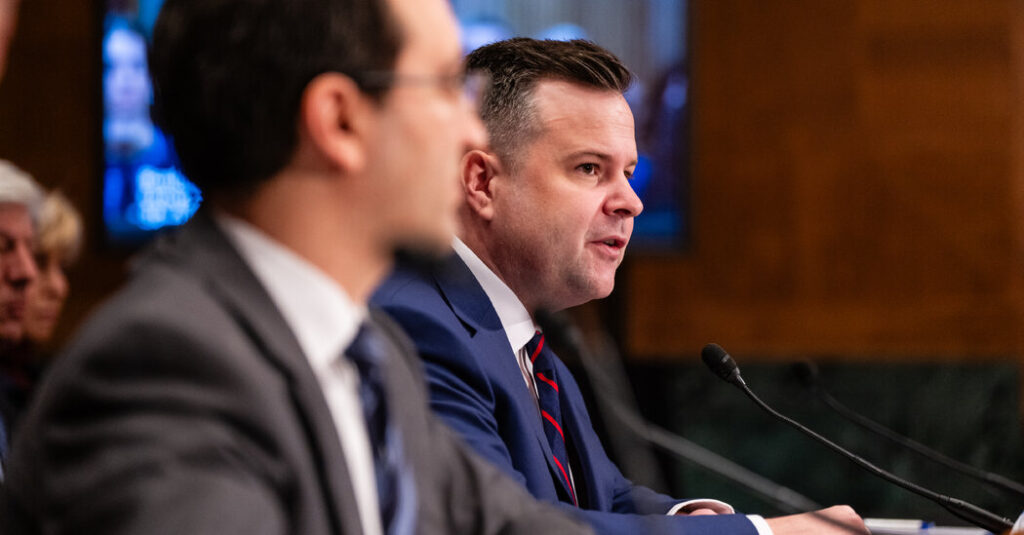
With just one week left until a key government surveillance authority was set to expire, a deal to renew it faltered in the Senate early Friday morning after Democrats refused to back it because of concerns over President Trump’s recent appointment of Bill Pulte to oversee the nation’s intelligence agencies.
A bloc of Republicans who have long harbored concerns about the spy program joined Democrats to block consideration of a bill that would extend for three years a warrantless wiretapping law known as Section 702 of the Foreign Intelligence Surveillance Act. The vote was 52 to 47, well short of the 60 that would have been needed to move ahead.
While a group of Democrats had been working with Republicans on the measure and had been expected to deliver the votes necessary to move ahead with the extension, their anger over Mr. Pulte’s naming prompted an almost unanimous retreat from the emerging deal. Every Democrat except Senator John Fetterman of Pennsylvania voted against advancing the bill. They were joined by seven right-wing Republicans: Senators Josh Hawley of Missouri, John Kennedy of Louisiana, Mike Lee of Utah, Rand Paul of Kentucky, Eric Schmitt of Missouri, Rick Scott of Florida and Tommy Tuberville of Alabama.
The defeat left uncertain the future of Section 702, which allows intelligence agencies to collect communications of foreign targets overseas — including when they are communicating with Americans — and has become one of the government’s most important counterterrorism and espionage tools. It is slated to expire on June 12, after members of Congress failed to reach a deal this spring for a longer-term extension.
Friday’s vote capped a week of growing unease after Mr. Trump tapped Mr. Pulte, a businessman and close political ally who has used his role as federal housing director as a perch to carry out a campaign of retribution against the president’s perceived enemies. Democrats and some Republicans have also criticized the choice given his lack of national security experience.
“I don’t know whether he has any intelligence or military background,” Senator Susan Collins, Republican of Maine, said of Mr. Pulte. “I don’t even know whether he has a security clearance.”
Democrats argued that Congress should not move forward with a long-term renewal of surveillance authorities until lawmakers received assurances about how the intelligence community would be led.
Senator Mark Warner of Virginia, the top Democrat on the Intelligence Committee, warned this week that “everything’s up in the air now,” calling Mr. Pulte an “enormously bad choice” who has “no national security experience.”
Republican leaders argued that his appointment should have no bearing on the fate of the surveillance program, calling it vital and warning of dangerous consequences should Congress fail to act.
“That is an issue that you’ve got to deal with separately in my view,” Senator John Thune, Republican of South Dakota and the majority leader, said before the vote. “The Democrats blocking us getting on the bill and then eventually passing it, I think, is a really dangerous position to take for the country.”
Yet the concerns were not limited to Democrats.
“It doesn’t seem like a very smart idea,” Senator John Cornyn, Republican of Texas, said of naming Mr. Pulte days before Congress confronted the surveillance deadline.
Senator Lisa Murkowski, Republican of Alaska, suggested the White House had given little consideration to the consequences for Congress.
“I don’t think he thinks about it,” she said of Mr. Trump. “I don’t think he thinks about the impact on this and the timing.”
As Republicans sought to salvage the deal late Thursday night and early into Friday morning, Marco Rubio, the secretary of state and a former member of the Senate intelligence panel, was at the Capitol conferring with senators. But with Democrats dug in, the measure still stalled.
Senators left Washington for the weekend without a clear plan to resolve the standoff before the deadline next Friday, and will return next week facing the prospect of either negotiating a compromise or watching one of the government’s most consequential surveillance authorities lapse altogether.
Were that to happen, Section 702 has a built-in safety net to allow it to continue operating until annual certifications issued by the nation’s intelligence court expire. The court recertified the program in March, meaning the National Security Agency could legally continue to operate the program through March 2027 even if the statute were to expire.
Robert Jimison covers Congress for The Times, with a focus on defense issues and foreign policy.
The post Deal to Renew Surveillance Law Falters in the Senate Amid Revolt Over Pulte appeared first on New York Times.